
Disclosure: Some links in this article are affiliate or sponsored links. If you buy through them, we may earn a commission at no extra cost to you. Our opinions are our own.

Germany is one of Europe’s most significant online markets, and accessing its digital landscape from outside the country requires a reliable German IP address. Whether you need to bypass geo-restrictions, scrape local pricing data, verify ads in the German market, or manage regional social media accounts, a quality proxy makes all the difference. We ran hands-on tests across multiple providers, evaluating speed, IP pool depth, targeting accuracy, and overall dependability before settling on these five picks. Here are the Top 5 German proxy providers worth your attention.
What Are German Proxies?
Under normal browsing conditions, your device connects directly to remote servers, which can immediately see your real IP address and the country it originates from. A German proxy routes your traffic through a server with a German IP address, making websites and platforms treat you as a local visitor from Germany.
This matters for a wide range of people. Artists, marketers, streamers, researchers, and businesses that are not physically based in Germany rely on these proxies to access geo-targeted data and localized content. The proxy network handles the redirection, so no matter what browser or device you use, the end result stays the same: the destination server sees a German IP instead of yours.
Residential German proxies, in particular, behave like residential proxies that work from real home internet connections. That makes them far harder for websites to detect or block compared to traditional datacenter alternatives.
Top 5 Best German Proxies 2026
1) Bright Data
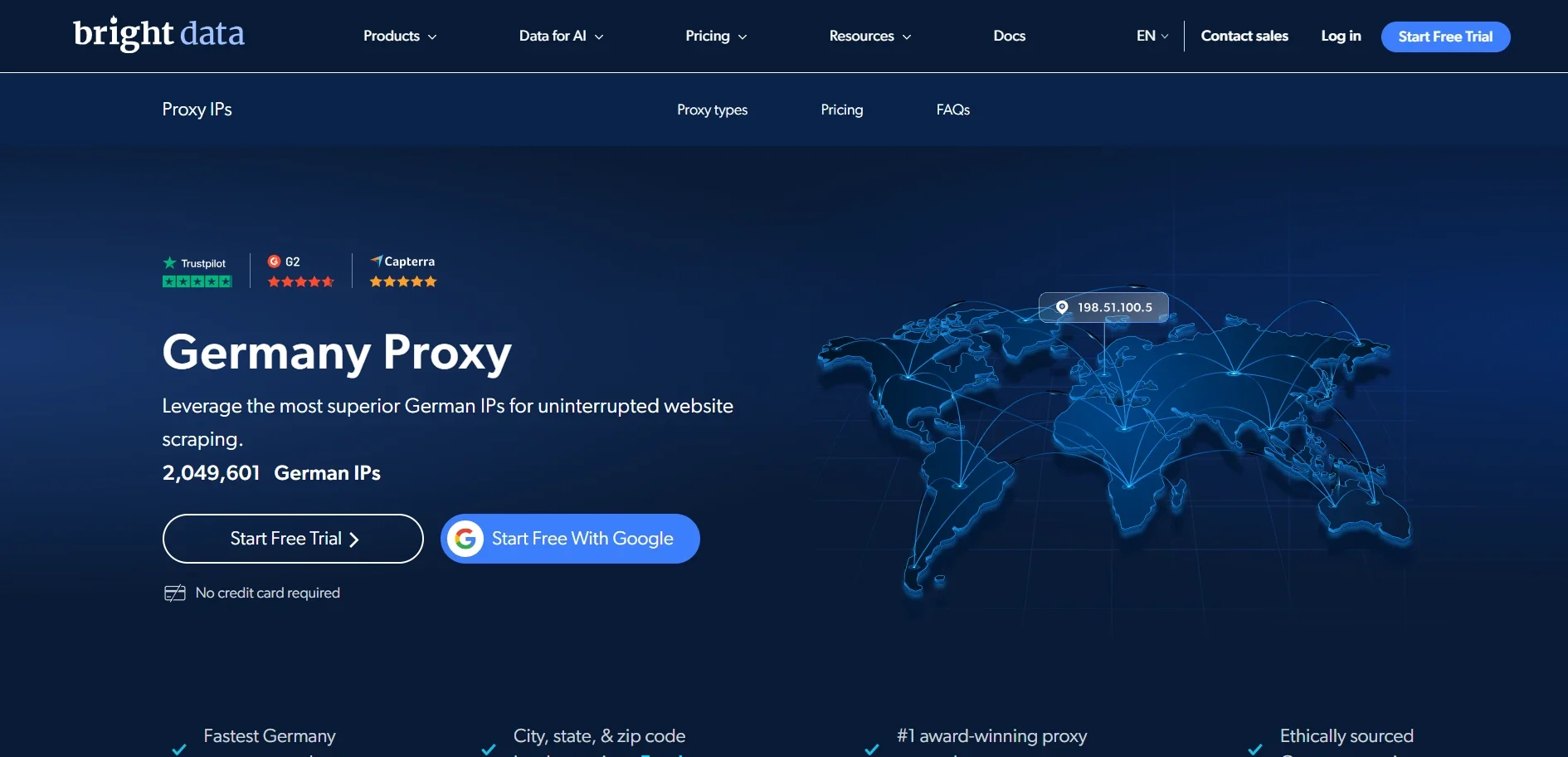
Bright Data is the largest proxy network in the world, and its German IP coverage reflects that scale. The platform gives you access to over 72 million residential IPs globally, spread across 195 countries, and Germany is one of the best-served locations in the pool. Targeting options go deep: you can filter by city, carrier, ASN, and even ZIP code, which is particularly useful for localized tasks like price comparison or ad verification in specific German cities.
Pricing for residential proxies starts from $5.88/GB, with custom enterprise plans for high-volume users. The platform is enterprise-grade in its complexity, so newcomers may need some time to get comfortable with the interface compared to simpler providers. That said, for scraping projects where success rates and uptime actually matter, very few services come close.
PROS
- Enormous residential IP pool with deep German coverage
- City, carrier, ASN, and ZIP code-level targeting
- Chrome extension for easy browser-based configuration
- Ethically sourced IPs with GDPR compliance documentation
CONS
- Setup complexity is higher than that of most competitors
- Pricing structure requires custom negotiation at scale
Comprehensive Guide: Bright Data Review
2) Oxylabs
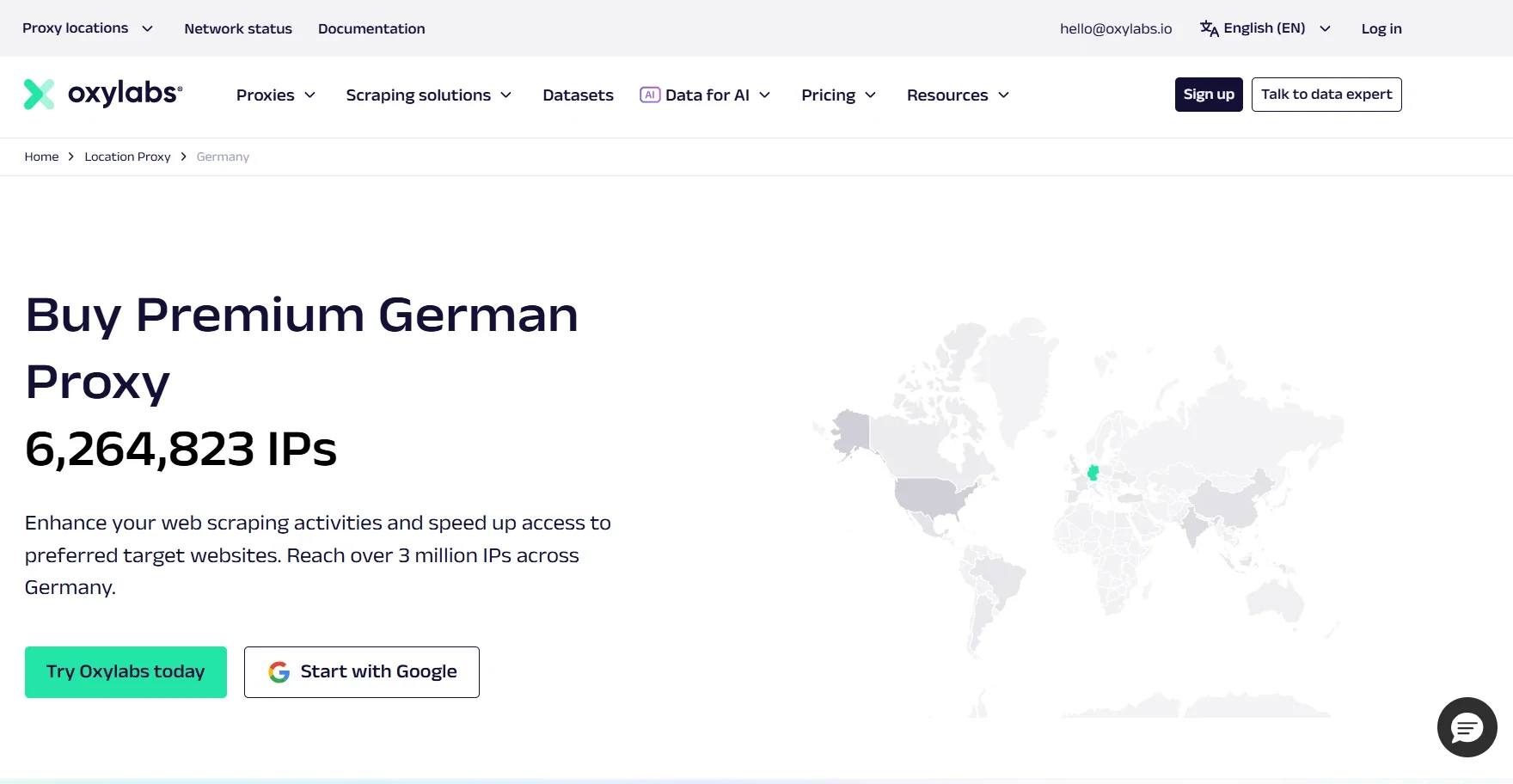
Oxylabs serves both enterprise clients and individual data teams with one of the most well-maintained proxy networks available. Their German IP pool sits at around 42,000 residential IPs based on publicly listed location data, and the overall residential network spans 175M+ IPs across 195 locations. The service supports country, state, city, and ZIP code targeting, making it easy to narrow down to specific German regions for competitive intelligence or localized scraping tasks.
Residential proxy pricing starts from $6/GB, with a pay-as-you-go option available for teams that do not want a fixed commitment. Oxylabs includes unlimited concurrent sessions across its residential plans, and the 99.9% uptime track record holds up in practice. If you are already thinking about how to avoid IP blocks when pulling data from German websites at scale, Oxylabs’ rotating residential pool handles that quietly in the background.
PROS
- 175M+ residential IPs with verified German location coverage
- Country, state, city, and ZIP-level geo-targeting
- Dedicated account managers for business plans
- Unlimited concurrent sessions
CONS
- Entry pricing sits above many mid-tier providers
Comprehensive Guide: Oxylabs Review
3) Decodo (formerly Smartproxy)
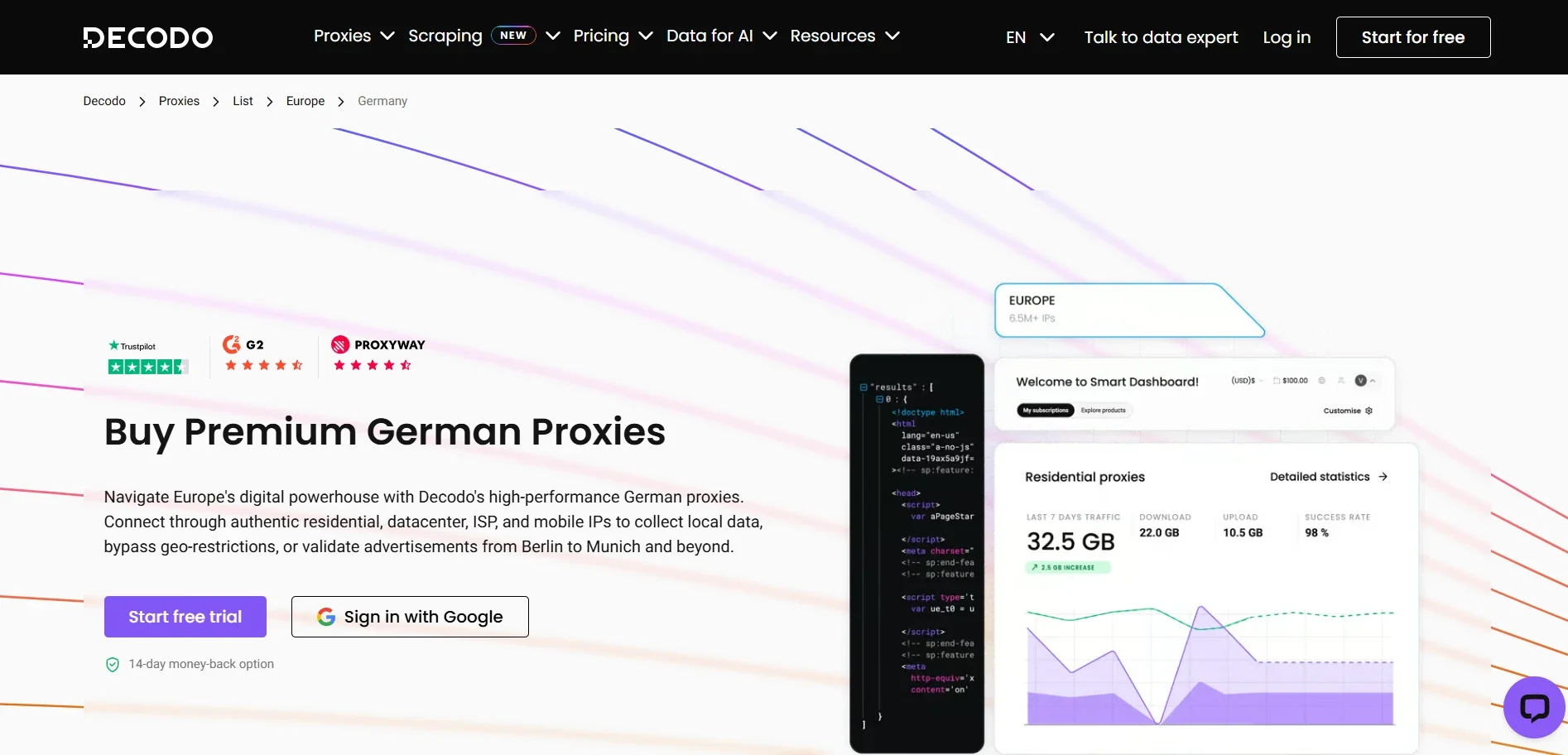
Formerly known as Smartproxy before its April 2025 rebrand, Decodo has quickly become the go-to option for teams seeking premium performance without the enterprise price tag. The platform now runs a pool of 115M+ residential IPs across 195+ locations, and Germany is one of the most well-served countries, with over 1.2 million German IPs available. Pricing starts from $2/GB, with a 3-day free trial and a 14-day money-back guarantee on eligible plans.
Decodo supports both rotating and sticky sessions, HTTP/HTTPS and SOCKS5 protocols, and targeting down to the city level. For anyone working on web scraping at scale across German e-commerce platforms or local news sites, the speed and rotation quality hold up well under load. The interface is beginner-friendly, with a clean dashboard and browser extensions for Chrome and Firefox.
PROS
- 1.2M+ German residential IPs in a 115M+ global pool
- Competitive pricing from $2/GB
- Simple setup with Chrome and Firefox extensions
- SOCKS5 support included
CONS
- Some high-security targets may require the Web Scraping API add-on
Comprehensive Guide: Decodo Review
4) IPRoyal
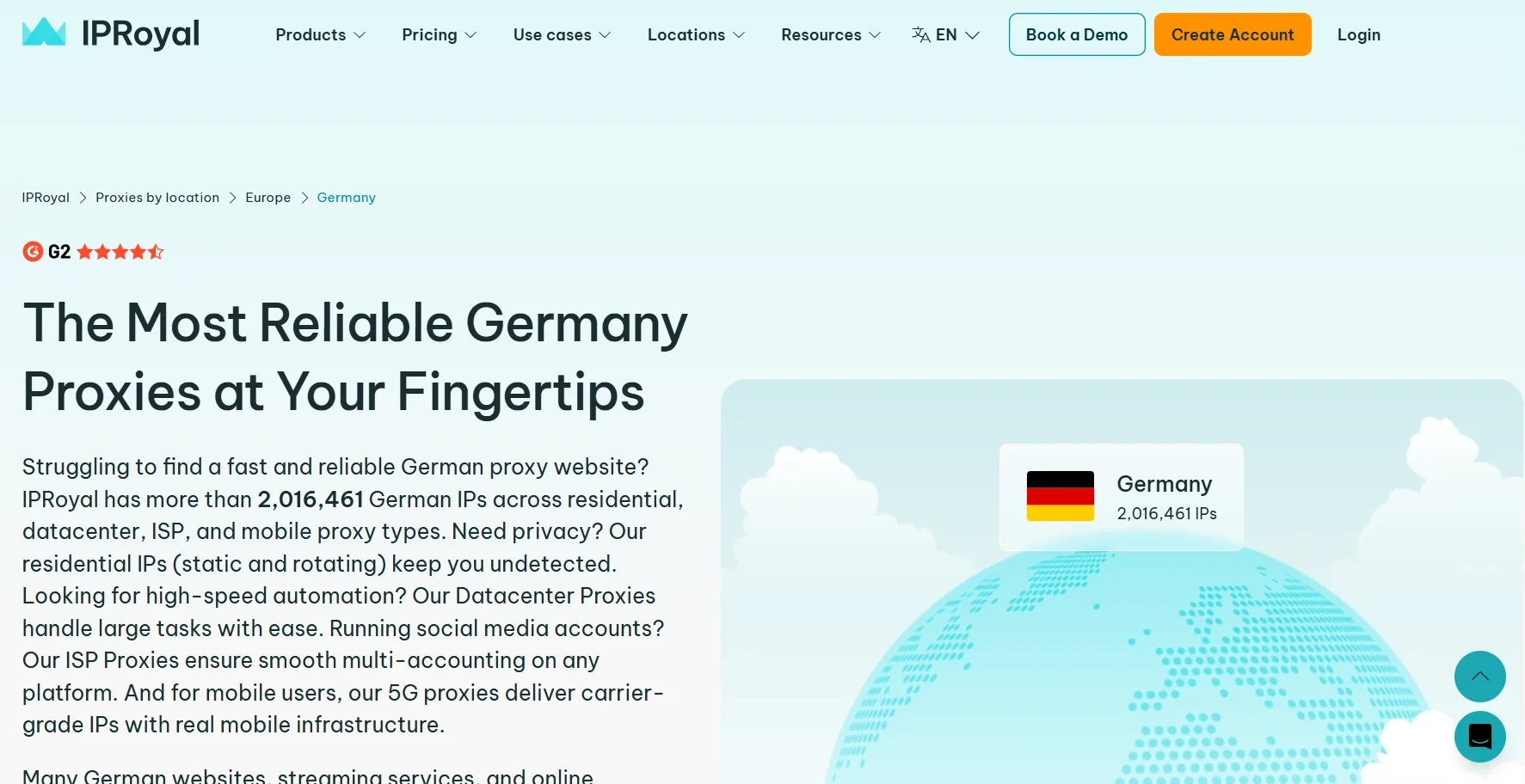
IPRoyal appeals to a broad range of users because its pricing model scales in both directions: small teams can get started affordably, and larger operations benefit from the 32M+ residential IP pool without overpaying. The platform lists hundreds of thousands of German residential proxies, with support for both rotating and sticky sessions, city and state-level targeting, and both HTTP/HTTPS and SOCKS5 protocols.
Residential proxy pricing starts from $1.75/GB, and traffic never expires on any purchased plan, which is a practical advantage for teams running intermittent campaigns. Businesses use IPRoyal for market data collection, social media campaign management, ad verification, and ISP proxies that behave like legitimate home connections in Germany. Educational institutions and compliance teams also rely on it for content filtering verification. Uptime sits at 99.9%, and the no-browser-extension limitation is the main practical trade-off.
PROS
- German residential and ISP proxy support
- Traffic never expires after purchase
- City and state-level targeting
- 99.9% uptime and SOCKS5 support
CONS
- No browser extension available
- Smaller overall pool than Bright Data or Oxylabs
RELATED: Top Twitter Proxies
5) Storm Proxies
Storm Proxies has been in the budget proxy market since 2016 and remains one of the few providers where unlimited bandwidth is a genuine selling point rather than a marketing claim. The service relies on backconnect rotating proxies, meaning you connect to a fixed gateway, and Storm handles the IP rotation on its end. Coverage spans US and EU locations, making it usable for German IPs even if city-level precision is not on the table.
Rotating residential plans start at $50/month for 5 ports, with an entry-level 1-port option at $19/month. Datacenter-based plans begin even lower. The port-based pricing, rather than data billing, suits campaigns where bandwidth usage is unpredictable. One port is exclusive to one user, and all plans include unlimited monthly bandwidth. Storm Proxies is best suited for lighter workloads: tools that need rotating proxy behavior without the overhead of enterprise contracts will find it a practical fit. For geo-precision or large-scale extraction, the premium providers above are better equipped.
PROS
- Unlimited bandwidth on all residential plans
- Simple port-based pricing starting at $19/month
- Fast rotation suitable for scraping and automation
- Beginner-friendly setup
CONS
- No city or state-level geo-targeting
- Smaller IP pool than premium providers
RELATED: Top Instagram Proxy Provider
Why Do I Need a German IP?
German broadcasters like ZDF and ARD restrict a large portion of their online content to viewers located within Germany. The same applies to German-only retail deals, localized search engine results, and regional social media content. Geo-blocking has become sophisticated enough that simple VPNs and shared datacenter IPs often get flagged automatically.
A German residential proxy sidesteps most of these restrictions by using an IP address tied to a genuine German ISP connection. That makes it far less likely to trigger automatic bans or content walls. With a reliable German IP, you can manage local social media profiles, access pricing data from German marketplaces, and consistently pull accurate search results from Google.de without interference. It also supports better accuracy when running browse anonymously setups where your real location must stay private.
Germany ranks among Europe’s most active online markets. According to Semrush’s Germany web traffic data, the country hosts significant traffic across retail, news, travel, and finance verticals. Having a local IP means your data collection reflects what actual German users see, not a filtered or geo-adjusted version.
Why Avoid Free German IP Addresses?
Free German proxy services are easy to find but carry substantial risk. Most free providers make money by logging your traffic and selling browsing behavior to third parties, which defeats the purpose of using a proxy in the first place. Security researchers have also documented free proxies injecting ads, stripping HTTPS encryption, and exposing users to man-in-the-middle risks.
Beyond privacy, free proxies tend to be slow, frequently offline, and shared among thousands of users, which means they get blocked almost instantly on any platform that actively monitors traffic. All five providers listed above encrypt connections and operate under defined usage policies. If full anonymity is a concern, residential proxies from providers like Bright Data or Decodo are worth the investment over any free alternative. For understanding the difference between datacenter proxy options versus residential ones, the type you choose significantly affects detection rates.
FAQs
What are the German proxy rules?
Proxy use is legal in Germany, provided you are not using them to bypass laws, circumvent authorized security measures, or engage in any activity that violates the Telemediengesetz (TMG) or GDPR. If you are outside Germany, you should also verify your local regulations before using any proxy service.
What is the safest proxy type?
Private dedicated proxies assign a specific IP address exclusively to one user, which means no one else’s activity can affect your IP reputation. Residential proxies from reputable sources are also considered highly safe because they originate from genuine household connections rather than data centers.
How do German proxies help conceal my IP address?
When you connect through a German proxy, the destination website sees the proxy’s German IP rather than your real one. Residential and mobile proxies offer the highest degree of anonymity because their IPs look identical to those of ordinary German internet users. Datacenter proxies can work for lower-risk tasks, but are easier for sites to detect in bulk.
Conclusion: Best German Proxies
German proxies serve a practical purpose for anyone needing genuine access to Germany’s digital ecosystem, whether that involves market research, content access, ad verification, or data collection from local platforms. A quality proxy masks your real IP, routes traffic through a German connection, and keeps your activities consistent and undetectable.
Bright Data leads the pack for enterprise-grade requirements, with the deepest German IP coverage and the most granular targeting options available. Oxylabs follows closely as a strong choice for businesses that need consistent uptime and a dedicated support relationship. Decodo (formerly Smartproxy) offers the best balance of pool size and price for growing teams, while IPRoyal suits users who want solid performance without paying premium rates. Storm Proxies rounds out the list as the budget-friendly option for lighter, bandwidth-heavy tasks.
The right pick depends on your targeting needs, scale, and budget. All five providers offer more reliability, security, and anonymity than any free German proxy alternative.
You might be interested in these other location proxies:
