
Disclosure: Some links in this article are affiliate or sponsored links. If you buy through them, we may earn a commission at no extra cost to you. Our opinions are our own.

If you have ever tried to check Australian retail prices, track local search rankings, or scrape a Melbourne classifieds site from outside the country, you already know the problem. Most sites quietly serve you a different version, a different price, or outright block the moment they see a non-Australian IP address. A proxy that routes through a real Telstra, Optus, or TPG connection solves this instantly, but picking the right one from the dozens of providers claiming Australian coverage is where most people get stuck.
This guide breaks down the providers that actually deliver working Australian IPs in 2026, pulled straight from each company’s own network data rather than recycled marketing copy. We cover residential, mobile, ISP, and datacenter options, what each one costs today, how their session controls and protocols actually work, and which use case each is genuinely built for.
Key Facts Before You Buy
- Australia’s local IP space is small relative to demand, which keeps prices for genuinely local residential and mobile IPs higher than US or European equivalents.
- Most networks now support both HTTP(S) and SOCKS5 protocols on the same pool, so protocol choice usually comes down to what your scraping stack or app requires rather than provider limitation.
- Sticky session windows vary widely, from 10 minutes on the low end up to a full 24 hours on providers built for long-running account tasks.
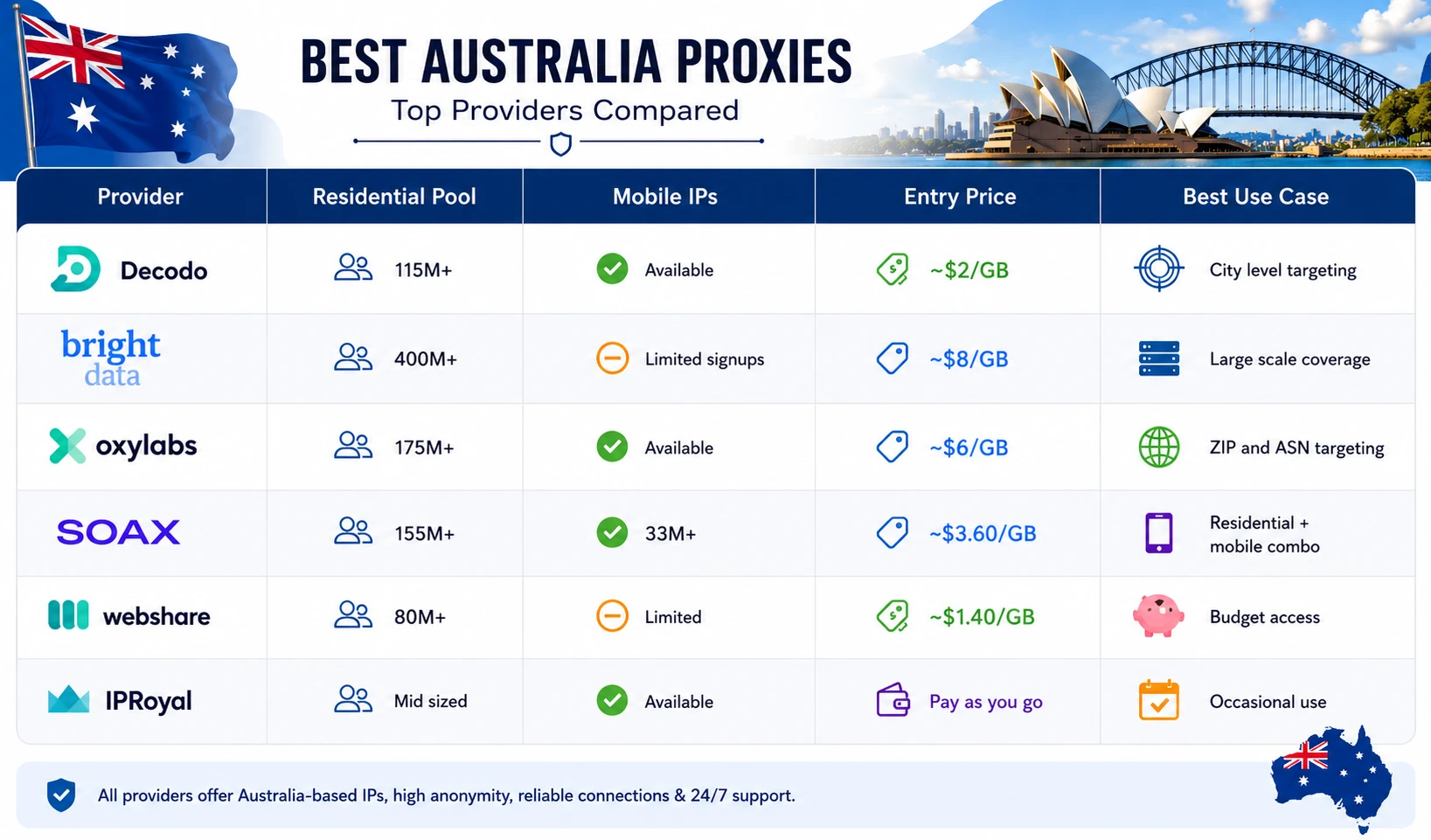
- Entry pricing across the six providers below ranges from about 1.40 dollars per GB to 8 dollars per GB, so the gap between budget and premium options is real and worth matching to your actual traffic volume.
- Free trials, small free tiers, or pay-as-you-go options exist on most of these networks, which makes testing before a full commitment realistic.
How We Selected These Providers
Every provider below was checked directly against its own pricing page, network documentation, and dashboard details rather than aggregator listings or affiliate comparison sites. We looked at four things specifically: whether the network actually lists Australian cities or ASNs rather than just a country level flag, whether current pricing is published openly rather than hidden behind a sales call, what session control and protocol support looks like in practice, and whether the company has made any recent changes, discontinued products, rebrands, or new restrictions, that would affect a buyer in 2026. NetNut was excluded from this edition after a disruption linked to a law enforcement action against a peer-to-peer network earlier this year, which is a case worth watching if you are comparing older lists that still include it.
Why You Need an Australia-Specific Proxy
Australia sits in an odd spot for global traffic. It is a wealthy, English-speaking market that advertisers, retailers, and streaming platforms treat as its own pricing and content zone, yet the actual pool of local IP space is small compared to the US or UK. That combination makes Australian IPs both valuable and comparatively expensive to source cleanly.
A handful of practical situations come up constantly:
- Price and ad verification. Australian retailers like JB Hi-Fi, Woolworths, and Officeworks run region-locked pricing and promotions that only display to local visitors.
- Search and SEO tracking. Google.com.au results differ meaningfully from the global index, so agencies running rank tracking for local clients need IPs that resolve to actual Australian cities, not just the country.
- Marketplace research. Sellers monitoring Amazon Australia listings need clean residential exits to avoid triggering the marketplace’s bot defenses.
- Streaming and content access. Services like 7plus, Stan, and the ABC iView library use strict geo-fencing that only a genuine local IP reliably gets past.
- Ad and affiliate compliance. Network auditing of Australian campaigns needs to see exactly what a Sydney or Brisbane user sees, not a US cached version.
- Academic and market research. Analysts pulling public pricing or sentiment data at scale need enough IP diversity that one blocked address does not stall an entire research run.
Types of Proxies That Work for Australia
Not every proxy type is equally suited to these jobs, and mixing them up is the most common reason campaigns fail.
Residential proxies route traffic through real home internet connections issued by Australian ISPs. They are the closest thing to browsing as an actual local resident and are the safest option for retail sites, social platforms, and anything with aggressive bot detection. Most networks let you choose between rotating IPs that change on every request and sticky sessions that hold one IP for a set window, which matters for anything involving logins or multi-step checkout flows.
Mobile proxies use IP addresses assigned to 4G and 5G carrier networks such as Telstra or Optus. Because thousands of real phones share the same carrier-grade NAT IP, these are extremely hard for anti-fraud systems to flag, which makes them the top pick for app testing and mobile ad verification.
ISP proxies, sometimes called static residential, combine a datacenter’s speed with an IP address registered to a residential ISP block. They hold a fixed IP for as long as you need, which suits account management and monitoring tasks that require a consistent identity over weeks or months.
Datacenter proxies are the fastest and cheapest option, hosted on commercial servers rather than home connections. They work fine for public data that isn’t behind heavy bot protection but get flagged quickly on retail and social platforms.
The 6 Best Australia Proxy Providers in 2026
1. Decodo (formerly Smartproxy)
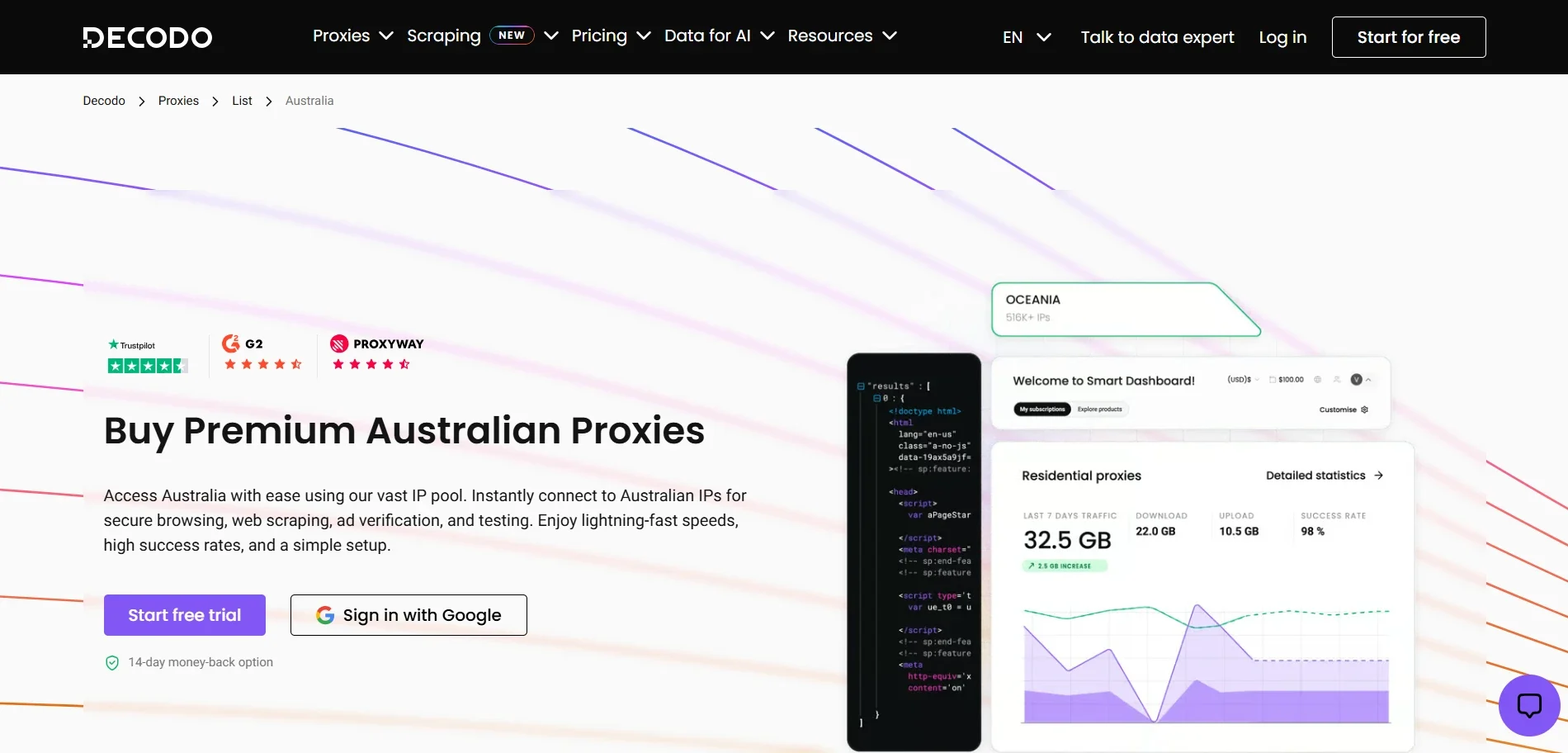
Decodo rebranded from Smartproxy in April 2025 and has kept building out its network since. It currently advertises a pool of over 115 million residential IPs spread across more than 195 locations, with Australia represented at the state and city level rather than just a generic country flag, plus targeting down to ZIP code and ASN where available. Sticky sessions default to a short window but can be extended up to 24 hours through a session duration parameter, and both HTTP(S) and SOCKS5 are supported on the same pool at no extra cost. Pricing on the official site starts at roughly 2 dollars per GB on the entry residential tier, dropping further at higher volumes, and a 3-day free trial lets you test Australian routing before committing budget. The dashboard also lets you filter directly by Australian city for geo-targeted data collection.
Best for: teams that want city-level Australian targeting with flexible session control and a free trial to test first.
2. Bright Data
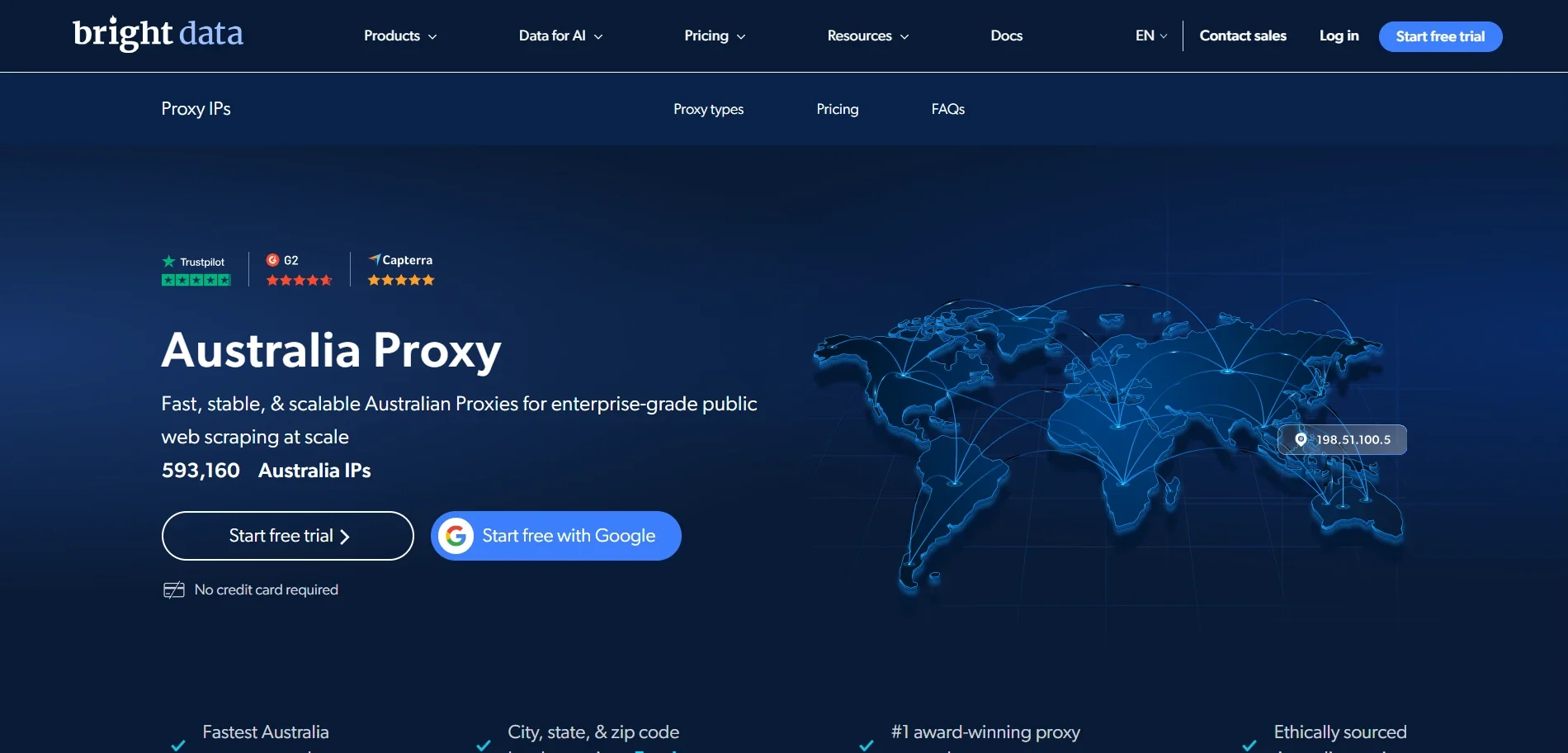
Bright Data remains the largest network by raw numbers, with more than 400 million residential IPs across over 195 countries, according to its current documentation, refreshed monthly, and the biggest publicly disclosed pool of any provider on this list. Its Australian coverage spans major metro areas along with regional pockets that smaller networks tend to miss, and targeting goes down to country, state, city, ZIP code (US only), ASN, and carrier level through its dashboard, with both rotating and sticky sessions supported. Pricing on the pay-as-you-go residential plan starts around 8 dollars per GB, dropping to roughly 3 dollars per GB once you commit to a monthly volume plan, so the effective rate depends heavily on how predictable your usage is. Worth noting for 2026, the dedicated mobile proxy product has seen tighter availability for new signups, so anyone specifically after carrier IPs should confirm current access before committing budget, and lean on the residential or ISP options instead where mobile is not strictly required.
Best for: large-scale operations that need breadth and are comfortable with enterprise-style pricing.
3. Oxylabs
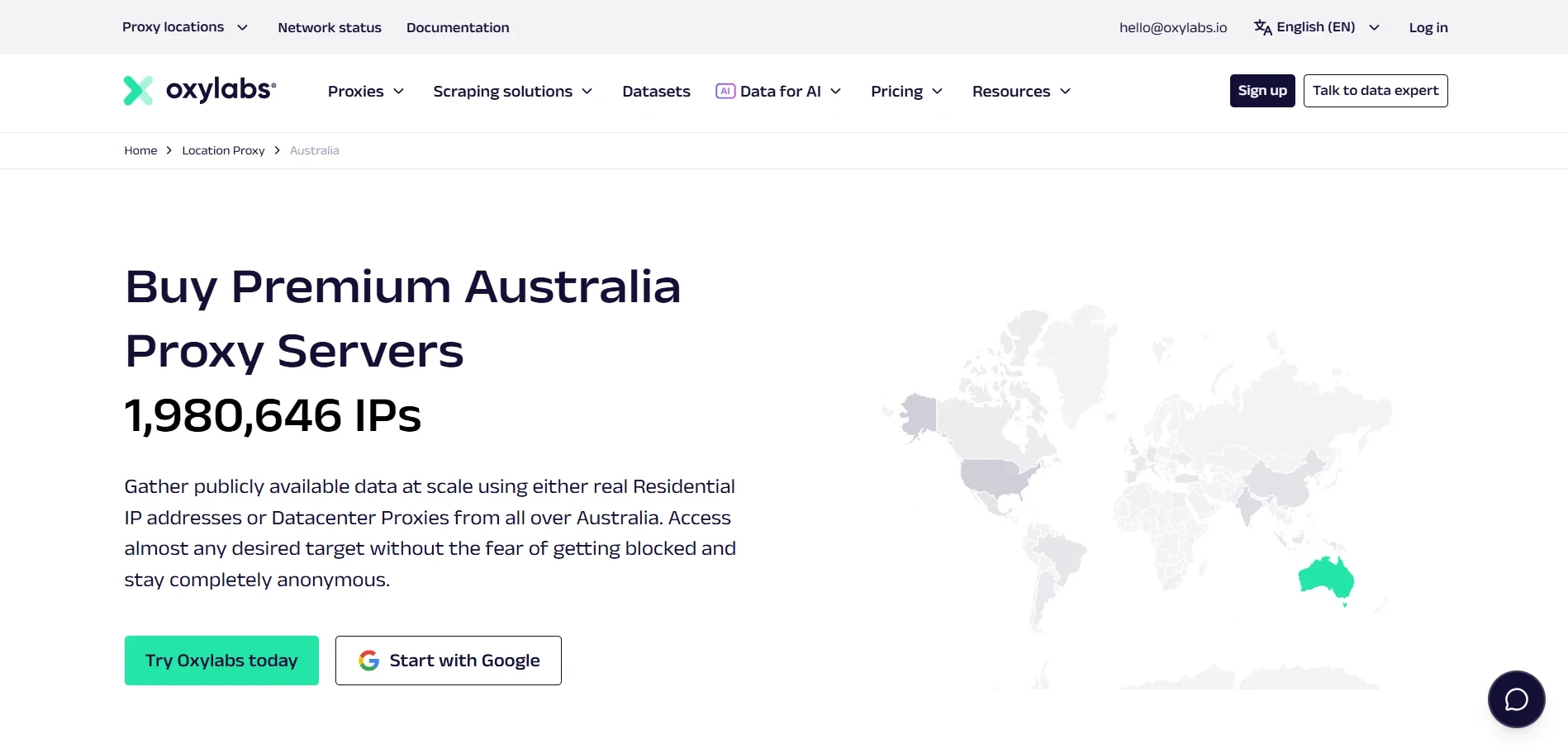
Oxylabs runs a residential pool of over 175 million IPs and is one of the few providers offering targeting down to ZIP code and ASN level inside Australia, useful when a campaign needs a specific carrier or region rather than just “Australia” as a whole. Entry pricing on the official pricing page sits around 6 dollars per GB, with dedicated plans for scraping heavy workloads and a proxy manager tool that handles rotation logic automatically rather than requiring custom scripts on your side. Their infrastructure also supports the kind of large-scale web scraping at volume that agencies run daily, and their documentation is thorough enough that most integration questions are answered without needing to contact support.
Best for: technical teams that need precise geo targeting and are running scraping jobs at scale.
4. SOAX
SOAX combines a residential pool above 155 million IPs with a separate mobile pool of over 33 million carrier IPs, a rare combination at this price point. The starter plan on its official pricing page runs about 3.60 dollars per GB for a 25GB package, and sticky sessions can hold the same IP for up to 30 minutes, handy for multi-step account workflows that need session continuity through a login or checkout process. Both HTTP(S) and SOCKS5 protocols are supported, and the dashboard breaks targeting down by country, region, and city, with carrier-level filtering available on the mobile pool specifically.
Best for: buyers who want both residential and mobile Australian IPs under one account.
5. Webshare
Webshare has become the budget entry point without cutting corners on the basics. Its residential network sits above 80 million IPs across 195 countries, with pricing that drops to roughly 1.40 dollars per GB at volume, and datacenter plans start under 3 dollars a month for buyers who do not need residential authenticity. A free tier with a small proxy allowance is still available, which makes it a genuinely useful option for testing an Australian rotating proxy setup before committing to a paid plan. The dashboard is straightforward enough for non-technical users, though targeting granularity inside Australia is less precise than on Decodo or Oxylabs.
Best for: freelancers, students, and small teams that need Australian IPs on a tight budget.
6. IPRoyal
IPRoyal keeps a smaller but well-maintained residential pool with flexible pay-as-you-go pricing rather than forcing subscriptions, which suits people who need Australian IPs occasionally rather than every day. Sticky sessions run up to 24 hours, and its lifetime static residential option is worth a look for anyone maintaining long-term ISP-style connections to a single Australian account. Both HTTP(S) and SOCKS5 protocols are supported, and because billing is not locked into a monthly plan, it is one of the easier options to try for a single short project without ongoing commitment.
Best for: occasional or low-volume users who don’t want a monthly subscription.
How to Set Up an Australia Proxy in Practice
The setup flow is broadly similar across all six providers, though the exact dashboard labels differ slightly.
- Create an account and pick a plan. Most providers let you start with pay-as-you-go or a small trial package rather than committing to a large monthly block upfront.
- Choose your targeting level. Select Australia as the country, then narrow to a specific state or city if the provider supports it; this matters most for retail pricing and local search tasks.
- Pick a session type. Rotating sessions suit simple scraping where each request can come from a different IP; sticky sessions suit logins, checkouts, or anything that needs the same identity across several steps.
- Select a protocol. HTTP(S) is the simpler default for browser-based scraping and most SEO tools; SOCKS5 is worth choosing if your stack also needs to route non-web traffic or handle UDP.
- Authenticate and test. Use either username and password credentials or IP whitelisting, then run a quick request against an IP checking endpoint to confirm the exit location actually shows Australia before running a full job.
- Monitor usage. Most dashboards show bandwidth consumed in real time, which helps catch a misconfigured rotation setting before it burns through a monthly allowance.
Avoiding IP Blocks While Working with Australian Sites
Even a clean Australian IP gets flagged if the request pattern behind it looks automated. Rotating too fast, ignoring rate limits, or hammering the same endpoint from one IP are the usual culprits. Spacing out requests, rotating sessions at sensible intervals, and matching browser headers to the IP’s expected location all help avoid the kind of IP blocks that shut a project down mid-run. Retailers in particular have gotten sharper about detecting scraping patterns since 2025, so a slower, more human-paced approach tends to outperform brute force volume.
A Quick Note on Legal Use
Using proxies to check public pricing, verify ads, or run your own SEO tracking is standard industry practice and not something Australian law restricts on its own. Where it gets complicated is data that touches personal information. If a scraping project might collect anything tied to an identifiable person, it is worth reviewing the Office of the Australian Information Commissioner’s guidance on the Australian Privacy Principles before building the pipeline, since those obligations sit separately from anything a proxy provider’s terms of service cover. On the carrier side, the Australian Communications and Media Authority publishes regular data on the local telecommunications market that is useful context when deciding which mobile network’s IP range actually matches your target audience.
Matching a Provider to Your Actual Use Case
Picking from a list is easier once you map it back to what you are actually trying to do.
Running SEO and rank tracking at scale. Decodo or Oxylabs make the most sense here, since city-level targeting lets you pull Google.com.au results as they would actually appear to a searcher in Sydney versus Perth, rather than a blended national average that skews reporting.
Verifying ads or checking retail pricing occasionally. IPRoyal or Webshare cover this well without locking you into a large monthly commitment, since a single audit or price check rarely burns through much bandwidth.
Managing multiple marketplace or social accounts. SOAX or IPRoyal’s longer sticky sessions keep the same IP tied to the same account across a full session, which reduces the chance of a platform flagging inconsistent login locations.
Mobile app testing or mobile ad verification. SOAX currently offers the clearest combination of residential and dedicated mobile IPs together, useful since Bright Data has pulled back on new mobile signups and Oxylabs’ mobile options require a higher entry commitment.
Large-scale data collection across many domains at once. Bright Data’s sheer pool size and Oxylabs’ proxy manager tooling both reduce the manual work of handling rotation logic across thousands of concurrent requests, which matters more as request volume grows into the millions per month.
Frequently Asked Questions
Do I need a proxy specifically located in Australia, or will any residential IP work?
For anything checking Australian pricing, search results, or streaming access, the exit IP has to actually resolve to Australia. A generic residential IP from another country will trigger the same geo restrictions you are trying to avoid.
Which is cheaper, residential or mobile proxies for Australia?
Residential IPs are almost always cheaper per GB. Mobile proxies cost more because the pool of available carrier IPs is smaller and harder to source, but they are worth it for jobs where mobile-specific detection is a concern.
Can free proxies handle Australian targeting reliably?
Free proxies rarely maintain consistent Australian coverage and tend to get blacklisted quickly by major retailers and search engines. They are fine for casual browsing but not for any task that depends on consistent access.
What is the difference between rotating and sticky sessions?
Rotating sessions assign a new IP on every request, which suits high-volume scraping where each page load does not need to look like the same visitor. Sticky sessions keep one IP for a set window, which is necessary for logins, checkouts, or any flow where the site expects the same visitor across several steps.
Should I choose HTTP or SOCKS5 for an Australian scraping project?
HTTP(S) is the simpler choice for standard browser-based scraping, SEO tracking, and most ad verification work since it handles headers and cookies the way a normal browser would. SOCKS5 is worth choosing if your stack needs to route non-browser traffic, handle UDP, or share one proxy pool across mixed tools.
Do these providers support city-level targeting inside Australia, or just the country as a whole?
Decodo and Oxylabs both support targeting down to city, ZIP code, or ASN level inside Australia. Bright Data and SOAX support state and city-level targeting. Webshare and IPRoyal are more limited in granularity but still resolve reliably to Australia as a country.
Is it legal to use a proxy to check Australian retail prices or track search rankings? Yes, checking publicly available pricing or search results is standard practice and not restricted on its own. The legal considerations change if the data collected includes personal information, which is where Australia’s privacy framework becomes relevant.
Final Thoughts
The right Australia proxy comes down to matching the tool to the task rather than picking the provider with the largest headline pool size. Decodo and Oxylabs suit teams that need precise city or ASN-level targeting, Bright Data and SOAX cover larger or mixed residential and mobile workloads, and Webshare or IPRoyal make sense when budget or occasional use is the priority. Whichever you pick, verify current pricing, pool figures, and session limits directly on the provider’s own site before buying, since these numbers shift often enough that even a few months can make a real difference to what you actually get for your budget.
