
Disclosure: Some links in this article are affiliate or sponsored links. If you buy through them, we may earn a commission at no extra cost to you. Our opinions are our own.

By 2026, online education will no longer be a side project or a trendy experiment. It has matured into a serious industry where creators, educators, coaches, and businesses are expected to deliver experiences that rival, and often outperform, those of traditional classrooms. Learners today expect more than just videos behind a paywall. They want interaction, personalization, mobile access, and a sense that the course adapts to them, not the other way around.
That’s why choosing the right online course platform has become one of the most important strategic decisions a creator can make. The platform you choose shapes not only how your content looks, but how effectively students learn, how long they stay engaged, and how easily your business can scale.
Two platforms continue to dominate this conversation in 2026: LearnWorlds and Teachable. LearnWorlds positions itself as a feature-rich, education-first learning management system (LMS) that delivers interactive, immersive, and outcome-driven learning experiences. Teachable, by contrast, is widely known as a simple, sales-oriented platform favored for quick launches and straightforward digital products.
This article delivers a deep, unbiased, experience-driven comparison of LearnWorlds vs. Teachable, examining features, pricing, learner experience, scalability, branding, AI capabilities, and long-term value, and explains why LearnWorlds ultimately delivers superior results for most creators in 2026.
Overview of LearnWorlds
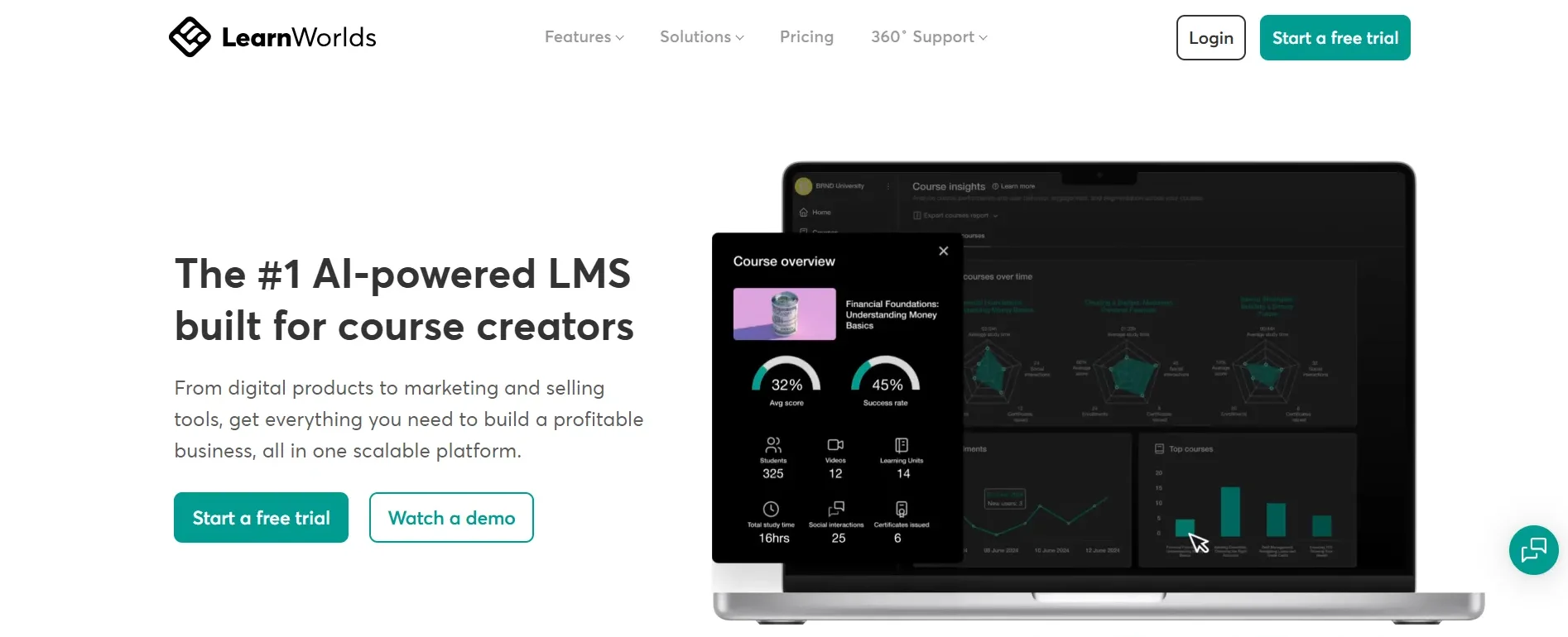
LearnWorlds was built on one core belief: better learning experiences lead to better business outcomes. Rather than treating courses as static content products, the platform approaches them as living, interactive learning journeys.
In practice, this philosophy shows up everywhere. LearnWorlds offers advanced instructional design tools that go far beyond hosting videos and PDFs. Course creators can build interactive videos with in-video questions, create digital eBooks with embedded activities, design structured assessments, and issue certificates that actually reflect learning outcomes. In 2026, its AI-powered features have further strengthened this focus, helping creators generate course outlines, refine learning objectives, suggest assessment questions, and even personalize feedback based on learner behavior.
The platform is especially well-suited for educators building full academies, coaches offering high-ticket programs, training companies, and businesses running internal or customer education. LearnWorlds doesn’t impose artificial limits on courses or learners, which makes it a natural fit for creators who are thinking beyond their first product.
One of its standout strengths is branding and scalability. LearnWorlds allows creators to build fully white-labeled schools with custom domains, branded emails, and even dedicated mobile apps. For creators who want their academy to feel like a serious institution rather than a generic course site, this makes a significant difference in perceived value and trust.
Overview of Teachable
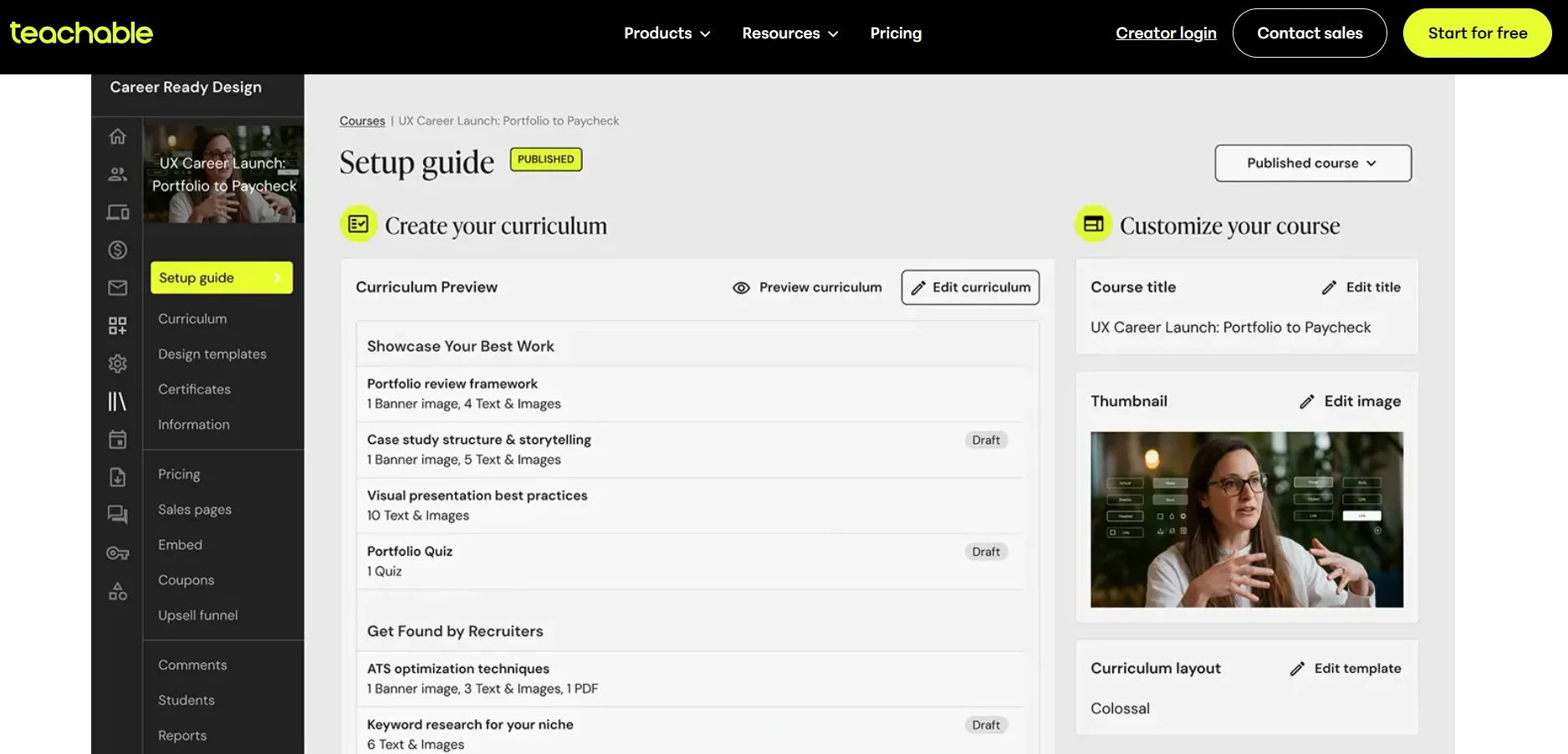
Teachable’s appeal has always been rooted in simplicity. It’s designed for creators who want to get a course online quickly without worrying about technical complexity or instructional theory. You upload your videos, add some text, set a price, and you’re ready to sell.
This approach has made Teachable especially popular among side-hustle creators, coaches, and influencers selling straightforward educational products. Its interface is clean, the learning curve is gentle, and the platform handles payments, taxes, and basic digital product delivery well.
In 2026, Teachable continues to emphasize ease of use and monetization. It offers built-in checkout pages, basic email integrations, upsells, and affiliate functionality, making it relatively easy to generate sales without connecting to a long list of third-party tools. The availability of a free plan also lowers the barrier to entry for creators who want to test an idea before committing financially.
However, Teachable’s simplicity is also its main limitation. While it works well for basic courses and memberships, it lacks the depth required for more complex educational experiences, especially those involving assessments, structured learning paths, or corporate-level training.
Pricing Comparison
Pricing is often where creators think they see the biggest difference, but in my consulting work, it’s also where many misunderstand the long-term costs.
LearnWorlds pricing in 2026 starts with a Starter plan in the roughly $24–29 per month range, which includes transaction fees. As creators grow, the Pro Trainer plan, typically around $79–99 per month, removes transaction fees and unlocks advanced features. For businesses and academies, the Learning Center plan, priced approximately between $249–299 per month, offers full scalability, advanced integrations, and enterprise-level tools.
Teachable’s pricing starts with a free plan, but it comes with high transaction fees and limited features. Its Starter plan generally sits around $29–39 per month, still with fees, while more capable tiers start around $89 per month and climb higher for business-focused plans.
On paper, Teachable can look cheaper at the entry level. In reality, creators who gain traction often find themselves paying more over time due to transaction fees, product limits, and the need to upgrade sooner than expected. LearnWorlds, by contrast, becomes more cost-efficient as you scale. Unlimited courses and learners, combined with no transaction fees on mid-tier plans, mean your costs don’t rise in proportion to your success.
For creators planning serious growth, LearnWorlds consistently delivers better value over the long term.
Course Creation and Learner Experience
This is where the gap between the two platforms becomes impossible to ignore.
LearnWorlds is designed to help creators build courses that feel intentional, interactive, and pedagogically sound. You can structure lessons with advanced quizzes, exams, and assignments, use interactive videos to keep learners engaged, and create multimedia learning paths that adapt to different learning styles. Gamification features, certificates, gradebooks, live sessions, and SCORM support make it suitable for both professional and academic use cases.
In 2026, LearnWorlds’ AI tools further enhance this experience by helping creators refine assessments, analyze learner engagement patterns, and improve course completion rates. I’ve seen creators use these insights to redesign modules and dramatically increase student retention within a single cohort.
Teachable, by comparison, offers a more basic toolkit. Videos, downloads, and simple quizzes cover the essentials, but there’s limited room for deeper instructional design. For creators teaching soft skills or introductory topics, this may be enough. For anyone delivering complex, high-stakes, or transformation-focused education, it quickly feels restrictive.
If learner outcomes, engagement, and professionalism matter to you, LearnWorlds is clearly the stronger platform.
Website, Branding, and Customization
Your course platform is also your brand. In 2026, learners are increasingly selective, and a generic-looking site can undermine credibility before the first lesson even begins.
LearnWorlds excels in this area. It offers a powerful no-code site builder, multiple professionally designed templates, and extensive customization options. Creators can fully white-label their schools, customize emails, use custom domains, and create a cohesive brand experience that feels independent of the platform itself.
Teachable’s website builder is functional but limited. While it allows for basic customization, there are fewer options for deep branding, and platform elements are more visible. For creators who care about aesthetics and differentiation, this can become a noticeable drawback.
In my experience, creators building premium academies or B2B training programs almost always prefer LearnWorlds for this reason alone.
Marketing, Sales, and Monetization
Teachable has traditionally positioned itself as a sales-friendly platform, and it does offer solid basics. Upsells, coupons, simple email integrations, and affiliate tools make it easy to monetize quickly.
LearnWorlds, however, has closed that gap and, in many cases, surpassed it. It supports coupons, bundles, subscriptions, affiliates, and flexible payment options across different regions. More importantly, it focuses heavily on engagement-driven monetization. Features like personalized learning paths, community elements, and automated engagement flows help creators increase lifetime value rather than just initial sales.
In practice, this means LearnWorlds users often see better retention and higher repeat purchases, even if their upfront marketing tools look similar on the surface.
Administration, Analytics, Support, and Scalability
As your course business grows, backend management becomes just as important as front-end features.
LearnWorlds offers advanced administrative tools, detailed learner analytics, multi-school management, and robust user controls. You can track progress, identify drop-off points, and make data-driven improvements. Its support team is known for being responsive and hands-on, which matters when your platform is central to your business.
Teachable’s admin tools are simpler and easier to navigate at first, but they lack depth. Analytics are more limited, and support quality varies by plan level. For small creators, this may be acceptable. For scaling businesses, it often becomes a bottleneck.
Mobile Learning and Additional Features
Mobile learning is no longer optional. LearnWorlds stands out by offering fully branded mobile apps for iOS and Android, complete with push notifications and offline access. For many creators, this dramatically improves engagement and completion rates.
Teachable’s mobile experience is more limited and typically revolves around a shared marketplace-style app rather than a fully branded environment. This can work, but it doesn’t deliver the same level of ownership or immersion.
Pros and Cons
LearnWorlds stands out for its educational depth, AI-powered innovation, cost-efficiency at scale, full white-label branding, and enterprise-level flexibility. The primary drawback is a slightly steeper initial learning curve, especially for creators unfamiliar with instructional design.
Teachable excels in ease of use, quick setup, and low entry barriers, but is held back by transaction fees, limited engagement tools, branding constraints, and restricted scalability.
Also, Read –
Final Verdict: Why LearnWorlds Comes Out on Top in 2026
In 2026, the online education market rewards quality, engagement, and adaptability. While Teachable remains a viable option for absolute beginners or creators selling very simple products, LearnWorlds emerges as the clear winner for the majority of course creators.
Its focus on meaningful learning experiences, combined with fair pricing, unlimited scalability, advanced AI tools, full branding control, and deep analytics, makes it a future-proof platform. LearnWorlds doesn’t just help you sell courses; it helps you build an academy, a reputation, and a sustainable education business.
If you’re serious about creating impactful online education in 2026, LearnWorlds is the platform that grows with you. The best way to understand the difference is to experience it firsthand, which is why I strongly recommend signing up for a LearnWorlds free trial or booking a demo to see how it transforms both teaching and learning.
