
Disclosure: Some links in this article are affiliate or sponsored links. If you buy through them, we may earn a commission at no extra cost to you. Our opinions are our own.

Few areas of the internet change as frequently as e-commerce product pages. A product listed at one price in the morning may have a discount by the afternoon. Stock levels shift, sellers compete for better placements, customer reviews accumulate, and product listings appear or disappear across marketplaces. For retailers, brands, pricing analysts, and product researchers, keeping track of these changes manually is rarely practical.
The scale of online retail helps explain the demand for automated data collection. Online sales now account for roughly one in six retail dollars in the United States, according to the U.S. Census Bureau. That represents a considerable amount of product information spread across marketplaces, independent stores, and retail websites.
Collecting that information is another matter. E-commerce websites use bot detection, request limits, JavaScript rendering, and changing page structures to control automated access. A basic script might retrieve a product title but miss its price, availability, or customer rating. More capable e-commerce scrapers handle these obstacles through proxy rotation, browser rendering, automatic retries, and structured data extraction.
The resulting data can be stored in databases, spreadsheets, or cloud platforms, making it easier to monitor product prices, compare competitors, study marketplace activity, and maintain product catalogs.
This comparison covers the 10 best ecommerce scrapers for 2027, including their main capabilities, pricing, free allowances, and intended use cases. Provider information comes from their respective websites and was checked in November 2026. Pricing and plan limits can change, so check the provider’s current pricing page before purchasing.
Best Ecommerce Scrapers at a Glance
The table below compares the main specifications of the selected ecommerce scraping tools. It covers pricing, free access, marketplace support, and other important features to help narrow down the options before reading the individual reviews.
| Rank | Scraper | Type | Best For |
|---|---|---|---|
| 1 | Decodo | Scraping API | Balance of coverage and price |
| 2 | Oxylabs | Enterprise scraping API | Localized product data at scale |
| 3 | Bright Data | Scrapers and datasets | Breadth and ready-made scrapers |
| 4 | Zyte | Developer scraping API | Scrapy and developer pipelines |
| 5 | Apify | Actor marketplace | Ready-made Actors and automation |
| 6 | ScraperAPI | Credit-based scraping API | Simple retail endpoints |
| 7 | ScrapingBee | REST scraping API | Low entry price, small teams |
| 8 | Nimble | Web Search Agents | AI-driven structured feeds |
| 9 | SOAX | Proxies plus scraper API | Proxy-led teams adding an API |
| 10 | Octoparse | No-code scraper | Non-technical users |
Free access, entry pricing and coverage
| Scraper | Free Access | Entry Pricing | Coverage Highlight |
|---|---|---|---|
| Decodo | Free plan, 7-day trial | From $0.09 per 1,000 requests | 50+ marketplaces, 195+ locations |
| Oxylabs | Up to 2,000 results | $49/month (98,000 results) | 195 countries, zip-level targeting |
| Bright Data | 5,000 records/month | $1.50 per 1,000 records | 1,400+ scrapers, 400M+ IPs |
| Zyte | $5 credit, 30 days | From $0.06 per 1,000 responses | AI Extraction for product pages |
| Apify | $5 monthly credit | $19/month Starter | Thousands of Actors in the Store |
| ScraperAPI | 1,000 credits/month | $49/month (100,000 credits) | US and EU on lower tiers, country-level on Business |
| ScrapingBee | 1,000 credits | $19/month (75,000 credits) | 200+ countries and territories |
| Nimble | 5,000 web pages | Pay as you go, e.g., $1.60 per 1,000 URLs | Pre-built agents for major retailers |
| SOAX | No free trial, $1.99 for 3 days | 400-request paid trial | 50+ ecommerce sites, 195+ locations |
| Octoparse | Free forever plan, 10 tasks | $83/month ($69 billed annually) | Preset retail templates, no code |
What Is an Ecommerce Scraper?
An ecommerce scraper automatically collects product-related information from online stores and marketplaces. Instead of opening individual product pages and manually copying details, the software sends requests to selected URLs, retrieves the available information, and converts it into a structured format.
The process is a form of web scraping, where automated programs collect information from websites. Ecommerce scraping focuses specifically on retail information, including product listings, prices, discounts, seller details, customer reviews, and stock availability.
Consider a retailer selling wireless headphones across several marketplaces. Its pricing team might need to check the listed price, discount, seller, and availability of the same product on Amazon, Walmart, and independent online stores. An e-commerce scraper can collect these details in a single dataset, making comparisons much easier.
Common data fields include:
- Product titles, descriptions, and specifications
- Current prices, original prices, and discount percentages
- Currency and regional pricing information
- Product availability and stock status
- Product images and image URLs
- Customer ratings and review counts
- Individual review text
- Seller names, brands, and product categories
- Product identifiers such as ASINs, SKUs, and GTINs
- Search rankings and category positions
The exact information depends on the target website and the extraction method. Some scrapers return raw HTML, leaving the developer to identify the relevant fields. Others use dedicated product parsers and return ready-to-use JSON records.
Different Types of Ecommerce Scrapers
The term ecommerce scraper covers several types of tools. Understanding the differences helps when evaluating providers.
- Ecommerce scraping APIs: These accept product URLs, search queries, or marketplace identifiers and return extracted information. Developers can connect them to applications, databases, and automated workflows.
- Proxy networks and web unblockers: These provide IP addresses and access-management features to help collect information from protected websites. The user generally needs to build or supply the extraction logic.
- Pre-built scraping tools: These come with existing extractors for specific marketplaces. Instead of writing a parser from scratch, users can select a supported website and configure the collection.
- No-code scraping software: These tools use visual builders, templates, and point-and-click selection. They are useful for collecting information without writing scripts.
- Pre-collected ecommerce datasets: Rather than running live scraping jobs, users can purchase existing product records. This approach can be useful for large catalog projects or historical analysis.
Some providers combine several of these approaches. Bright Data, for example, offers ready-made scrapers and datasets, while Apify provides a marketplace of reusable Actors alongside its automation infrastructure.
Who Uses Ecommerce Scrapers?
Ecommerce data has practical value across several departments and industries. The information collected depends on the decisions each team needs to make.
Retail pricing teams monitor competitor prices, promotions, and product availability. They can compare the same product across marketplaces and identify retailers selling below advertised price thresholds.
Brands and manufacturers track product distribution, reseller activity, and marketplace listings. This helps them identify unauthorized listings, check how products are presented, and monitor changes in their retail presence.
Dropshippers and product researchers examine product prices, customer ratings, review activity, and marketplace demand signals. These details can help narrow down products for further research.
Marketplace sellers study category rankings, competing listings, and changes in product assortments. A seller monitoring several hundred products would otherwise spend considerable time opening individual listings.
Data engineers and analysts collect product information for internal dashboards, pricing systems, and business intelligence applications. They usually need consistent output formats and reliable API access.
AI and machine learning teams use product descriptions, categories, specifications and reviews as input for recommendation systems, classification models and other data applications.
The scale of these projects can vary considerably. Someone tracking 50 products on one marketplace may need little more than a ready-made scraper. A retailer monitoring thousands of listings across Amazon, Walmart, Target and independent Shopify stores needs broader coverage, dependable extraction and a way to manage large datasets.
How We Ranked These Ecommerce Scrapers
There is no single ecommerce scraper that performs equally well across every marketplace and project. Some providers concentrate on ready-made product endpoints, while others offer general-purpose scraping infrastructure or visual extraction tools.
The ranking considers how well each platform supports general ecommerce data collection across different technical requirements and project sizes.
We evaluated five main areas:
- Marketplace coverage: The number of supported retailers, ecommerce platforms, ready-made endpoints, and extraction templates.
- Scraping reliability: Proxy rotation, CAPTCHA handling, browser rendering, automatic retries, and other unblocking capabilities.
- Pricing and free access: Entry-level costs, free allowances, trial availability, and the clarity of usage-based billing.
- Data delivery: Available formats, API access, webhooks, cloud storage connections, and scheduling.
- Ease of use: The level of technical knowledge required, along with the platform’s suitability for developers, analysts, and enterprise data teams.
The ranking also considers the practical differences between tools. A large proxy pool does not automatically mean a product scraper is suitable for every project. The quality of the extracted records, supported marketplaces, and actual cost per successful result matter just as much.
The 10 Best Ecommerce Scrapers
1. Decodo: Best Balance of Coverage and Price
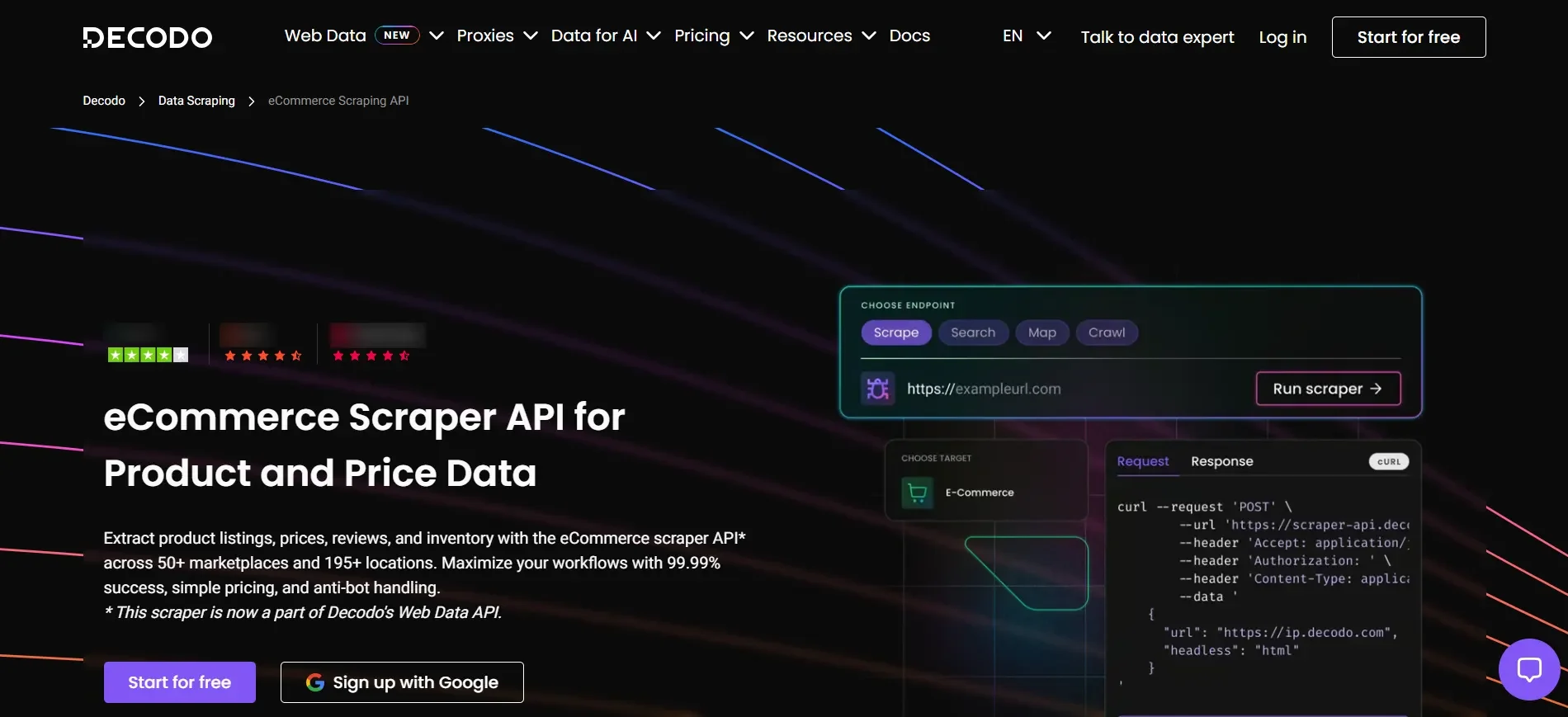
Decodo, previously known as Smartproxy, offers ecommerce scraping through its Web Scraping API. Its ecommerce offering covers more than 50 marketplaces across 195+ locations and includes over 100 ready-made templates. The provider also advertises throughput of up to 200 requests per second, a 99.99% success rate, and access to a proxy pool containing more than 125 million IPs.
The platform provides four main API endpoints for e-commerce-related extraction. Users can scrape individual product pages, map store URLs, crawl multiple product pages through a single job, or search the web for new listings and sellers.
This range is useful when a project involves more than collecting a few product prices. A retailer researching a new category, for instance, might first identify relevant product URLs and then extract their prices, ratings, and availability through the same API.
Results are available in HTML, JSON, and CSV formats. The parsing option converts supported product pages into structured fields, reducing the amount of custom extraction code required. Decodo also provides an API playground where developers can configure requests, inspect responses, and copy working code before integrating the service into an application.
Key features and pricing:
- Free plan, a seven-day trial, and a 14-day money-back option
- Web Scraping API pricing starts at $0.09 per 1,000 requests
- Ecommerce subscription page lists $29 per month for 90,000 requests, equivalent to approximately $0.32 per 1,000 requests
- Task scheduling for recurring extraction jobs
- Python, Node.js and cURL support
Decodo is a practical starting point for small and mid-sized teams collecting data from multiple marketplaces. The separate request-based pricing structure deserves attention, though. JavaScript-heavy and protected pages can cost more to scrape than straightforward product URLs.
Before committing to a monthly plan, run a sample batch using the actual marketplaces and product pages you intend to monitor. The results will provide a more realistic estimate of both extraction quality and monthly spending.
2. Oxylabs: Best for Localized Product Data at Scale
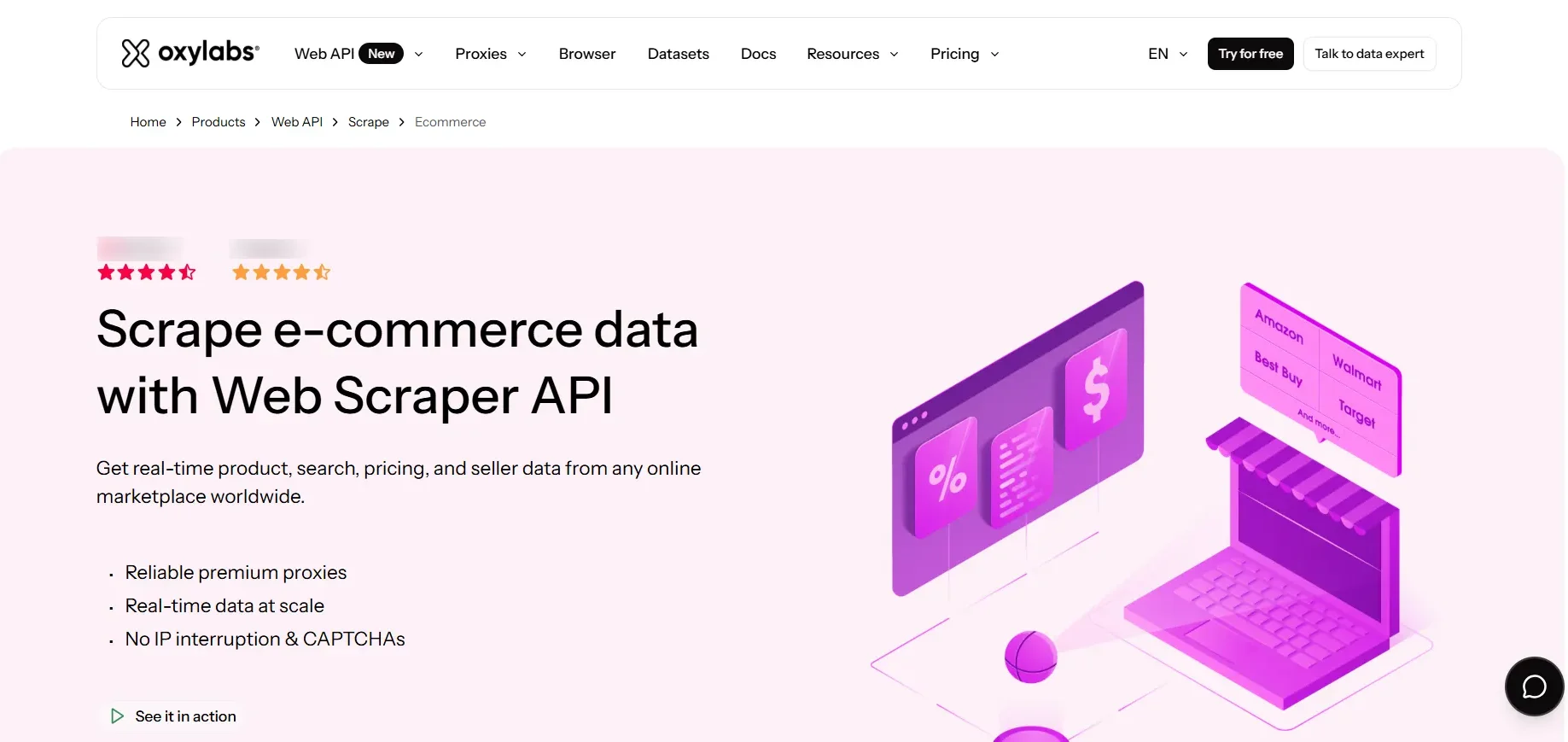
Oxylabs provides e-commerce scraping through its E-Commerce Scraper API, which is part of its wider Web Scraper API offering. The service extracts product information from major marketplaces and smaller online retailers, returning results in HTML or JSON.
One of its notable capabilities is location targeting. Requests can be configured for specific countries, states, cities, or ZIP codes across 195 countries. This level of control is particularly relevant to price comparison projects, where product prices, shipping availability, and stock information may differ between locations.
Oxylabs also offers extensive pre-built parsers. Its Amazon product endpoint returns 129 data points, while the Amazon search endpoint provides 88. Other supported targets include eBay, Etsy, SHEIN, Mercari, eMAG, and Digi-Key.
For websites without dedicated parsers, the platform offers OxyCopilot, an AI-based assistant that generates parsing instructions from plain-language prompts. Self-healing parser presets are also available to help adapt extraction logic when website layouts change.
Key features and pricing:
- Free trial covering up to 2,000 results, without requiring a credit card
- Micro plan at $49 per month for up to 98,000 results
- Amazon extraction starts at $0.50 per 1,000 results without JavaScript rendering
- Google targets start at $1.00 per 1,000 results
- Other targets start at $1.15 per 1,000 results without JavaScript rendering
- ISO/IEC 27001 certification
- 24/7 customer support
Oxylabs is particularly relevant to projects that need localized retail information and structured product records. The ability to target a specific ZIP code can help analysts examine regional pricing rather than relying on a single nationwide result.
The $49 monthly starting price may be difficult to justify for a small one-time collection. Rendering also increases the cost of extraction. Teams planning a large monitoring operation should estimate usage with and without JavaScript rendering before deciding on a subscription.
3. Bright Data: Best for Broad Marketplace Coverage and Ready-Made Datasets
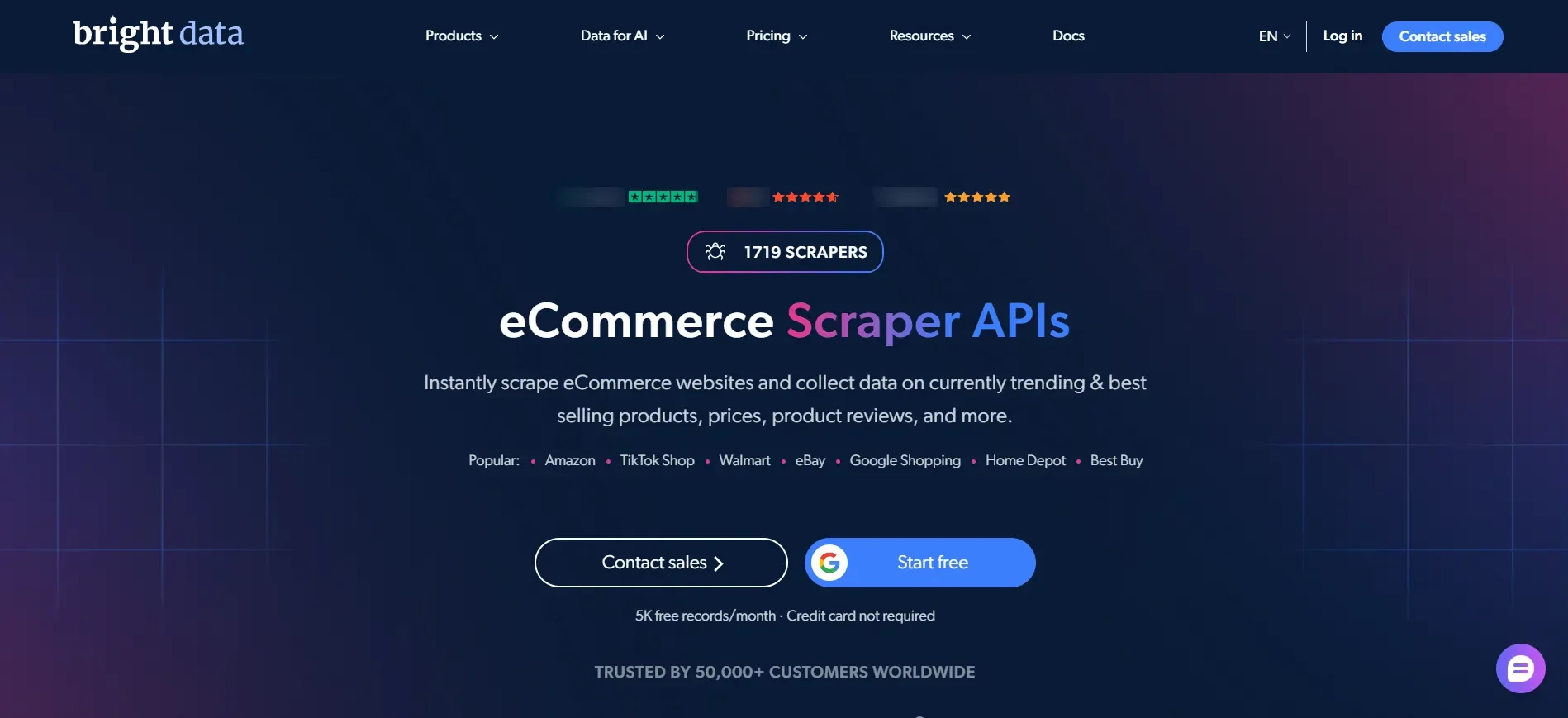
Bright Data has one of the largest collections of ready-made ecommerce scrapers in this comparison. Its ecommerce offering advertises more than 1,400 pre-built scrapers, with dedicated extractors for Amazon, Walmart, TikTok Shop, eBay, Google Shopping, Home Depot, Best Buy, Etsy, Target, Lazada, Wayfair, IKEA, Zara, Sephora, and AliExpress, among other retailers.
The range of supported websites is useful for projects that need to combine data from different types of marketplaces. A product research team can collect information from general retailers, fashion stores, and social commerce platforms without maintaining a separate extraction system for every website.
Each scraper provides information about its output fields and the volume of records it has delivered. This gives prospective users a starting point for evaluating the available extractors before running their own jobs.
Bright Data accepts up to 5,000 target URLs in a single API call. Results can be returned as JSON, NDJSON, or CSV, with delivery options covering APIs, webhooks, Amazon S3, Google Cloud Storage, Azure, Snowflake, and SFTP.
The infrastructure includes a network of more than 400 million IPs, and the platform supports unlimited concurrency. Bright Data also reports serving over 50,000 customers. Its stated compliance credentials include ISO 27001 certification and GDPR and CCPA compliance.
Key features and pricing:
- 5,000 free records per month, without a credit card
- Pay-as-you-go pricing at $1.50 per 1,000 records
- Charges apply to successful data deliveries
- Scale plan at $499 per month, including 384,000 records
- Additional Scale records cost $1.30 per 1,000
- Ready-made datasets start at $250 per 100,000 records across 900+ domains
- 24/7 human support, including on the free plan
Bright Data is particularly useful when the project covers several marketplaces or requires large amounts of product information. Its dataset offering also gives teams an alternative to building and maintaining a live scraping pipeline.
The $499 Scale subscription is a substantial starting commitment. Smaller projects can begin with the pay-as-you-go option, test the supported scrapers and estimate their monthly requirements before moving to a higher plan.
4. Zyte: Best for Developers and Scrapy Pipelines
Zyte has a strong connection to the developer community as the company behind the open-source Scrapy framework. Its Zyte API extends that background into managed web extraction, combining proxy routing, browser rendering, and automatic retries within a single API.
Instead of offering one fixed request price, Zyte uses five website difficulty tiers. The pricing depends on the target website and the extraction requirements, including whether a request needs a simple HTTP response or a browser-rendered page.
This model can be useful for projects that scrape several types of websites. Straightforward pages do not necessarily need the same infrastructure as marketplaces with extensive bot protection or JavaScript-dependent product information.
Key features and pricing:
- $5 in free credit and a 30-day trial without a commitment
- Pay-as-you-go HTTP pricing ranges from $0.13 to $1.27 per 1,000 requests
- Browser-rendered requests range from $1.01 to $16.08 per 1,000
- Monthly commitments of $100, $200, or $500 provide discounted rates
- At the $500 commitment level, HTTP responses start at $0.06 per 1,000 requests and rendered responses at $0.48
- AI Extraction identifies product pages and returns fields such as price, regular price, currency, and brand
- Residential, datacenter and mobile IP rotation
- CAPTCHA solving, session management, JavaScript rendering and browser actions
- Zyte Data provides managed dataset collection
- ISO 27001 certification
The AI Extraction feature is useful when developers want structured product information without creating individual parsing rules for every page. Zyte Data offers another route for teams that would rather specify their data requirements and receive a managed dataset.
Python developers already familiar with Scrapy should find the integration approach relatively straightforward. The pricing structure requires more calculation, particularly when different website difficulty tiers are involved. Use Zyte’s cost calculator with representative URLs before choosing a monthly commitment.
5. Apify: Best for Ready-Made Scrapers and Automation
Apify takes a different approach to ecommerce data collection. It provides a cloud platform built around Actors, which are small serverless programs that perform specific tasks and return structured results.
The Apify Store contains thousands of Actors, including extractors for Amazon, eBay, and Shopify. Instead of writing an e-commerce scraper from scratch, users can search the marketplace, select an available Actor, and configure its input parameters.
This is useful for projects involving multiple websites or recurring extraction tasks. A team can use one Actor to collect Shopify product listings and another to monitor Amazon search results, then connect the outputs to a larger workflow.
Apify also provides scheduling, webhooks, API access, and integrations that help automate data collection. Results can be exported in JSON, CSV, HTML, XML, RSS, or Excel formats.
Key features and pricing:
- Free plan with $5 of monthly platform credit and no credit card requirement
- Starter plan at $19 per month, including $19 of usage
- Scale plan at $199 per month
- Business plan at $999 per month
- Compute units cost $0.20 on Free and Starter, $0.16 on Scale, and $0.13 on Business
- Higher subscription levels offer larger discounts on Store Actors
- Individual ecommerce Actors may charge additional per-result fees
- One Shopify extractor in the Store lists pricing at $5 per 1,000 results
The pricing structure needs a little attention. An Apify project can involve the subscription, compute consumption, and an individual Actor’s usage charges. These costs should be considered together rather than treating the monthly subscription as the entire scraping budget.
Apify is a useful choice for developers and operations teams that want to connect ready-made scrapers to automated workflows. Actor quality can vary because many are developed by independent creators and community contributors. Test the selected Actor with a small batch of actual product URLs before scheduling large collections.
6. ScraperAPI: Best for Simple Credit-Based Ecommerce Extraction
ScraperAPI keeps the extraction process relatively straightforward. Developers send a request to its API, and the service manages proxy rotation, CAPTCHA handling, and JavaScript rendering.
For ecommerce projects, it also provides dedicated endpoints for major marketplaces such as Amazon and Walmart. These endpoints return structured JSON, which can save time compared with extracting individual fields from raw HTML responses.
The platform uses a credit-based pricing model. Each request consumes credits according to the target website and the features required to retrieve its data.
Key features and pricing:
- Free tier offering 1,000 credits per month
- Seven-day trial with 5,000 credits
- Hobby plan at $49 per month for 100,000 API credits and 20 concurrent threads
- Startup plan at $149 per month for 1,000,000 credits and 50 concurrent threads
- Business plan at $299 per month for 3,000,000 credits and 100 concurrent threads
- Country-level geotargeting on the Business plan
- US and EU geotargeting on the Hobby plan
- Programming language support with corresponding code examples
- Dedicated endpoints for major retailers
Annual billing reduces the monthly prices to $44 for Hobby, $134 for Startup, and $269 for Business.
The pricing documentation also explains that the Hobby plan can cover 100,000 simple URLs or approximately 3,000 heavily protected URLs. This illustrates why the headline credit allowance should not be treated as the number of product pages a subscription will always retrieve.
ScraperAPI suits developers who want a relatively simple API for common retail websites. The main consideration is credit consumption. JavaScript rendering, protected pages, and additional extraction features can increase the credits used for each request. Run a small test against your intended websites to calculate the actual cost per successful product record.
7. ScrapingBee: Best for a Low Starting Price and Flexible Extraction
ScrapingBee provides a REST API that handles proxy rotation, headless browser rendering, and anti-bot measures through a single endpoint. It also offers dedicated Amazon and Walmart APIs for e-commerce data collection.
Developers can configure CSS and XPath extraction rules to identify specific elements on a page. AI-assisted extraction adds another way to retrieve structured information without writing extensive parsing logic.
The platform also includes screenshots and scripted browser actions. These capabilities are useful when a product page requires scrolling, clicking or interacting with elements before the desired information becomes available.
Key features and pricing:
- 1,000 free API credits without a credit card
- Hobby plan at $19 per month for 75,000 credits and 25 concurrent requests
- Freelance plan at $49 per month for 250,000 credits and 50 concurrent requests
- Startup plan at $99 per month for 1,000,000 credits and 100 concurrent requests
- Business plan at $249 per month for 3,000,000 credits and 200 concurrent requests
- Geotargeting across more than 200 countries and territories
- Classic proxy coverage across 40+ locations
- JavaScript rendering and premium proxies included across plans
- MCP server for connecting AI assistants
Credit consumption changes according to the extraction method. JavaScript rendering costs five credits per request, while premium proxies cost 10 or 25 credits depending on the rendering configuration.
The entry-level price makes ScrapingBee accessible for smaller projects and individual developers. Its dedicated retail APIs also reduce the need to configure every extraction request manually.
The main concern is how quickly credits can be consumed on protected product pages. A project collecting a large number of records should estimate usage with rendering and premium proxies enabled, rather than calculating its budget using the simplest request rate.
8. Nimble: Best for AI-Driven Agents and Structured Ecommerce Feeds
Nimble approaches ecommerce extraction through Web Search Agents. These can be pre-built or custom-created agents that navigate websites and return structured information.
Its ecommerce agent library covers several types of retail information. Available examples include Amazon product search, category listings, reviews, best sellers, and seller profiles. Other supported targets include Walmart, Target, Home Depot, Lowe’s, Wayfair, SHEIN, TikTok Shop, and Kroger.
Beyond its agent library, Nimble provides Extract, Crawl, and Map APIs for custom data collection workflows. This gives technical teams different ways to retrieve information depending on the structure of their project.
For instance, an AI research system might use an agent to collect product listings and customer reviews, then pass the extracted records into a separate classification or recommendation pipeline.
Key features and pricing:
- Pay-as-you-go billing
- Charges apply only to successful requests
- 5,000 free web pages for new accounts, without a credit card
- Extract API pricing example of $1.60 per 1,000 URLs for a JavaScript-rendering and stealth-mode tier
- Custom Data Services plans for larger deployments
- Storage options and service-level agreements for enterprise projects
Nimble is particularly relevant to enterprise data teams and AI developers that need structured retail information delivered into their existing systems.
Its agent-based approach may require more planning than a simple API request, especially when designing custom workflows. Larger deployments also involve custom plans and discussions with the provider’s sales team. Smaller projects looking for an inexpensive way to collect a few thousand product records may find the other tools on this list quicker to configure.
9. SOAX: Best for Combining Proxy Infrastructure With Ecommerce Scraping
SOAX began as a proxy provider and expanded into scraping APIs. Its ecommerce offering combines product extraction with the company’s wider proxy infrastructure, giving developers access to scraping tools and IP resources through the same account.
The Ecommerce Scraper API supports more than 50 ecommerce websites. It can return raw HTML or JSON and extract common product fields, including titles, prices, and descriptions.
The platform also uses an adaptive parser to handle changes in website layouts. For websites that require additional access capabilities, SOAX provides a separate Web Unblocker.
Its infrastructure includes more than 155 million rotating residential proxies and over 33 million mobile IPs, with coverage across 195+ locations.
Customer support is available through chat, email, and phone, with teams covering the Americas, Europe, and Asia-Pacific.
Key features and pricing:
- E-commerce Scraper API supporting 50+ websites
- Raw HTML and structured JSON output
- Adaptive parsing for changing page layouts
- Separate Web Unblocker for more demanding websites
- 155M+ rotating residential proxies
- 33M+ mobile IPs
- Coverage across 195+ locations
- Three-day paid trial for $1.99
- Trial includes 400 scraping requests
Unlike several providers in this comparison, SOAX does not offer a free trial. Its three-day trial costs $1.99 and provides access to the platform’s features.
This arrangement can suit teams that already use SOAX proxies and want to add ecommerce extraction without managing another provider. The limited trial allowance is enough for an initial technical evaluation, though larger projects will need a paid plan.
10. Octoparse: Best No-Code Ecommerce Scraper
Octoparse is aimed at people who need website data but do not necessarily have programming experience. Its desktop and cloud applications provide a visual interface where users can select the information they want to collect from a website.
Instead of writing selectors or building API requests, users can interact with a page and configure the extraction workflow through the software. Preset templates are also available for popular retail websites.
Octoparse supports automatic pagination, scheduled cloud extraction, and exports to Excel, CSV, JSON, HTML, and XML. These features make it relatively convenient for analysts who want to move collected product information into spreadsheets for further review.
Key features and pricing:
- Permanent free plan with 10 tasks
- Local extraction and exports of up to 50,000 rows per month on the free plan
- Free users can run preset templates and view results
- Exporting template data requires a paid subscription
- Standard plan at $83 per month, or $69 per month with annual billing
- Professional plan at $299 per month, or $249 per month annually
- Cloud extraction included with paid plans
- 14-day trial of Standard or Professional for free accounts, once per account
- Proxy bandwidth charged separately at $3 per GB
- CAPTCHA solving costs $1 to $1.50 per 1,000 bypasses
Octoparse is a practical choice for sellers, researchers, and analysts who need product information in spreadsheet-friendly formats. Its visual workflow reduces the amount of technical setup required for straightforward extraction jobs.
There are limitations when working with heavily protected websites or building large programmatic pipelines. Teams handling high-volume extraction may prefer API-based platforms with dedicated unblocking and rendering infrastructure.
How to Choose the Right Ecommerce Scraper
Selecting an ecommerce scraping tool involves more than comparing the monthly subscription prices. The number of websites you need to monitor, the fields you want to extract, and the frequency of collection all affect the final decision.
A tool that performs well on Amazon may not offer the same extraction quality on an independent Shopify store. Similarly, a low-cost API can become expensive when every protected request consumes several credits.
The following factors deserve attention before choosing a platform.
1. Start With the Marketplaces You Need to Scrape
Make a list of the websites involved in your project before evaluating individual providers.
A project limited to Amazon product listings may work with a dedicated Amazon endpoint. A competitor monitoring system covering Amazon, Walmart, Target, eBay, and independent Shopify stores needs broader marketplace support.
Ready-made scrapers are particularly useful here. They reduce the need to build individual extraction rules for every retailer. Check the actual output fields, though. Two providers may advertise support for the same marketplace but return different levels of product detail.
Also consider the websites you might add later. Building a scraping workflow around one retailer can create additional maintenance work when the project expands into new marketplaces.
2. Calculate the Cost per Successful Record
The advertised price per 1,000 requests does not always represent the actual cost of collecting 1,000 usable product records.
Consider two hypothetical extraction services. One charges $0.50 per 1,000 requests but frequently requires retries. Another charges $1.50 per 1,000 successful records. The second service may cost less in practice if the first produces a large number of incomplete responses.
Credit-based billing adds another variable. Rendering, premium proxies, and CAPTCHA handling may consume additional credits.
For a realistic comparison, run the same group of product URLs through each shortlisted tool. Record the number of successful results, incomplete records, retries, and total credits consumed. Then calculate the cost of obtaining 1,000 complete records.
This approach gives you a much better estimate than comparing entry-level subscription prices alone.
3. Decide Between Live Scraping and Ready-Made Datasets
Not every ecommerce data project requires continuous scraping.
Live extraction is useful for tracking current prices, stock availability, discounts, and marketplace rankings. A scheduled job can collect the same product information at regular intervals and store each result for comparison.
Pre-collected datasets serve a different purpose. They can provide large catalog snapshots, historical information, or a one-time collection without requiring the team to build a complete scraping pipeline.
Bright Data offers ready-made datasets alongside its live scraping products, while Zyte provides managed data collection through Zyte Data.
The decision often comes down to data freshness. A dataset collected last month may be sufficient for a broad product catalog analysis, but it will not tell a pricing team whether a competitor reduced its price this morning.
4. Match the Platform to Your Technical Skills
The extraction interface should fit the people responsible for running and maintaining the project.
A developer building an internal pricing application will probably want an API, programming language support, and the ability to customize requests. Zyte, Decodo, and ScraperAPI provide options suited to this type of workflow.
A marketing analyst who needs product listings in Excel may prefer a visual scraper such as Octoparse. Apify provides another route through its ready-made Actors, which can be launched and configured through its platform.
Teams with existing scraping infrastructure may not need a complete extraction API. They might only need additional proxy access or an unblocker. A comparison of IPRoyal alternatives can help when evaluating that part of the scraping stack.
Think about ongoing maintenance as well. A custom scraper may be inexpensive to launch but require regular work when a retailer changes its website structure.
5. Check Geographic Targeting
Product prices, availability, and promotions can vary between countries and even between cities.
A retailer monitoring international competitors may need to see the same product as a shopper located in the United States, United Kingdom, or another market. Without geographic targeting, the collected information may not represent the prices customers actually see.
Oxylabs offers targeting down to ZIP code level. ScrapingBee advertises coverage across more than 200 countries and territories, while Decodo and SOAX provide coverage across 195+ locations.
ScraperAPI has different geotargeting options across its subscription tiers, so check the plan details before purchasing.
For a localized pricing project, test several target locations using the same product URL. This will show whether the scraper returns the regional information your analysis requires.
6. Examine Data Formats and Delivery Options
The extraction process does not end when a product page is scraped. The resulting records need to reach the system where the information will be analyzed.
CSV and Excel are convenient for manual review and smaller research projects. JSON is generally more suitable for applications that consume structured API responses.
Larger data operations may need webhooks, cloud storage, or direct connections to data warehouses. Bright Data, for example, supports delivery to Amazon S3, Google Cloud Storage, Azure, Snowflake, and SFTP.
Check whether the provider supports scheduled extraction as well. Running a daily price monitoring job manually defeats much of the purpose of automation.
7. Test Reliability Before Scaling
A successful test on one product page does not establish that a scraper can handle thousands of pages.
Test different page types, including product details, category listings, search results, and seller profiles. Include pages with discounts, unavailable products, multiple sellers, and customer reviews.
Monitor incomplete responses and changes in the output structure. A scraper might continue returning a successful HTTP response even when an important field, such as the product price, is missing.
A small test across several page types can reveal problems before they affect an entire dataset.
Common Ecommerce Scraping Use Cases
Product information can support several types of retail research and automation. The following applications are among the most common reasons teams invest in ecommerce scrapers.
Price and Minimum Advertised Price Monitoring
Retail pricing teams regularly compare product prices across marketplaces and competing stores.
An automated scraper can collect the current selling price, original price, discount information, and seller details. The collected records can then be compared against internal pricing rules or previous snapshots.
Minimum Advertised Price (MAP) monitoring is another application. Brands can identify listings that appear below their advertised pricing thresholds and investigate the relevant sellers.
Freshness matters considerably in this type of project. A monitoring system that collects information once every few weeks may miss short promotions or temporary price reductions.
Product Catalog and Assortment Tracking
A retailer’s product assortment changes over time. New listings appear, discontinued products disappear, and competing stores introduce additional brands or variations.
Ecommerce scrapers can collect category pages, search results, and product listings at scheduled intervals. Comparing these records helps analysts identify changes in product availability and assortment.
A brand tracking its products across several marketplaces might also examine which retailers carry each item and how product descriptions or images differ between listings.
Retailers with physical locations sometimes combine online catalog information with local store data. In those projects, Google Maps scrapers can help collect store hours, ratings, and location details.
Customer Review and Sentiment Analysis
Product reviews provide information that is difficult to understand through price and specification fields alone.
A review dataset can include ratings, written feedback, review dates, and other publicly displayed details. Analysts can examine recurring complaints, frequently mentioned product features, and changes in customer sentiment.
For example, a team researching wireless headphones might discover that several products receive similar ratings but attract very different comments about battery life or comfort.
Video reviews and social discussions can add another layer to this research. YouTube scrapers can collect publicly available video information, including titles, view counts, and comments, which can be analyzed alongside marketplace reviews.
Social Commerce and Product Research
Product discovery increasingly involves social platforms and online communities, not just conventional retail search pages.
Dropshippers and product researchers often compare wholesale marketplace prices with retail listings to identify potential product opportunities. They may also monitor products receiving attention on social media.
Ecommerce data provides the retail side of that research, including product pricing, reviews, availability, and seller information. Social data offers another perspective on engagement and product interest.
Instagram scrapers can support related research by collecting publicly accessible posts, profiles, and engagement information.
Combining these sources can help researchers build a more complete picture of how products are presented and discussed online.
AI and Machine Learning Data Collection
Product catalogs contain structured and unstructured information that can be useful for machine learning projects.
Titles, descriptions, categories, specifications, and customer reviews can become inputs for recommendation engines, product classification models, and search applications.
A recommendation system, for example, may use product attributes and category information to identify similar listings. A classification model could examine descriptions to assign products to more consistent categories.
Data delivery becomes particularly important in these projects. Teams may prefer JSON records or direct cloud storage delivery so that extracted information can enter an existing training pipeline without extensive manual processing.
Technical Challenges When Scraping Ecommerce Sites
Collecting information from an online store is not always as simple as sending an HTTP request and reading the response. Retail websites use several technologies that can interfere with automated extraction.
Understanding these challenges helps explain why dedicated ecommerce scraping tools offer features such as proxy rotation, browser rendering, and adaptive parsing.
Bot Protection and Browser Fingerprinting
Large retail websites commonly use content delivery networks, security services, and reverse proxies to inspect incoming requests.
These systems can examine request frequency, IP reputation, TLS fingerprints, browser characteristics, and interaction patterns. Requests that appear automated may receive a CAPTCHA challenge, a restricted response or an access-denied page.
A basic HTTP library can therefore fail before retrieving the product information.
Scraping platforms address these problems through different combinations of IP rotation, browser simulation, session management, and automated challenge handling. The exact capabilities vary by provider and target website.
Proxy quality matters here, but a large IP pool alone does not guarantee successful extraction. The browser configuration, request behavior, and target website’s protection mechanisms also influence results.
JavaScript-Rendered Product Information
Some ecommerce websites load important information after the initial HTML response.
A product page might return its title and description immediately but load the current price, availability, or review count through additional JavaScript requests.
A scraper that only reads the original HTML may miss these fields. The request can appear successful even though the resulting product record is incomplete.
JavaScript rendering addresses this issue by loading the page in a browser environment before extraction. Tools such as ScrapingBee, Zyte, and Decodo provide rendering-related capabilities.
Rendering can increase processing time and usage costs, so it is worth checking whether the target website actually requires it. Not every product page needs a full browser session.
Rate Limits and IP Rotation
Retail websites often restrict the number of requests that can originate from a particular IP address or session within a given period.
Repeated requests can trigger rate limits and temporary access restrictions. This becomes a problem when a scraping job needs to collect information from hundreds or thousands of product URLs.
IP rotation distributes requests across different addresses instead of relying on a single connection. Some providers also offer residential, mobile, and datacenter IP options.
The appropriate infrastructure depends on the website and the project’s requirements. Request frequency should remain reasonable, and the collection process should respect applicable website restrictions.
Changing Website Layouts
Ecommerce websites regularly update their frontend designs. Product information that previously appeared in one HTML element may move to another, and category pages can receive entirely different layouts.
A custom scraper relying on fixed CSS selectors may stop extracting the correct fields after such a change.
Maintained templates, adaptive parsers, and AI-assisted extraction can reduce this maintenance burden. Oxylabs offers self-healing parser presets, while other providers use dedicated extraction endpoints for supported marketplaces.
Even with managed parsing, output validation remains important. Check whether essential fields are present and correctly formatted rather than assuming every successful request contains complete product information.
Handling Product Variations and Multiple Sellers
A product page does not always represent one simple listing.
Clothing products may have several sizes and colors, electronics may have different storage configurations, and marketplaces may display multiple sellers for the same item.
A scraper needs to capture the relevant variation or seller information instead of treating every page as an identical product record.
This is particularly important for price comparison systems. Comparing the price of a 128 GB smartphone with a 256 GB version would produce misleading results, even if both listings use the same product name.
Before building a collection workflow, decide which identifiers and attributes will be used to match equivalent products across different stores.
Staying on the Right Side of the Rules
Publicly accessible product information is frequently collected for market research, pricing analysis, and catalog management. The legal and contractual requirements surrounding automated data collection can still vary by website and jurisdiction.
A website’s terms of service may restrict certain types of automated access. Privacy regulations such as GDPR can apply when collected material includes personal information, and copyright rules may affect how product descriptions, photographs, and other content are reused.
Review the relevant website terms and applicable laws before launching a scraping project. Limit collection to the information required for the intended purpose, avoid unnecessary personal data, and use reasonable request rates.
Also distinguish between collecting information for internal analysis and republishing it. The latter can raise additional questions around copyright, database rights, and contractual restrictions.
For projects involving sensitive information, large-scale commercial use, or uncertain legal requirements, consult a qualified legal professional before proceeding.
Frequently Asked Questions
1. What is the best ecommerce scraper?
Decodo offers a useful balance of marketplace coverage and pricing for general ecommerce extraction. Bright Data provides an extensive catalog of ready-made scrapers and datasets, while Oxylabs is particularly relevant to localized product data collection.
Zyte and ScraperAPI are worth considering for developer-led projects. Apify offers ready-made Actors and automation, whereas Octoparse provides a visual interface for people who prefer not to write code.
The most reliable way to compare them is to test the same product URLs across a few shortlisted platforms.
2. What data can ecommerce scrapers collect?
Ecommerce scrapers can collect publicly displayed product information, including names, descriptions, prices, discounts, currencies, stock availability, images, ratings, and seller details.
They can also retrieve customer reviews, category positions, search listings, and product identifiers such as ASINs and SKUs.
Available fields depend on the website and the scraper’s extraction capabilities. Dedicated marketplace parsers often return more structured information than general-purpose HTML extraction.
3. Do I need coding skills to scrape ecommerce websites?
No-code scraping tools such as Octoparse provide visual builders that let users select page elements without writing scripts.
Apify also makes ready-made Actors available through its platform, allowing users to run existing extraction programs with configured inputs.
API-based tools usually require some programming knowledge, particularly when connecting scraped data to applications, databases, or automated workflows. Pre-collected datasets require even less technical involvement.
4. Is there a free ecommerce scraper?
Several providers offer free access or trial allowances.
Bright Data includes 5,000 free records per month. Oxylabs offers up to 2,000 trial results, while Nimble provides 5,000 free web pages for new accounts.
ScrapingBee offers 1,000 free API credits, Apify provides $5 in monthly platform credit, and Octoparse has a permanent free plan with usage restrictions.
These allowances are useful for testing extraction quality and learning how a platform works. Larger recurring collections will generally require a paid subscription or usage-based plan.
5. Should I use live ecommerce scraping or purchase a dataset?
Live scraping is useful when you need current product prices, availability, discounts, or marketplace listings. A scheduled extraction job can collect updated records and store them for comparison over time.
Purchasing a dataset can be more convenient for a one-time catalog collection, historical analysis, or large-scale product research project.
The key distinction is data freshness. A pre-collected dataset may be sufficient for catalog research, but live extraction is necessary when the analysis depends on current marketplace conditions.
6. Can ecommerce scrapers track product price changes over time?
Yes. A scraper can collect product prices on a recurring schedule, provided the selected tool supports scheduling or can be triggered through an external automation system.
The collected records need to be stored with timestamps. Comparing successive snapshots then makes it possible to identify price reductions, promotions, availability changes, and longer-term pricing patterns.
Decodo, Apify, and Octoparse provide scheduling-related capabilities that can support recurring extraction workflows.
7. How do ecommerce scrapers avoid getting blocked?
Ecommerce scraping platforms use combinations of proxy rotation, browser rendering, session management, request handling, and CAPTCHA-solving capabilities.
The exact approach depends on the provider and the target website. Some retail pages require only a standard HTTP request, while others need a browser environment to retrieve their product information.
A larger IP pool can help distribute requests, but extraction quality also depends on request patterns, browser fingerprints, and the website’s security systems.
8. What is the difference between an ecommerce scraper and a proxy service?
An ecommerce scraper collects product information from online stores. It may include ready-made parsers, APIs, browser rendering, and data delivery options.
A proxy service provides an intermediary IP address through which requests can be routed. Proxies help manage connections and geographic access, but they do not necessarily extract or organize product information.
Some providers offer both services, while others focus on one part of the process. A team with its own extraction software may only need proxy infrastructure, whereas a team without a scraping system may prefer a managed API.
9. Can ecommerce scrapers collect data from Shopify stores?
Yes. Shopify product pages can be collected using compatible ecommerce scraping tools, depending on the store’s configuration and the information being requested.
Apify has Shopify-related Actors in its Store, and other general-purpose scraping platforms can be configured for supported Shopify pages.
The available data may include product names, descriptions, prices, variants, images, and availability. Test the actual target store rather than assuming every Shopify website exposes identical information.
10. How often should ecommerce product data be collected?
The collection frequency should reflect how quickly the information changes and how frequently the data will be used.
A pricing team monitoring fast-moving promotions may need several checks throughout the day. A catalog research project might only require weekly or monthly snapshots.
More frequent extraction increases request volume and potentially the monthly cost. Start with a schedule that captures meaningful changes without collecting duplicate information unnecessarily.
Final Thoughts
The best ecommerce scraping setup starts with a clear understanding of the data you need. Collecting prices from a few product pages is a very different task from maintaining a database covering thousands of listings across multiple countries.
Decodo offers a balanced entry point for general marketplace extraction, Bright Data provides extensive ready-made scraper coverage and dataset options, and Oxylabs brings detailed geographic targeting to product research. Developers already working with Scrapy may appreciate Zyte’s approach, while Apify offers considerable flexibility through its Actor marketplace.
Octoparse deserves consideration for spreadsheet-focused research that does not require a dedicated developer. ScraperAPI and ScrapingBee provide straightforward API access, and Nimble and SOAX offer additional approaches for structured extraction and scraping infrastructure.
Before committing to any subscription, select two promising platforms and run the same 200 product URLs through each. Check the completeness of the returned records, extraction speed, credit consumption, and total cost. Include different page types rather than testing only simple product listings.
That small evaluation will reveal far more about a scraper’s practical value than its advertised request volume or proxy pool size. It also gives your team a realistic basis for choosing a platform that can handle the actual workload.
