
Disclosure: Some links in this article are affiliate or sponsored links. If you buy through them, we may earn a commission at no extra cost to you. Our opinions are our own.

IPRoyal sells residential traffic by the gigabyte; the bandwidth you buy never expires, and nobody asks you to sign a contract. For a freelancer pulling product pages once a week, or a small team that scrapes in bursts, that is hard to argue with.
The search for an IPRoyal alternative usually starts later, when one specific thing stops fitting. The crawl grows, and the pool needs to be bigger. A client wants ASN or ZIP-level targeting. Your security team asks for compliance paperwork. Or you simply want residential, mobile, ISP, and an unblocker on one invoice with a support contact who knows your account. The trigger matters more than any ranking, because each of the best IPRoyal alternatives is strong at a different job.
This guide covers five options: Decodo, Oxylabs, Bright Data, SOAX, and Webshare. Each section says what the provider does well, where it asks more of you, and who should pick it. Pool sizes and prices below are vendor claims read from official pages in November 2026. Proxy companies reprice constantly, so confirm numbers at checkout before you commit.
Quick answer: which IPRoyal alternative fits which job
- Closest like-for-like with a bigger pool: Decodo
- Enterprise support and managed scraping tools: Oxylabs
- Largest pool plus compliance documentation: Bright Data
- Mobile and carrier-level targeting: SOAX
- Cheapest way to test, plus low-cost datacenter IPs: Webshare
If you only remember one rule, remember this: pick the replacement based on why you are leaving IPRoyal, not on the lowest per-GB price in a table.
What IPRoyal offers today
It helps to know exactly what you are replacing. IPRoyal sells five proxy lines and a managed unblocker under one login.
Residential is the flagship. The official product pages list 64M+ residential IPs across 195+ countries, with country, state, and city targeting at no extra charge. Sessions can rotate on every request or stick to one IP for up to seven days, although IPRoyal itself notes that because the IPs come from real users who come and go, the same address cannot be guaranteed for the full period. Pricing starts from $1.75 per GB at bulk volume, and smaller packs cost noticeably more per gigabyte. The detail that sets it apart is that purchased traffic never expires, which the residential quick-start guide confirms.
ISP proxies are static, dedicated IPs (500K+ listed) from about $1.80 per proxy with unlimited traffic. Datacenter proxies start around $1.39 per proxy across 60+ locations with unlimited bandwidth. Mobile proxies draw on 4.5M+ carrier IPs and are priced per day or per month. A Web Unblocker rounds out the catalog for hard targets.
Plenty of teams never outgrow that. The people who do tend to hit one of the limits below.
Why people look for an IPRoyal alternative
Pool depth and targeting. A pool of 64M+ residential IPs is large by most standards, but several rivals publish pools two to six times that size. Targeting is also by country, state, and city. If you need ASN or carrier filters, a few competitors offer them, and IPRoyal’s residential line does not list them.
Billing shape. Per-gigabyte billing is wonderful for text-only jobs and punishing for heavy pages. A crawl that renders JavaScript, loads images, or retries often can use many times the bytes of the underlying JSON endpoint. Teams that discover this after a month of invoices start comparing other models, such as per-IP, per-request, or flat monthly plans.
Managed scraping layers. IPRoyal’s Web Unblocker covers the basics. Teams that need browser automation, structured SERP data, ready-made datasets, or SLA-backed unblocking often move to a provider where those tools sit on the same account as the proxies.
Procurement requirements. A named account manager, a written SLA, a certification, a documented IP-sourcing policy. These are not complaints about proxy quality. They are what a larger company’s legal or security team asks for.
One bad stretch on a hard target. This is the weakest reason to leave. Block rates move when a target changes its defenses, not only when a pool degrades. Reproduce the problem over two weeks and two different sites before blaming the vendor.
What to compare before you choose
Six things separate one provider from another once you are past the marketing.
- Pool size and sourcing. Bigger pools reduce repeat addresses on large crawls, but a huge pool with poor filtering can still hand you burned IPs.
- Targeting depth. Country-level is enough for many jobs. Local pricing, regional inventory, and local search results need city, ZIP or ASN control.
- Billing unit. Per GB, per IP, per request, and per thread each reward a different usage pattern.
- Traffic expiry. Some plans reset unused gigabytes every month. IPRoyal does not, and this alone can decide a bursty workload.
- Testing options. Free plans, small paid trials, and money-back windows differ a lot.
- Support and tooling. Live chat, an API, scraper endpoints, and an unblocker matter more the closer you get to production.
The 5 best IPRoyal alternatives in 2026
1. Decodo: the closest like-for-like match
Key details from the official site:
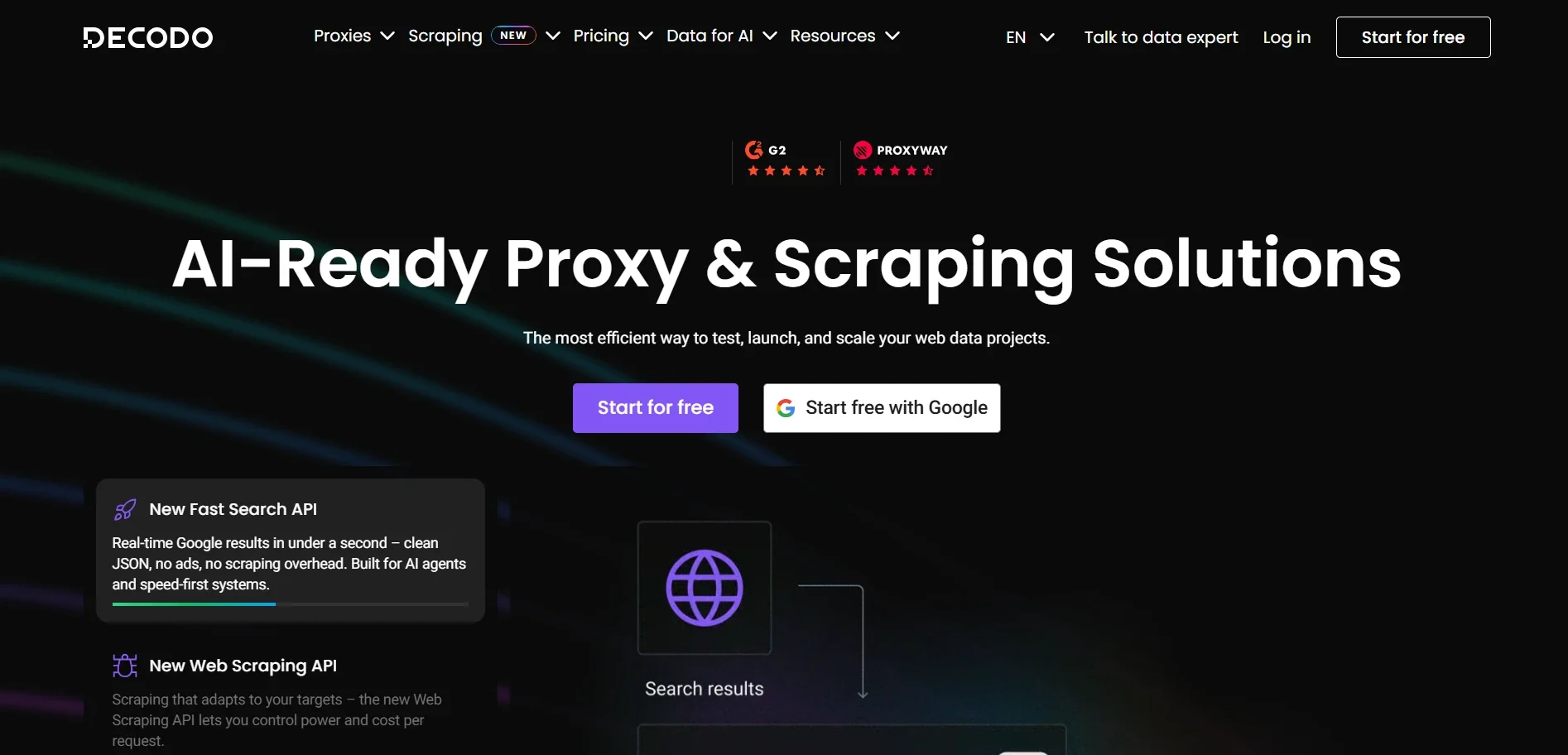
- A pool of 125M+ ethically sourced IPs across 195+ locations
- Residential, mobile, static residential (ISP), and datacenter proxies in one dashboard
- 99.99% uptime and a response time under 0.3 seconds, as published by Decodo
- A 14-day money-back option on paid plans
- A Site Unblocker, scraping APIs, and free tools such as a no-code scraper
On pricing, the smallest residential plan displayed on the fresh-proxies page was 3 GB at $3.75 per GB, billed monthly plus VAT, with the rate falling as plans get bigger. Static residential IPs start from about $0.27 each.
Where Decodo fits an IPRoyal switcher is breadth. It matches IPRoyal’s product mix closely, then adds a bigger residential pool, ASN-level filtering, and a managed scraping layer. The trade is the billing model. Decodo plans renew monthly, so IPRoyal’s never-expiring balance has no direct equivalent here. If your usage is steady, that hardly matters. If it is spiky, run the numbers in the billing section below first.
Best for: teams that like IPRoyal’s catalog but want a larger pool, finer targeting, and a friendlier dashboard.
2. Oxylabs: enterprise control and managed tools
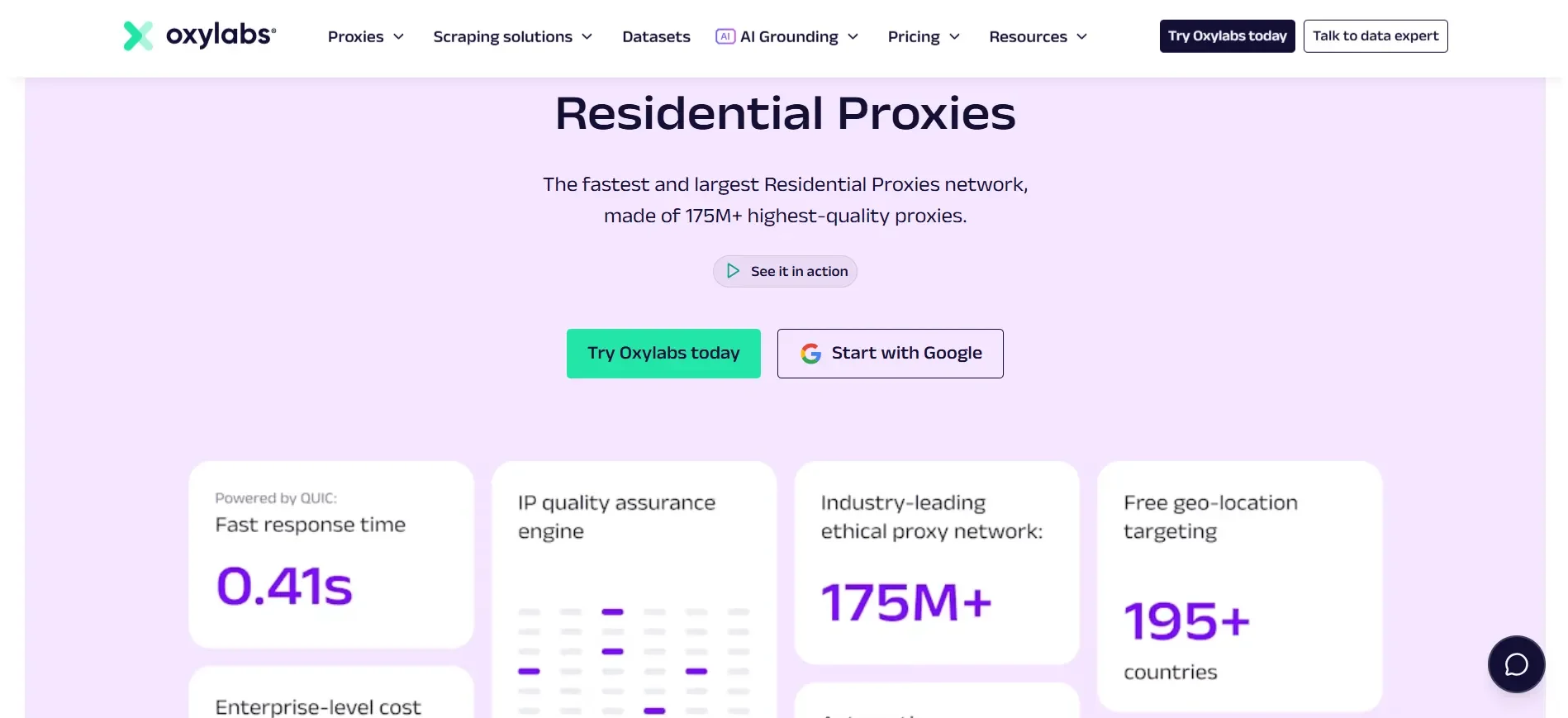
Oxylabs sits at the serious end of the market. Its residential network is listed at 175M+ IPs across 195 countries, including more than 10 million in the United States alone. Sessions can be sticky for up to 24 hours, concurrency is unlimited, and the company states that its products are ISO/IEC 27001:2022 certified.
Beyond proxies, Oxylabs sells a Web Unblocker, Web Scraper API, and a headless browser, plus dedicated datacenter and ISP options. Support runs through 24/7 live chat.
Pricing is where it feels different from IPRoyal. The residential product page advertises plans from $4 per GB, while the pricing page shows entry tiers that start higher, around $6 per GB on a small monthly commitment, and fall toward roughly $2.50 per GB at the top self-service tier. Pay-as-you-go and custom plans are both available. Our Oxylabs pricing breakdown walks through the tiers if you want to see how the commitment levels stack up.
The honest caveat is entry friction. A solo scraper or a small side project will find the minimums heavier than IPRoyal’s open pay-as-you-go packs. For a company that needs an SLA, a support contact, and managed unblocking under one contract, that friction buys something real.
Best for: data teams that need predictable performance on tough targets and want scraping APIs on the same account.
3. Bright Data: the largest network and the most paperwork
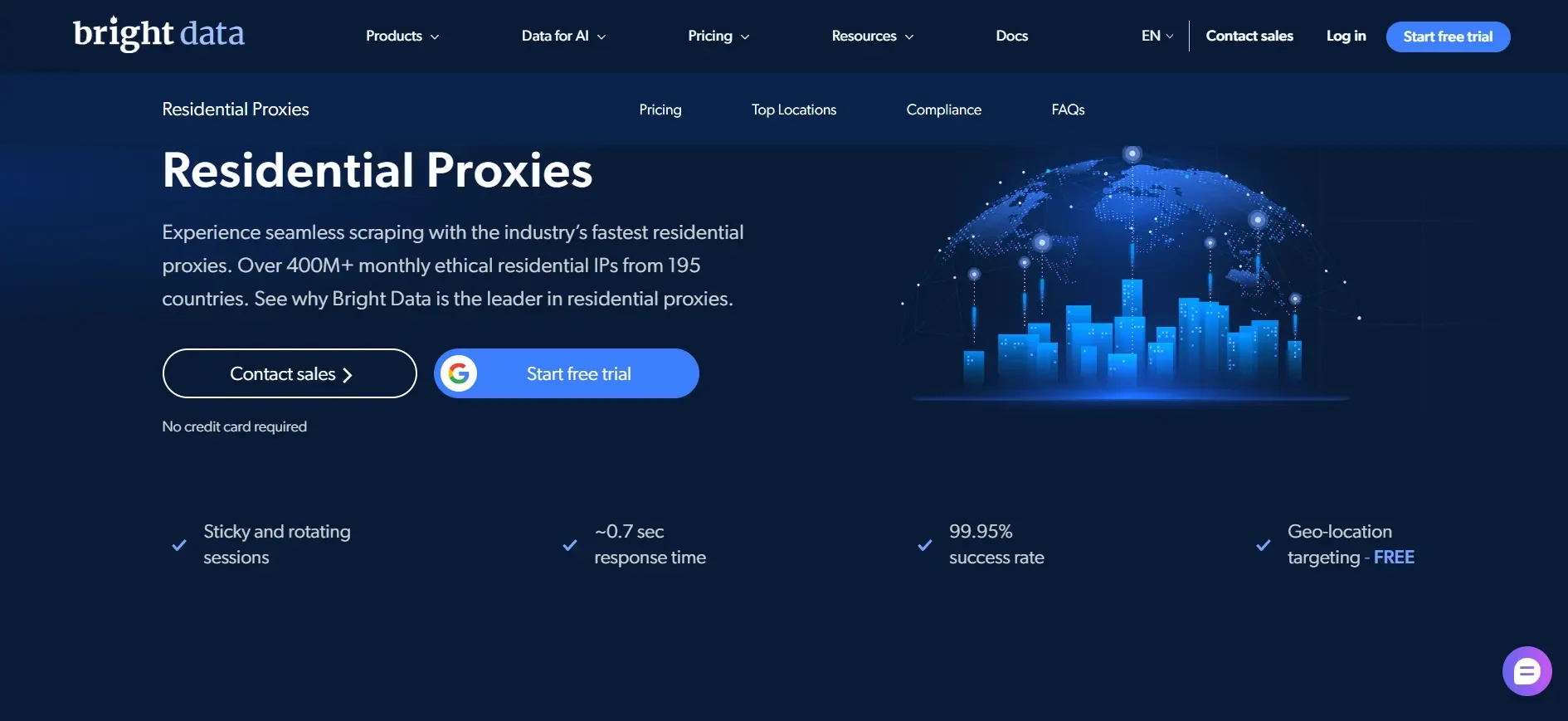
Bright Data lists 400M+ rotating residential IPs in 195 countries, with country, state, city, and ZIP code targeting included at no extra charge. It is also the broadest catalog of the group: datacenter, ISP, and mobile proxies, a Web Unlocker, SERP API, browser tooling, Web Scraper API, and ready-made datasets.
The residential pay-as-you-go plan is shown at a list price of $8 per GB with a 50% promotion bringing it to $4 per GB, with no commitment. Committed plans start at $499 a month, and the per-GB rate drops as the tier rises. Promotional prices change, so look at the live page before you plan a budget around that $4.
Two things stand out for someone coming from IPRoyal. First, unblocking tools reduce failed requests on hard sites, which can make the cost per successful record lower even when the cost per gigabyte is higher. Second, Bright Data runs identity verification as part of onboarding and publishes compliance documentation, which is exactly what some legal teams require and exactly what slows down someone who wants to be scraping in twenty minutes.
If Bright Data interests you but the price or process does not, there are other routes. The list of Bright Data alternatives is a useful side road before you commit.
Best for: large operations, regulated industries, and anyone who needs documented sourcing and the widest toolset.
4. SOAX: targeting depth on residential and mobile
SOAX publishes a pool of 155M+ residential IPs and 33M+ mobile IPs across 195+ locations. Its official residential page advertises a 99.95% success rate and a 0.55-second response time, and the network supports HTTP, SOCKS5, and UDP/QUIC. Targeting goes down to city, carrier, and ASN, and you can pick rotating or sticky sessions.
Pricing is package-based on a unified credit system. Third-party price trackers list entry packages around $3.60 per GB at small volume, falling toward $2 per GB on the largest self-serve tier, and a three-day trial has been offered for about $1.99. SOAX changes its packages from time to time, so treat those figures as a starting point and read the current page.
SOAX earns its place on this list through carrier-level work. Ad verification, app testing, and mobile price checks all benefit from exits that look like a specific network in a specific place. The cost is that datacenter proxies are not its focus, so if your IPRoyal bill is mostly datacenter, look elsewhere.
Best for: mobile-heavy workloads, ad verification, and jobs where ASN or carrier filters matter.
5. Webshare: the easy way to test and a cheap datacenter option
Webshare takes a different approach to the first conversation. Its free plan gives you 10 shared datacenter proxies with 1 GB of bandwidth per month and needs no payment card. There is no time limit, so it is the lowest-risk way to check whether a datacenter IP works against your target before you spend anything.
Paid plans are modest. A hundred shared datacenter proxies start at $2.99 per month, and static residential (ISP) plans start around $6 per month for 20 proxies. Webshare also lists 80M+ rotating residential IPs in 195 countries, 500K+ datacenter and ISP addresses, and HTTP and SOCKS5 support across products.
Two limits are worth knowing. The free plan is datacenter, so it tells you nothing about residential performance. And rotating residential allowances reset every 30 days, which loses the never-expiring benefit that IPRoyal gives you. There is also no mobile line, so a mobile-heavy IPRoyal account cannot move here whole.
Best for: developers who want to prototype for free, and teams whose real need is cheap datacenter or ISP addresses.
IPRoyal alternatives comparison table
| Provider | Published pool | Strongest at | Billing style | Ways to test |
|---|---|---|---|---|
| IPRoyal (baseline) | 64M+ residential, 4.5M+ mobile | Pay-as-you-go budget buying | Per GB or per proxy, residential traffic never expires | Small entry packs |
| Decodo | 125M+ IPs, 195+ locations | Breadth and value | Monthly plans per GB or per IP | 14-day money-back option |
| Oxylabs | 175M+ residential, 195 countries | Enterprise support and scraping APIs | Monthly tiers plus pay-as-you-go | Trials through onboarding |
| Bright Data | 400M+ residential, 195 countries | Compliance and unblocking tools | Pay-as-you-go or committed plans from $499 a month | Free trial offered |
| SOAX | 155M+ residential, 33M+ mobile | Carrier and ASN targeting | Credit-based packages | Low-cost 3-day trial |
| Webshare | 80M+ residential, 500K+ datacenter and ISP | Free testing, cheap datacenter | Per proxy and per GB, monthly | Free plan, 10 proxies, 1 GB a month |
How billing changes when you switch
Moving providers almost always changes the billing unit, and the new unit has its own way of costing more than you expect.
Per-gigabyte billing rewards small, precise requests. It punishes rendered pages, images, PDFs, and retries. Per-IP billing suits stable identities and allowlists but caps your throughput at whatever your addresses can handle. Per-request pricing, which is how most unblockers charge, helps on hard targets and wastes money on easy ones. Monthly commitments are cheap per unit and expensive when you stop using them.
Expiry is the quiet one. Here is a simple example. Say you buy a 20 GB plan each month at $3.50 per GB, which costs $70. Over three months, your real usage is 18 GB, 4 GB, and 9 GB. You paid for 60 GB, which is $210, but used 31 GB, so your effective price is about $6.77 per GB. On a never-expiring pack priced at an assumed $5 per GB, the same 31 GB would cost $155. That is a made-up number for illustration, but the pattern is real: bursty usage and monthly resets are a bad match.
The reverse also holds. If you use almost all of a plan every month, expiry costs you nothing and a bigger pool at a lower committed rate wins. Decodo pricing is a good example of how the per-GB rate falls as the plan grows, so check where your own monthly volume lands before you assume the sticker price applies to you.
Before cancelling IPRoyal, spend down any remaining balance. Residential traffic you already paid for stays yours.
| If you use this IPRoyal line | Common reason to leave | Providers worth checking |
|---|---|---|
| Residential proxies | Bigger pool, ASN targeting, managed tools | Decodo, Oxylabs, Bright Data, SOAX |
| ISP proxies | Larger static pool or different locations | Webshare, Oxylabs |
| Datacenter proxies | Lower per-IP cost or different billing | Webshare, Oxylabs, Bright Data |
| Mobile proxies | Carrier-level targeting | SOAX, Oxylabs, Bright Data, Decodo |
| Web Unblocker | Stronger unblocking on hard targets | Decodo Site Unblocker, Oxylabs Web Unblocker, Bright Data Web Unlocker |
Which alternative suits which scraping job
Price monitoring across large retailers is mostly a volume and success-rate problem. Decodo, Oxylabs and Bright Data all publish pools big enough to spread requests thin, and the managed unblockers help when a retailer fingerprints aggressively.
Search result tracking needs accurate local results, so targeting depth matters more than pool size. City and ZIP controls from Bright Data and Oxylabs, or ASN filters from Decodo and SOAX, give you more ways to pin the exit location than country-only routing does.
Ad verification and app testing care about what the exit looks like. A carrier IP in the right region sees different ads than a home connection, which is why SOAX’s mobile depth keeps coming up for this work.
Account-based tasks, such as managing several logged-in profiles, want an address that stays put. Static ISP proxies from Webshare or Oxylabs fit better than any rotating pool, because the target sees one consistent visitor.
Prototyping is a different job again. Before you pay anyone, push a few hundred requests through Webshare’s free datacenter plan. If the target accepts those, you may not need residential IPs at all, and that single check can save months of spend.
How to choose the right IPRoyal alternative
Start with the product line you actually use. IPRoyal is a catalog, and each line has different replacements.
If you scrape at volume with residential IPs, pool size and success rate on your specific targets are what count. Decodo, Oxylabs, and Bright Data are the natural shortlist, and SOAX belongs on it if you need ASN filters.
If you rely on static identities, such as logged-in sessions or allowlisted addresses, look at the ISP lines from Webshare or Oxylabs. Rotating pools are the wrong shape for that work.
If your bill is mostly datacenter, you probably do not need a residential pool at all. Webshare’s low per-proxy pricing and free tier make it the first place to test. The difference between datacenter versus residential proxies is worth a read if you are unsure which category your targets demand, because choosing the wrong category costs more than choosing the wrong vendor.
If you need managed unblocking, compare Decodo’s Site Unblocker, Oxylabs’ Web Unblocker and Bright Data’s Web Unlocker on your hardest URLs. Per-request pricing makes the cheapest option on paper the most expensive one on a hard target.
Protocol support deserves a quick check too. HTTP and HTTPS cover most scraping, while SOCKS5 matters for desktop tools and non-browser traffic. Proxy servers and tunneling explain how the two behave, in case a tool of yours has strict requirements.
Testing an alternative properly
Do not decide from a table; this one included. Pick your two hardest target URLs and send about 500 requests through each shortlisted provider. Record the success rate, median latency, and bytes transferred per record. An afternoon of measurement tells you more than a month of reading, and it reflects your targets rather than someone else’s.
Use the free options where they exist. Webshare gives you free datacenter proxies, Decodo offers a money-back window, and SOAX has offered a small paid trial. Bright Data and Oxylabs run trials through their onboarding.
Migrating from IPRoyal without breaking your scraper
Assume nothing carries over except your target list.
- Run both providers for a billing cycle. A rollback path is worth one month of double payment.
- Record a baseline first. Log success rate, median latency, and bytes per record on IPRoyal for a representative day, so you can tell whether the new provider is worse or the target simply changed.
- Change one variable at a time. Swap the proxy layer only. A parser rewrite, a concurrency bump, and a provider change in the same deploy leave you guessing which one moved the numbers.
- Re-register authentication. You have to add IP allowlists again at the new provider, and changes aren’t always instant. If your scraper runs from a changing address, move to username and password auth during the switch.
- Check geo and session syntax. Every provider expresses country targeting and session IDs differently, and a silently ignored country flag produces data that looks fine and is wrong.
- Ramp gradually. Send 10% of traffic first, then half, then everything. Some block patterns only show up above a volume threshold.
Keep the proxy string in one place in your code. If it appears in ten files, fix that before you migrate.
When staying with IPRoyal is the right call
Stay if you use three or more of its product lines and enjoy having one login, one invoice, and one support queue. Splitting that across vendors to save a little on one line rarely pays once you count the admin.
Stay if your usage is bursty, and you depend on non-expiring residential traffic. Few competitors match that structure.
Stay if the complaint is one rough month. Switch when a specific, repeatable limit is costing you money: a targeting option that does not exist, a throughput ceiling you keep hitting, or a document your security team needs and cannot get.
Frequently asked questions
What is the best IPRoyal alternative?
It depends on what you use. Decodo is the closest match in catalog and price range, Oxylabs and Bright Data suit enterprise needs, SOAX fits mobile and ASN targeting, and Webshare suits free testing and cheap datacenter IPs.
What is the best IPRoyal alternative for web scraping?
For general large-scale scraping, Decodo, Oxylabs, and Bright Data have the biggest residential pools and managed unblockers. Test two or three of them on your hardest URLs, because success rates vary by target.
Is there a cheaper IPRoyal alternative?
Sometimes. Webshare is usually cheaper for datacenter and ISP proxies, and Decodo’s larger plans can undercut IPRoyal’s mid-size residential packs. Compare effective cost, including expiry and failed requests, rather than the headline rate.
Which IPRoyal alternative has traffic that never expires?
IPRoyal states this on its own pages, and many competitors reset allowances every month. Ask any provider you are considering how unused gigabytes are handled, and get the answer in writing.
Do these providers offer free trials?
Webshare has a permanent free datacenter plan, Decodo advertises a 14-day money-back option, and SOAX has run a low-cost three-day trial. Bright Data and Oxylabs offer trials through their onboarding. Terms change, so check each page.
Will I have to rewrite my scraper to switch?
Usually, only the proxy URL changes, as long as it lives in one place. The parts that break quietly are geo-targeting syntax, session identifiers, and IP allowlists, so test those three on purpose.
Are residential or datacenter proxies better when leaving IPRoyal?
Residential proxies resist blocks better on protected sites. Datacenter proxies are faster and much cheaper on easy targets. Match the type to your targets before you pick a provider.
