
Decodo, the proxy and web scraping platform formerly known as Smartproxy, runs one of the more transparent pricing structures in the proxy industry, but “transparent” doesn’t mean “simple.” Between residential bandwidth tiers, ISP per-IP plans, pay-as-you-go rates, mobile pricing, and scraping API credits, the checkout page can feel like a maze if you don’t know what you’re looking for.
This guide breaks down exactly what Decodo charges for every product, how the billing model actually works, what the free trial and refund policy really cover, and where the pricing makes sense for your use case. Every figure below is pulled directly from Decodo’s own pricing pages, so you’re working with current numbers rather than a stale screenshot from a review site.
Decodo Pricing at a Glance
| Product | Starting Price | Billing Unit |
|---|---|---|
| Residential Proxies | $2.75 – $4.00 | per GB |
| Static Residential (ISP) Proxies | $0.27 – $3.33 | per IP |
| Mobile Proxies | $2.25+ | per GB |
| Datacenter Proxies | $0.02+ | per IP |
| Site Unblocker | $0.95+ | per 1,000 requests |
| Web Scraping API | $0.09+ | per 1,000 requests |
The “starting from” figures Decodo advertises on its homepage reflect the cheapest possible rate at the highest volume tier, so treat them as a ceiling on how low prices can go rather than what you’ll pay on day one. The sections below walk through the real tier-by-tier breakdown for each product.
Residential Proxy Pricing
Residential proxies are Decodo’s flagship product, built on a pool of over 115 million ethically sourced IPs spread across more than 195 locations. If you’re still weighing whether this proxy type fits your project, our guide on what residential proxies actually are covers the fundamentals before you commit to a plan. Pricing here is bandwidth-based, meaning you pay per gigabyte of traffic rather than per IP, and the rate drops as your monthly commitment grows.
Here’s the full subscription structure:
- 3 GB – $3.75/GB, $11.25 total per month
- 10 GB – $3.50/GB, $35 total per month
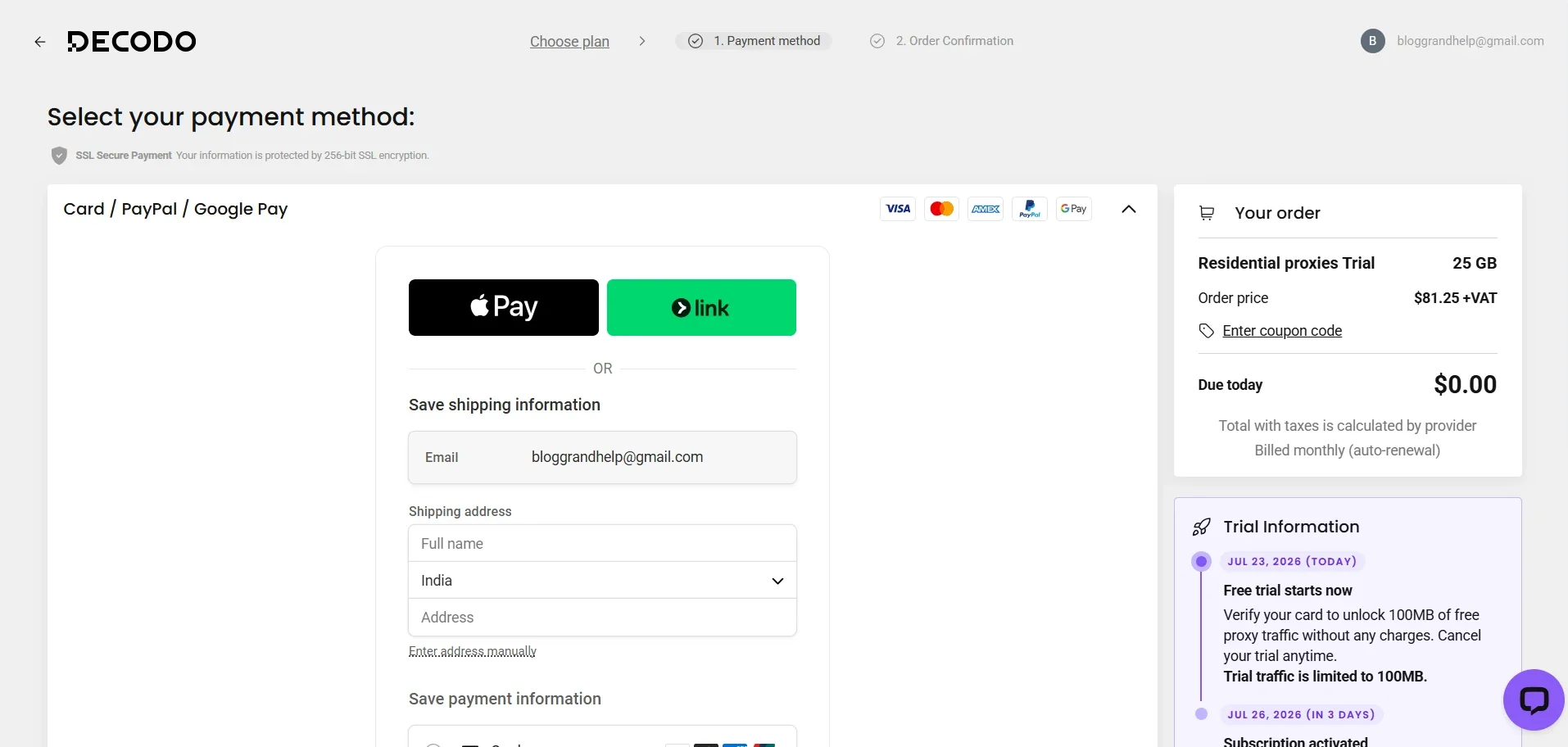
- 25 GB – $3.25/GB, $81.25 total per month (the most popular tier)
- 50 GB – $3.00/GB, $150 total per month
- 100 GB – $2.75/GB, $275 total per month
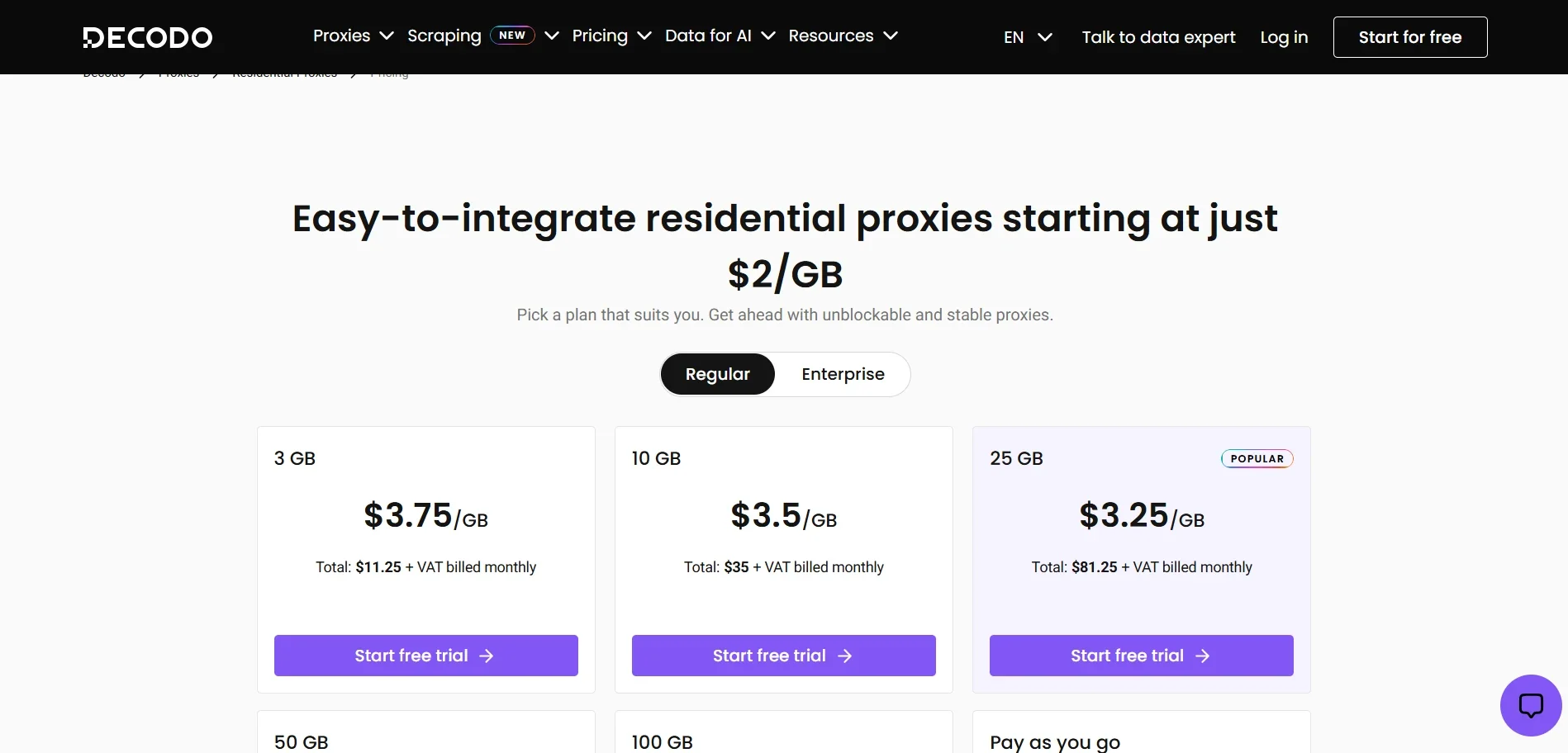
All prices are billed monthly and exclude VAT. Every tier, regardless of size, includes access to the full 115M+ IP pool, HTTP(S) and SOCKS5 protocol support, targeting down to the city, state, and ASN level, both rotating and sticky session options, sub-0.5 second average response times, and a 99.92% success rate.
Note: Decodo’s homepage advertises residential proxies “starting at just $2/GB.” That figure reflects Enterprise-tier custom volume pricing above the 100GB plan, not the lowest rate on the published Regular tier grid, which bottoms out at $2.75/GB.
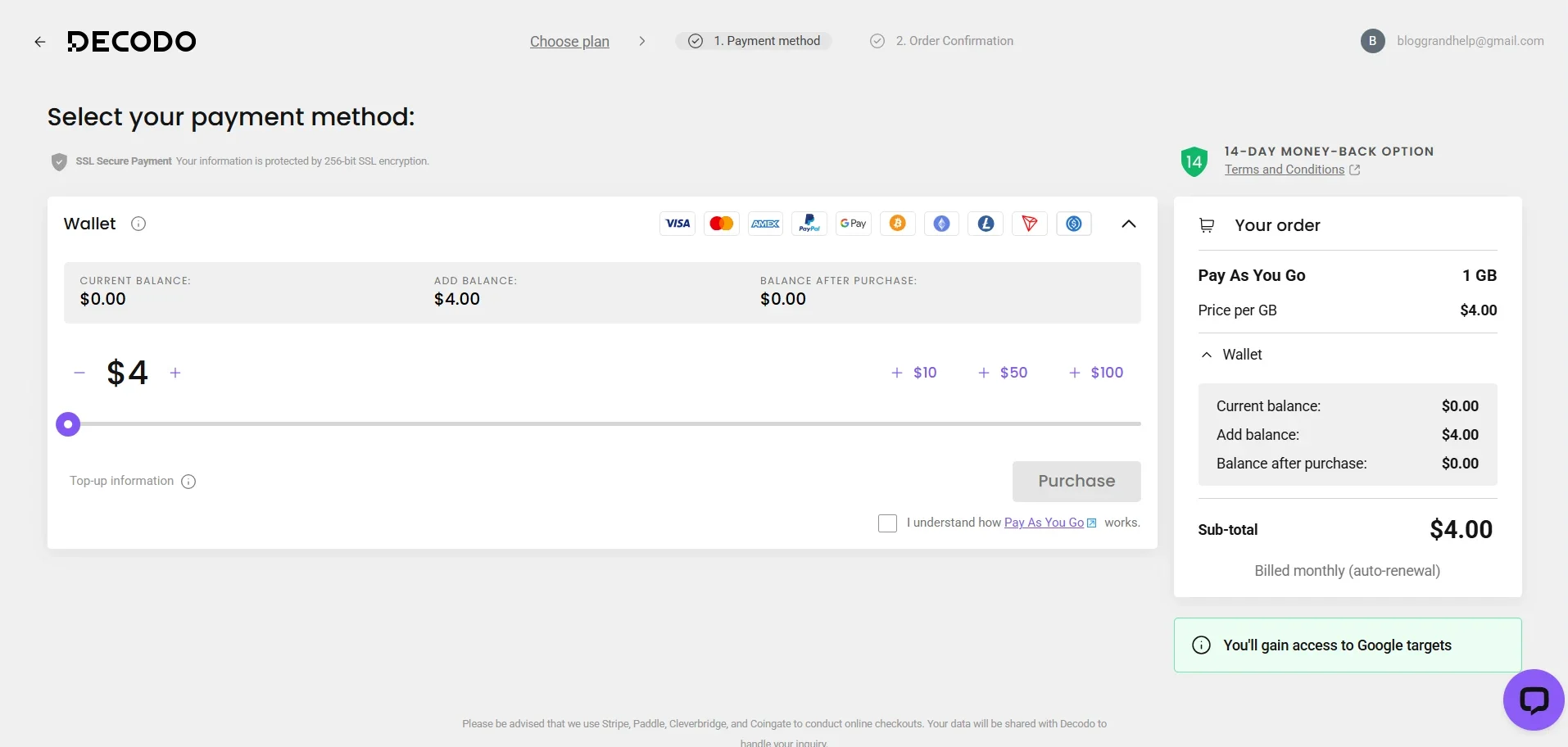
If you don’t want a recurring subscription, Decodo also offers a Pay As You Go option at $4.00 per GB, purchased through wallet credits rather than a monthly plan. This suits one-off projects better than ongoing scraping work, since the per-GB rate is noticeably higher than even the entry-level subscription tier. Note that PAYG and a monthly subscription can’t run simultaneously on the same account; you have to pick one billing mode.
For teams with heavier bandwidth needs, an Enterprise tier sits above the 100 GB plan with custom volume pricing, which requires talking to Decodo’s sales team directly rather than checking out through the standard flow.
Static Residential (ISP) Proxy Pricing
ISP proxies combine a residential-network IP with datacenter-level speed and stability, which makes them the go-to choice for tasks needing a consistent identity over time, like managing multiple eCommerce accounts or running SEO rank tracking. For a broader look at how this proxy type stacks up across providers, see our breakdown of the best static residential proxies on the market. Unlike residential proxies, ISP pricing is per-IP rather than per-GB, and Decodo splits it into three purchasing models.
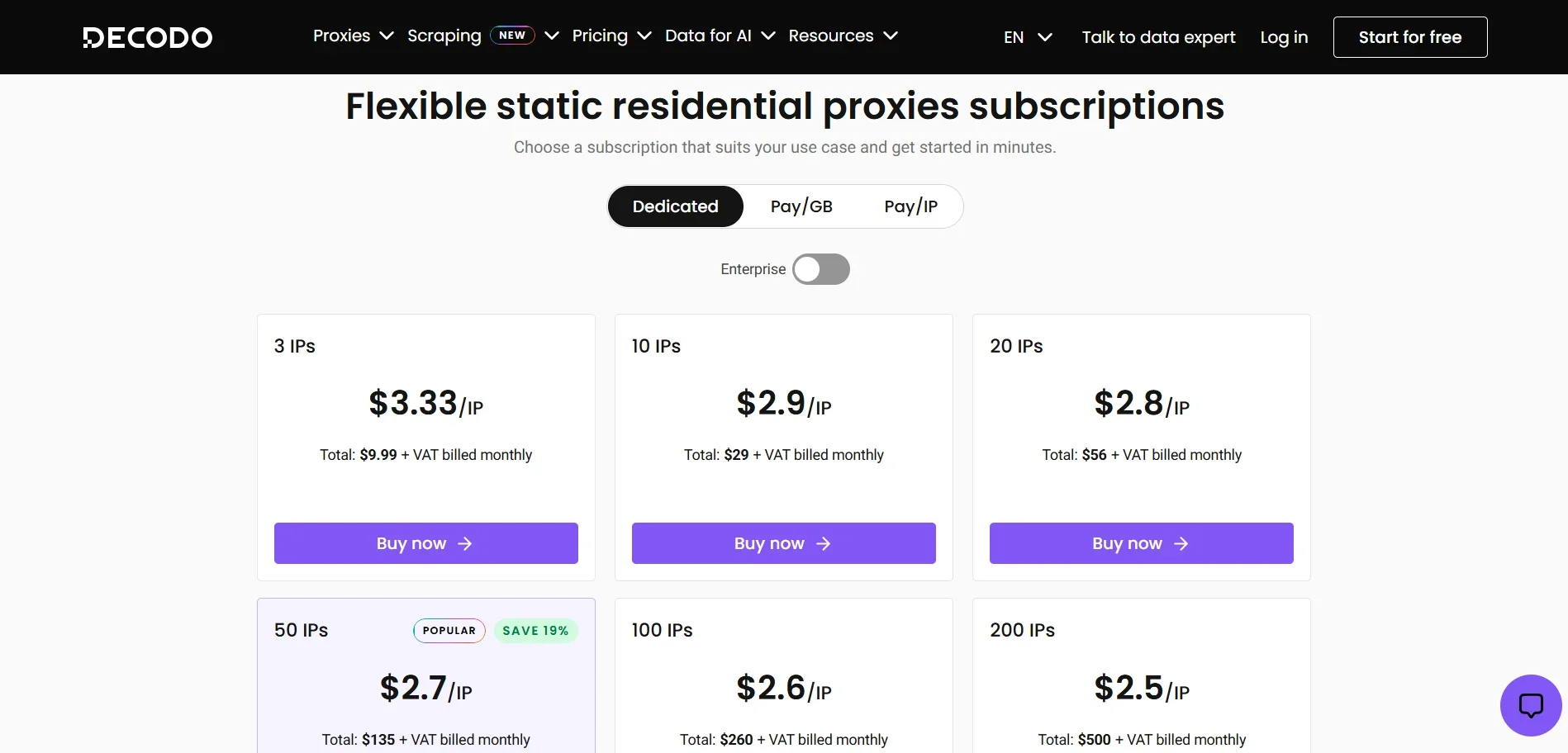
Dedicated IP plans (billed monthly, IP is yours exclusively):
- 3 IPs – $3.33/IP, $9.99 total
- 10 IPs – $2.90/IP, $29 total
- 20 IPs – $2.80/IP, $56 total
- 50 IPs – $2.70/IP, $135 total (marked as the most popular, saving roughly 19% versus the entry tier)
- 100 IPs – $2.60/IP, $260 total
- 200 IPs – $2.50/IP, $500 total
Pay-per-GB plans start from $1.30/GB and run on shared static IPs rather than dedicated ones, which suits traffic-heavy tasks like sneaker copping or continuous scraping better than a fixed IP count would.
Pay-per-IP plans start from $0.27/IP on shared infrastructure, making this the cheapest entry point into static residential proxies for anyone testing the waters before committing to a dedicated plan.
Every ISP plan comes with premium ASNs, unlimited threads and concurrent sessions, HTTP(S) and SOCKS5 support, and coverage across North America, Europe, and APAC markets including the US, UK, Germany, France, Japan, and India, though the exact country list varies slightly by plan type.
Mobile Proxy Pricing
Mobile proxies route traffic through real carrier IPs, drawn from a pool of over 10 million addresses across 160+ locations. Pricing starts from $2.25 per GB and follows the same step-down structure as residential proxies, where the per-GB rate decreases as you commit to larger monthly volumes. Mobile proxies also support a pay-as-you-go option for one-off tasks, priced separately from the residential PAYG rate. If mobile-specific pricing tiers matter for your budgeting, the mobile proxy pricing page has the current breakdown by GB tier.
Datacenter Proxy Pricing
Datacenter proxies are Decodo’s most affordable option, drawing from a pool of 500,000+ IPs across global server locations. Pricing starts from just $0.02 per IP, making this the cheapest way into the Decodo ecosystem for high-volume tasks that don’t need residential-grade trust, like general-purpose scraping or load testing where IP reputation matters less than raw throughput. If you’re comparing this option against other providers, our roundup of the best datacenter proxy providers breaks down how the category performs beyond just price.
Site Unblocker and Web Scraping API Pricing
For teams that need structured data rather than raw proxy access, Decodo runs two credit-based products priced per request instead of per GB or per IP.
Site Unblocker handles automatic proxy rotation and CAPTCHA solving for accessing protected sites, starting from $0.95 per 1,000 requests.
Web Scraping API configures scraping complexity per request and charges credits based on how demanding that request actually is, starting from $0.09 per 1,000 requests for simpler jobs. This is the most cost-efficient entry point in Decodo’s entire product line if your use case is structured data extraction rather than raw proxy traffic.
Real-World Cost Scenarios
Numbers on a pricing page are one thing; knowing what you’d actually pay for a specific job is another. Here’s how the math plays out for a few common use cases.
Scenario 1: Solo developer testing a scraping project. You need proxies for a few weeks to validate an idea before committing to anything long-term. The 3-day free trial covers initial testing, and if you need more after that, the 3 GB residential tier at $11.25/month is cheap enough to run for a single billing cycle and cancel without much financial risk.
Scenario 2: Small agency running SEO rank tracking for 15 clients. This kind of workload benefits from consistency, which points toward static residential (ISP) proxies rather than rotating residential ones. A 50 IP dedicated plan at $135/month spreads out to $9/client, which is easy to fold into a monthly retainer.
Scenario 3: eCommerce brand monitoring competitor pricing across marketplaces. This tends to be bandwidth-heavy rather than IP-count-heavy, since you’re hitting many product pages repeatedly. The 100 GB residential tier at $275/month, working out to $2.75/GB, is usually the more economical structure than trying to spread the same traffic across a smaller ISP IP allocation.
Scenario 4: One-off data pull for a research report. If you only need proxies once and don’t expect to renew, Pay As You Go at $4/GB avoids a recurring subscription altogether, even though the per-GB rate is higher than any subscription tier. For a single 5 GB pull, that’s $20 with no ongoing commitment, versus locking into a monthly plan you might not use again.
The pattern across all four scenarios: subscription tiers reward predictable, recurring usage, while Pay As You Go protects you from paying for bandwidth you won’t use again. Matching your actual usage pattern to the right billing model matters more than chasing the lowest advertised per-unit rate.
How Decodo’s Pricing Compares to the Broader Market
Proxy pricing varies wildly depending on how a provider sources its IP pool and which use cases it optimizes for, so head-to-head comparisons only go so far. That said, a few positioning points are worth knowing before you commit.
Decodo’s entry-level residential tier, at $11.25/month for 3 GB, sits toward the accessible end of the market for providers with IP pools in the 100 million-plus range. Providers with smaller pools sometimes undercut this on price but can’t match the same geographic targeting depth (down to city, state, and ASN level) that Decodo bundles into every tier without an upcharge. For a direct head-to-head against one of the larger enterprise proxy providers in this space, our comparison piece breaks down where each platform’s pricing model pulls ahead.
On the ISP proxy side, Decodo’s per-IP dedicated pricing scales down meaningfully at volume, from $3.33/IP at the 3-IP tier to $2.50/IP at 200 IPs, a discount of roughly 25% for committing to more IPs upfront. That step-down curve is fairly typical of the ISP proxy category generally, where dedicated infrastructure costs scale with the number of IPs you’re reserving.
Datacenter proxies are where Decodo’s pricing is hardest to beat industry-wide. Starting at $0.02/IP, this tier undercuts most residential-first providers who treat datacenter proxies as a secondary product rather than a core offering.
The area to watch is Pay As You Go. At $4/GB for residential proxies, this is meaningfully more expensive than the cheapest subscription tier, so treat PAYG as a convenience option for genuinely one-off needs rather than a long-term cost-saving strategy.
How Decodo’s Billing Model Actually Works
Understanding the mechanics behind these prices matters as much as the numbers themselves.
Subscriptions renew automatically. Every plan runs on a recurring monthly auto-renewal basis plus applicable VAT. You’re charged the same amount each billing cycle unless you upgrade, downgrade, or cancel before the renewal date.
Plans have hard usage caps. Each tier comes with a fixed bandwidth or IP allowance. If you’re on the Regular residential plan and burn through your GB allowance mid-cycle, you don’t get automatically bumped to a higher rate; instead, you can add supplemental credits to your current billing period to keep working without waiting for the next cycle.
Cancellations take effect at the end of the cycle. If you cancel or downgrade a subscription, whatever you’ve already paid for remains active and usable until that billing period ends, rather than cutting off access immediately.
Pay As You Go requires a funded wallet. You can’t access PAYG pricing directly at checkout; you first top up a Decodo wallet with credits, and those credits get drawn down as you consume bandwidth. One wallet credit equals one dollar.
Free Trial and Refund Policy
Decodo offers a 3-day free trial with 100 MB of residential proxy traffic for new users, accessible directly from the dashboard when selecting a residential plan. After the trial period ends, your selected paid plan activates automatically unless you cancel first, so it’s worth setting a reminder if you’re just testing the waters.
The 14-day money-back guarantee is real but comes with conditions worth reading closely before you buy a large plan:
- It applies only to your first purchase, not renewals or subsequent plan changes
- You must not have already used the 3-day free trial (the two can’t be combined)
- The refund request has to be submitted within 14 calendar days of your first transaction
- You must have used less than 20% of your plan’s traffic or results (10% for Enterprise plans)
- Your account can’t be suspended for violating the self-service subscription agreement
- You haven’t already filed a chargeback for the same charge
In practice, this means the guarantee protects light testing, not a plan you’ve already put to heavy use. Buy a 100 GB plan, burn through 25 GB confirming it works for your project, and you’re past the refund threshold.
Payment Methods
Decodo accepts credit cards, PayPal, Alipay, Google Pay, and Apple Pay across all products. Cryptocurrency is also supported, with one notable exception: it isn’t available for ISP proxies or datacenter proxies purchased under the pay-per-IP option. Orders are processed through Paddle, which acts as the merchant of record, so any billing disputes or invoice questions route through Paddle’s support rather than Decodo directly.
Is Decodo Pricing Actually Good Value?
Positioned against the broader proxy market, Decodo sits in the mid-tier bracket: not the cheapest option available, but consistently priced below premium enterprise providers while offering a comparable feature set. The entry-level residential tier under $12 a month makes it accessible for solo developers and small teams, while the tier-based discounting rewards anyone scaling into serious bandwidth usage without needing to negotiate a custom enterprise contract.
Decodo has also picked up recognition that speaks to this value positioning beyond just the sticker price. The provider has been recognized as a Best Value proxy service by Proxyway for five consecutive years, and PCMag has called Decodo’s residential proxy service an important asset for business data collection.
Where the pricing model shows its limits is on the low end of one-off usage. The $4/GB pay-as-you-go rate for residential proxies is considerably more expensive than committing to even the smallest subscription tier, so anyone expecting to use proxies more than a handful of times is generally better off starting a subscription rather than staying on PAYG indefinitely.
Who Decodo’s Pricing Structure Fits Best
Based on how the tiers are actually structured, Decodo’s pricing works best for:
- Small to mid-sized teams running regular but not massive scraping workloads, where the 10-50 GB residential tiers hit a sensible cost-per-GB without enterprise-level commitment. Budget-conscious teams can also see how this stacks up against other budget proxy options built for smaller operations.
- eCommerce and SEO operators who need static residential proxies for account management or long-term rank tracking, where the dedicated ISP tiers offer predictable per-IP costs
- Developers testing infrastructure before scaling, thanks to the low-risk 3-day trial and the ability to start on Pay As You Go without a subscription
- High-volume scrapers on a budget, where datacenter proxies starting at $0.02/IP undercut most residential-first competitors for tasks that don’t require residential-grade trust
It’s a less natural fit for anyone who needs proxies only a few times a year, since the PAYG premium erodes the cost advantage that makes Decodo’s subscription tiers attractive in the first place.
Choosing Between Residential, ISP, Mobile, and Datacenter Pricing
Since the pricing model varies by product, choosing the right one starts with matching your billing preference to your actual use case rather than just chasing the lowest price.
If your task needs a new IP on every request and you’re mainly worried about avoiding detection, residential proxies billed per GB make sense, since you’re paying for volume of rotation rather than a fixed set of addresses.
If your task needs the same IP to persist across a session, such as maintaining a logged-in account or building up trust with a platform over time, static residential (ISP) proxies billed per IP are the more cost-effective structure, since you’re not paying for bandwidth you don’t need just to keep one address alive.
If cost matters more than IP trust and your target sites aren’t aggressively blocking datacenter ranges, datacenter proxies are the cheapest way to move a lot of traffic, at a fraction of the per-unit cost of residential or ISP options.
If your workload is mobile-app-specific or targets platforms that scrutinize desktop traffic heavily, mobile proxies justify their higher per-GB rate through carrier-grade trust that residential and datacenter IPs can’t replicate.
And if you’d rather not manage proxy rotation, session handling, or CAPTCHA solving yourself at all, the Site Unblocker and Web Scraping API products fold all of that infrastructure into a single per-request price, trading a bit of flexibility for a much simpler integration.
Upgrading, Downgrading, and Changing Plans
Because every Decodo plan runs on a monthly cycle, moving between tiers doesn’t require canceling and restarting from scratch. You can upgrade mid-cycle if you’re running low on bandwidth or IPs, and the new rate applies going forward. Downgrades and cancellations take effect at the start of the next billing cycle rather than immediately, meaning you keep full access to whatever you already paid for until that period ends. This matters if you’re testing whether a smaller tier covers your needs before committing to a larger one: you can size down without losing access mid-month.
Frequently Asked Questions
How much do Decodo residential proxies cost?
Residential proxy subscriptions range from $2.75 to $3.75 per GB depending on your monthly commitment, with a $4.00/GB Pay As You Go option available for one-off use without a subscription.
Does Decodo offer a free trial?
Yes. New users get a 3-day free trial with 100 MB of residential proxy traffic. The trial converts automatically into your selected paid plan once it ends unless you cancel beforehand.
What is the cheapest way to access Decodo’s proxies?
Datacenter proxies are the most affordable entry point, starting at $0.02 per IP, followed by shared static residential (ISP) proxies at $0.27 per IP.
Can I get a refund from Decodo?
Refunds are available on first purchases within 14 days, provided you haven’t used the free trial, haven’t consumed more than 20% of your plan’s traffic (10% for Enterprise), and your account is in good standing.
Does Decodo charge VAT?
Yes. All advertised prices exclude VAT, which is added at checkout based on your billing location.
What payment methods does Decodo support?
Credit cards, PayPal, Alipay, Google Pay, Apple Pay, and cryptocurrency, though crypto isn’t accepted for ISP or datacenter pay-per-IP purchases.
Final Thoughts
Decodo’s pricing isn’t the cheapest across every single category, but it’s one of the more predictable structures in the proxy market: fixed tiers, published rates, no hidden overage penalties, and a refund policy that’s generous by industry standards even with its conditions attached. Whether residential, ISP, mobile, or datacenter proxies fit your project better comes down to how much you value IP trust versus raw cost, but the actual dollar figures above should make that comparison a lot easier to run than digging through Decodo’s navigation menu yourself.
