
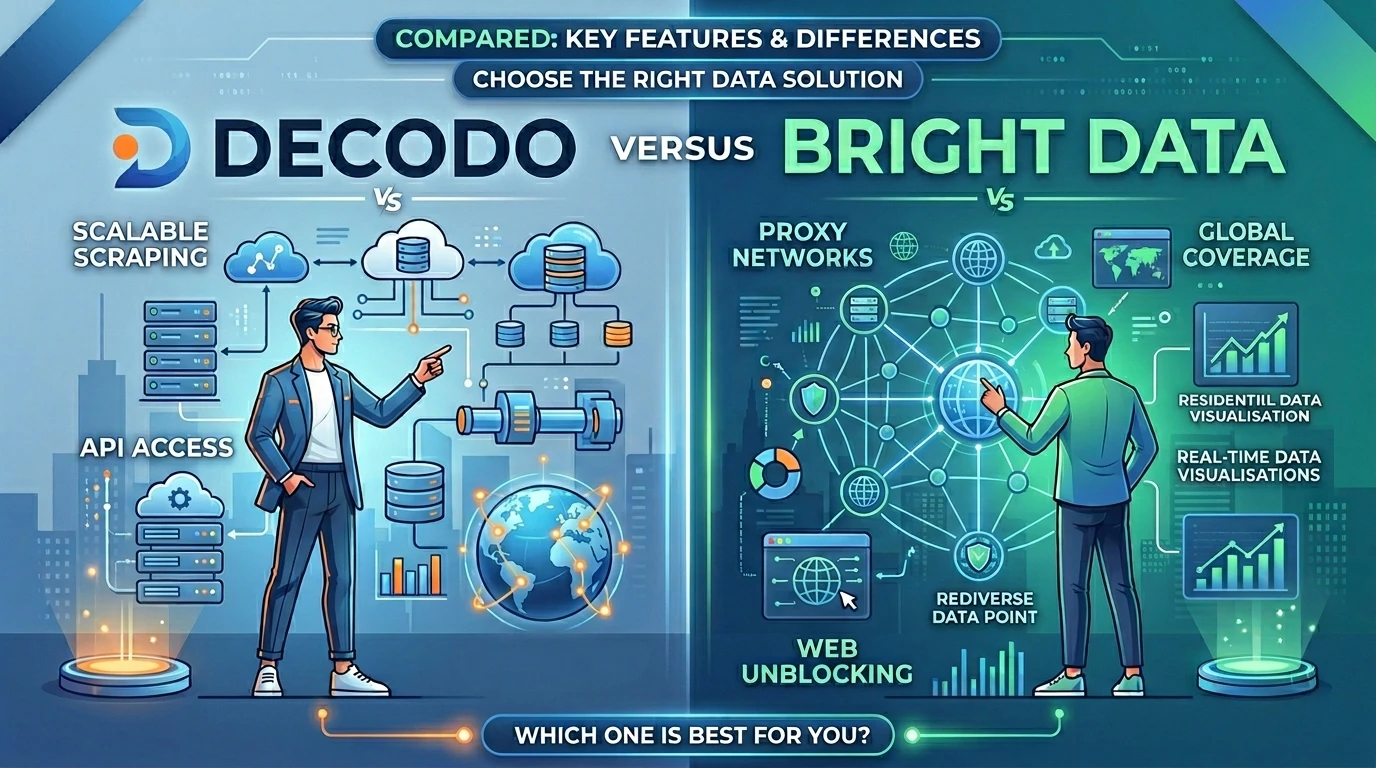
If you have spent any time researching proxy services, you have likely come across both Bright Data and Decodo. These two platforms consistently appear at the top of every comparison list, and for good reason. Both offer solid proxy infrastructure, multiple IP types, scraping capabilities, and global coverage. But they are built with different users in mind, priced differently, and deliver a noticeably different experience depending on what you are trying to accomplish.
This comparison breaks down everything that matters: proxy network size, pricing, performance, ease of use, scraping tools, compliance, support, and more. The goal is to give you an honest, detail-rich look at both platforms so you can make a confident decision for your data collection workflow.
A Quick Overview of Both Platforms
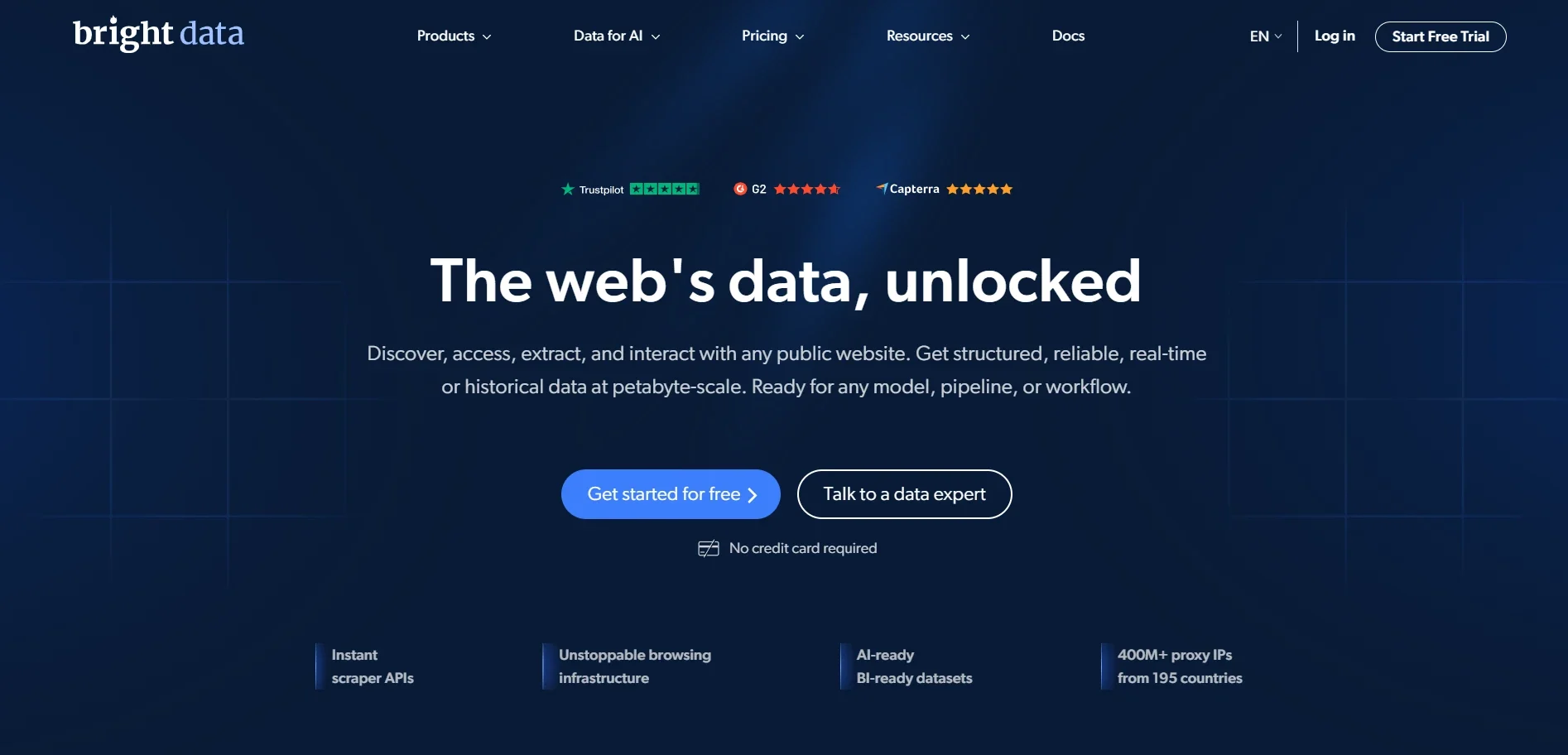
Bright Data has been in the proxy space for over a decade and is widely recognized as one of the largest proxy providers in the world. It serves more than 20,000 businesses globally, including Fortune 500 companies. The platform positions itself as a full-stack data collection solution, going beyond proxies to offer scraper APIs, a browser-based Web IDE, a dataset marketplace, and managed data services.
Decodo, which officially rebranded from Smartproxy recently, has built a strong reputation as a reliable, cost-effective proxy provider that does not compromise on performance. The rebrand was not just cosmetic. It introduced expanded AI integrations, new scraping products, and ISO/IEC 27001:2022 certification across proxies and scraping APIs. With over 135,000 clients and multiple industry awards to its name, Decodo has carved out a distinct identity in the market.
Both platforms offer residential proxies, datacenter proxies, ISP proxies, and scraping APIs. The question is not which one works, but which one works better for your specific use case, team size, and budget.
Proxy Network Size and Geographic Coverage
Network size matters because a larger pool of IPs translates to fewer blocks, lower detection rates, and more targeting flexibility. This is one area where both providers are genuinely strong, though they sit at different scales.
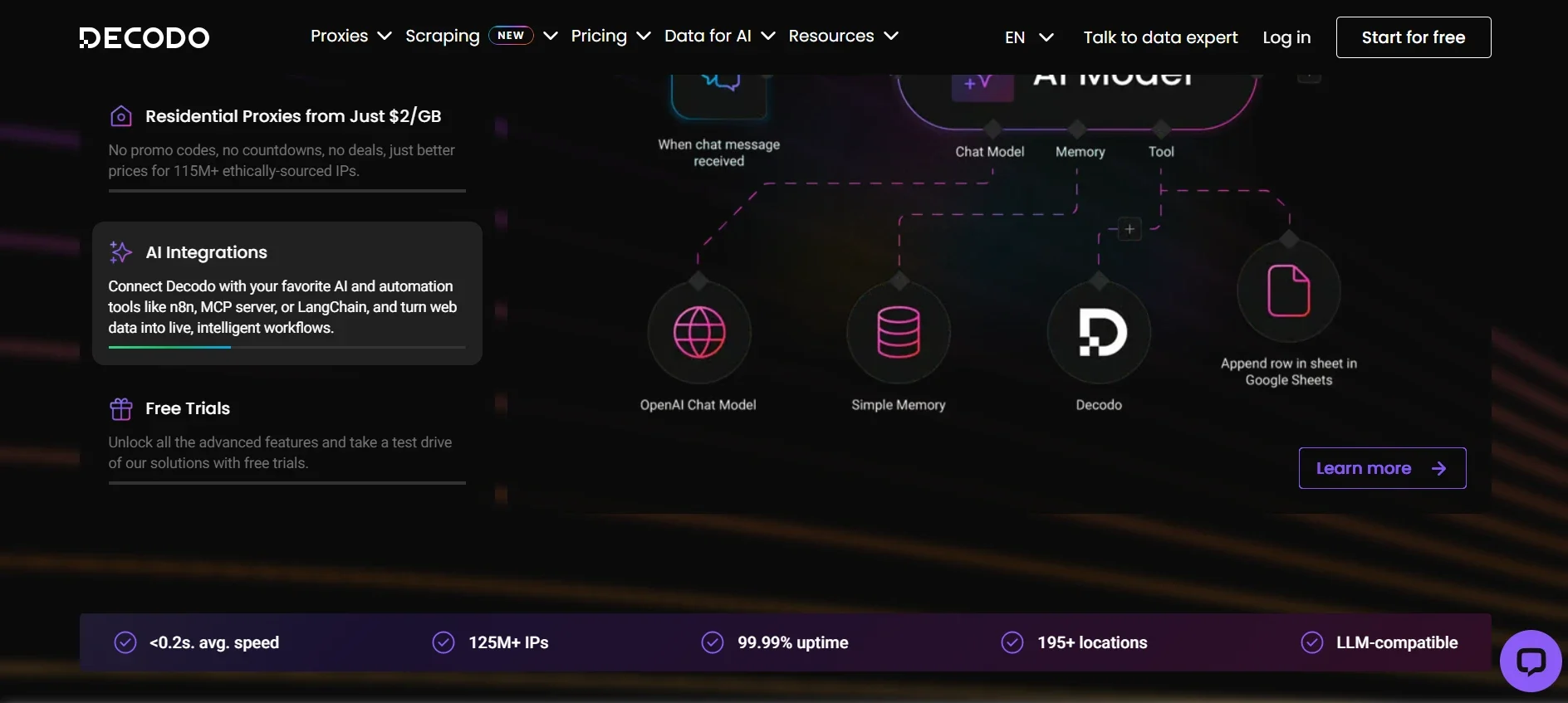
Bright Data operates the world’s largest residential proxy network with over 400 million IPs. It also maintains 1.3 million datacenter IPs, 1.3 million ISP IPs, and over 7 million mobile IPs across 195 countries. Its network covers every country, city, ZIP code, carrier, and ASN level. For enterprise operations that require extremely deep targeting precision and never want to run out of IP options, the sheer size of Bright Data’s network is undeniable.
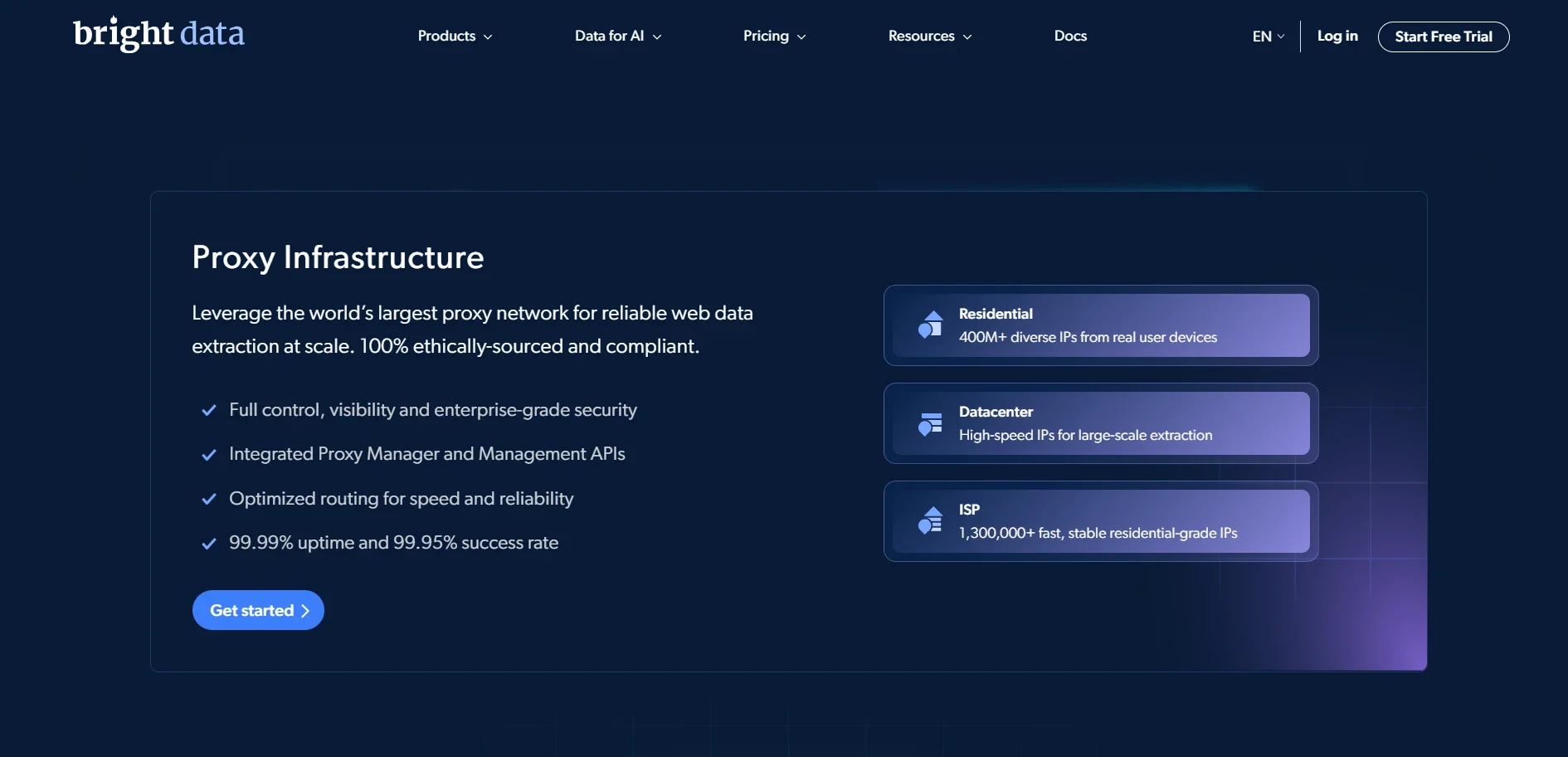
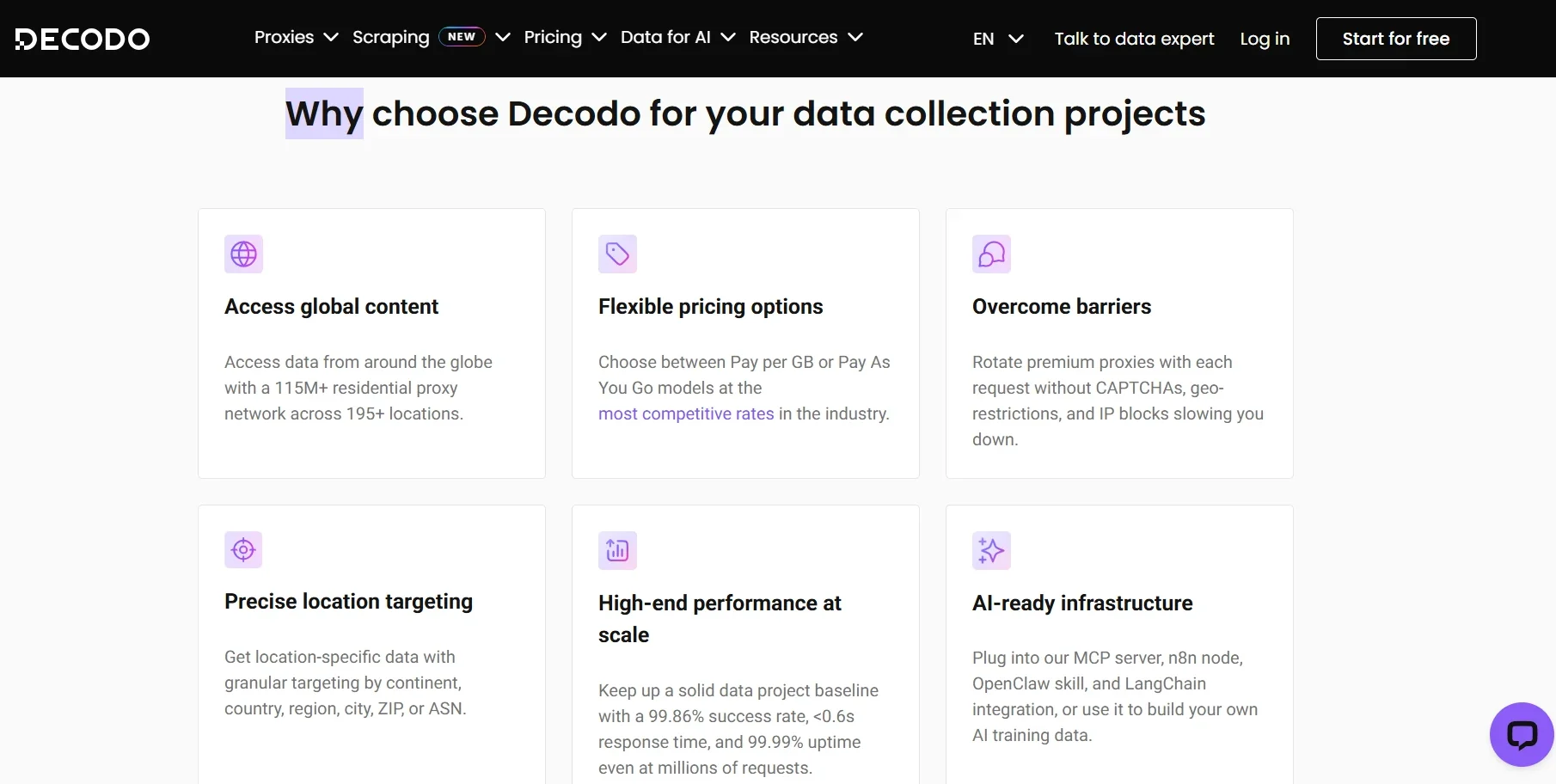
Decodo offers 115 million residential IPs across 195 plus locations, 500,000 plus datacenter IPs, 10 million plus mobile IPs, and ISP proxies available at highly competitive per-IP pricing. Coverage extends to continent, country, region, city, ZIP, and ASN level targeting. While numerically smaller than Bright Data’s pool, 115 million residential IPs is a substantial network that serves the vast majority of use cases without issue.
It is worth noting that raw numbers tell only part of the story. Independent third-party testing shows Decodo achieving a 99.86% success rate compared to Bright Data’s 98.96%. Decodo also delivered a faster average response time of 0.63 seconds versus Bright Data’s 1.12 seconds. In other words, Decodo’s smaller pool outperformed Bright Data’s larger one in two of the most critical real-world metrics.
Proxy Types: What Each Platform Offers
Both platforms cover the core proxy types that most users need, but they differ slightly in scope and positioning.
Bright Data offers residential proxies, ISP proxies with 1.3 million plus static residential IPs, datacenter proxies, and mobile proxies. Each proxy type can be configured for rotating or sticky sessions, and the platform allows zone-level customization for enterprise users who need granular control over how traffic is managed.
Decodo covers the same core categories: residential proxies, static residential ISP proxies, mobile proxies, datacenter proxies, and a Site Unblocker product built to handle heavy anti-bot defenses. Decodo’s ISP proxies start at just $0.27 per IP, and datacenter proxies start at $0.02 per IP, making both options accessible to smaller teams and individual developers who need static or high-speed options without a large budget commitment.
The Site Unblocker is worth calling out specifically. It combines automatic proxy rotation with CAPTCHA handling to give users access to even the most protected websites. This is Decodo’s answer to heavily defended targets, and it starts at $0.95 per 1,000 requests, which is a transparent and predictable pricing model.
Pricing: Where the Two Platforms Diverge Most
Pricing is one of the biggest differentiators between Bright Data and Decodo, and it has a direct impact on which platform makes sense for different team sizes and budgets.
Bright Data’s residential proxy pricing starts at $8 per GB on a pay-as-you-go basis, though promotional pricing can bring this down significantly. Their 141 GB monthly plan runs $499 per month, while a 332 GB plan is $999 per month. The 798 GB enterprise plan costs $1,999 per month. These are the base prices before promotional codes, which Bright Data frequently offers. ISP proxies start at $1.80 per IP for a minimum of 10 IPs billed monthly. Datacenter proxies start at $1.40 per IP.
Decodo’s residential proxies start at $2 per GB with pay-as-you-go, and the platform offers a current promotional rate of $1.50 per GB for larger commitments. ISP proxies from Decodo start at just $0.27 per IP. Datacenter proxies are available from $0.02 per IP. The scraping API starts at $0.08 to $0.09 per 1,000 requests, which is among the lowest in the industry.
For teams that are price-sensitive or scaling gradually, Decodo’s pricing structure is significantly easier to work with. There are no steep minimum commitments for mid-tier plans, and the per-unit costs across all proxy types are meaningfully lower. Industry benchmarks consistently recognize Decodo for matching the performance and feature sets of enterprise-tier providers like Bright Data while maintaining entry pricing designed for flexible scaling.
Bright Data’s pricing is justified when you need the full feature stack, Fortune 500 grade infrastructure, and officially maintained APIs with guaranteed uptime SLAs. For users who only need proxies or basic scraping, the cost difference is hard to ignore.
Onboarding and Ease of Use
Getting started quickly is a priority for most users, whether you are a solo developer testing a new scraping project or a team lead onboarding a new data pipeline. This is an area where the two platforms take meaningfully different approaches.
Decodo is built for self-service from the moment you land on the signup page. New users can register, select a plan, and receive proxy credentials in minutes. The dashboard is clean and organized with core tabs for proxies, traffic, and billing positioned front and center. Session types, geo targets, and rotation settings are accessible without navigating deep into sub-menus. The quick start guides include ready-made code snippets for common frameworks, meaning you can drop working code into your project without searching through documentation.
The onboarding difference between the two platforms also shows up at the account level. Decodo offers instant self-service access, while Bright Data requires a KYC verification process before users can even begin configuration. For legitimate enterprise users this is manageable, but for developers who want to test the product quickly, the extra friction is a real barrier.
Bright Data’s dashboard is feature-rich but reflects its complexity. Creating zones, setting budgets, managing peer controls, and navigating the analytics panels requires more time investment upfront. For teams running enterprise-grade operations with dedicated account managers, this complexity is worth mastering. For individual users or smaller teams, the learning curve is steeper than necessary.
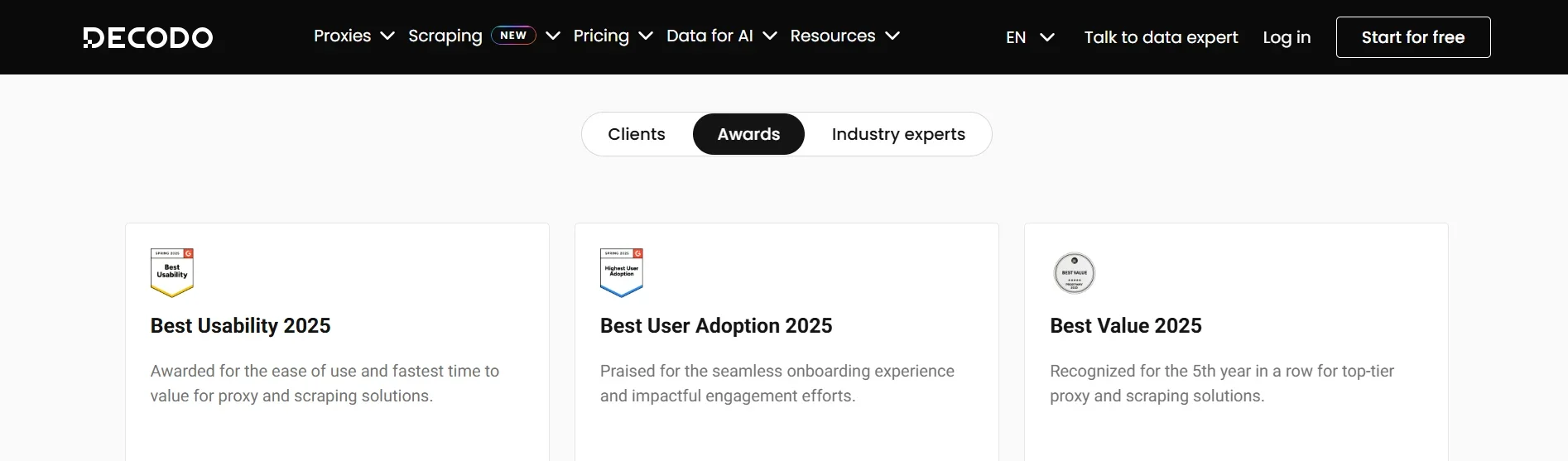
The difference in daily use has been independently recognized through multiple industry awards, with Decodo receiving the Best Usability award for its ease of use and fastest time to value among proxy and scraping solutions.
Scraping Tools and API Capabilities
Both Bright Data and Decodo have moved beyond pure proxy infrastructure to offer scraping tools, but their approaches and depth differ considerably.
Bright Data’s scraping ecosystem is extensive. It maintains 600 plus scraper APIs for specific websites and data sources, a browser-based Web IDE where developers can build, test, and deploy scrapers with AI assistance, and a dataset marketplace where pre-collected data from over 250 domains is available for purchase. For enterprises that want ready-made data without building pipelines, the dataset marketplace is a genuine differentiator. The Web IDE goes further than anything Decodo currently offers in terms of a development environment. Bright Data also supports NDJSON, CSV, Excel, and direct database integrations with MySQL, PostgreSQL, and MongoDB.
Decodo’s scraping suite centers on its All-In-One Scraping API, which covers eCommerce, SERP, social media, and general web scraping from a single unified interface. The Core Scraping API starts at $0.08 per 1,000 requests, and the Advanced Scraping API at $0.95 per 1,000 requests adds headless browser technology, structured data output, markdown support, and automated scheduling. The AI Parser is a notable feature that takes raw HTML and converts it to clean, structured JSON automatically with no coding required. This makes Decodo’s scraping tools genuinely accessible to non-developers.
Decodo also offers scraping templates for popular websites so users can launch pre-built scrapers with a few clicks, and a Video Downloader product for large-scale YouTube content collection at $0.08 per GB.
For AI-specific workflows, Decodo has built native integrations with n8n for workflow automation, LangChain for AI data pipelines, a Model Context Protocol server for connecting LLMs to live web data, and OpenClaw. These integrations position Decodo well for teams building agentic AI systems that need real-time web data. Bright Data has its own MCP server and agent browser, but Decodo’s native integration with n8n and LangChain out of the box is particularly developer-friendly.
Dashboard Navigation and Daily Workflow
The way you interact with a proxy dashboard every day matters more than most comparison articles acknowledge. Efficiency adds up over time, especially for teams managing multiple projects with different geo targets, session types, and bandwidth requirements.
Decodo’s dashboard was designed with daily use in mind. Core functionality is visible without drilling into sub-pages. Residential pool options, sticky session toggles, and city and state targeting for 195 plus locations are easy to find. Usage stats and traffic data load without requiring navigation through nested menu structures. For teams rotating between proxy types or frequently adjusting geographic targets, the reduced friction is a real productivity benefit.
Bright Data’s dashboard offers more granular controls, which is appropriate for its enterprise positioning. Zone management, peer controls, and deep analytics are all accessible, but the density of options can be overwhelming for new users. Teams with dedicated engineers who manage the platform full-time will find the depth useful. Smaller teams or developers working independently often find themselves spending more time configuring settings than running actual tasks.
Both dashboards allow sub-user management and access controls, which is essential for teams that need to segment usage by project or department.
Free Tools and Additional Features
Free tools add real value when they are genuinely useful rather than marketing add-ons. Both platforms include some extras, but Decodo’s free toolkit stands out for breadth and practicality.
Decodo includes a Chrome Proxy Extension that brings essential proxy controls directly into the browser, a Firefox Add-on, and a Proxy Checker tool that tests proxy lists to catch errors before they affect live projects. The X Browser for multi-account management is available as an additional free tool for users who need to manage multiple browser sessions across different IP identities.
Bright Data offers a browser extension and a Proxy Manager, which is a local application for advanced configuration and rule-based IP management. The Proxy Manager is powerful for developers who want to run custom rotation logic, whitelist rules, and debug proxy traffic locally. It is oriented toward technical users who need deeper control.
Decodo’s free tools lean toward accessibility, while Bright Data’s lean toward technical depth. If you are managing a team where not everyone is a developer, Decodo’s tools are easier to distribute and use without extensive onboarding.
Performance and Reliability
Success rate and response time are the two most important performance metrics for any proxy service. As already noted, independent third-party benchmarks place Decodo at a 99.86% success rate and 0.63 seconds average response time, while Bright Data comes in at 98.96% success rate and 1.12 seconds average response time.
Both platforms advertise 99.99% network uptime, and both have the infrastructure to back that claim at scale. Bright Data handles 650 terabytes of public data collected every day across its customer base. Decodo handles enterprise-grade request volumes with the same uptime SLA commitment.
The response time difference of roughly 0.49 seconds per request may seem minor in isolation, but at millions of requests it translates to meaningful time and resource savings. For latency-sensitive workflows like real-time price monitoring, ad verification, or SERP tracking where data freshness is critical, Decodo’s faster response time is a genuine operational advantage.
Compliance and Security Certifications
Compliance is non-negotiable for teams operating in regulated industries or handling sensitive data pipelines. Both platforms take compliance seriously, but their certification footprints differ.
Bright Data holds ISO 27001:2022, ISO 27017 and 27018 cloud security certifications, GDPR compliance, CSA STAR Level 1, and SOC 2 Type II certification. For enterprises in finance, healthcare, or government sectors where third-party vendors must meet specific compliance standards, Bright Data’s certification stack is comprehensive. The platform also provides full audit trails and data processing agreements for enterprise contracts.
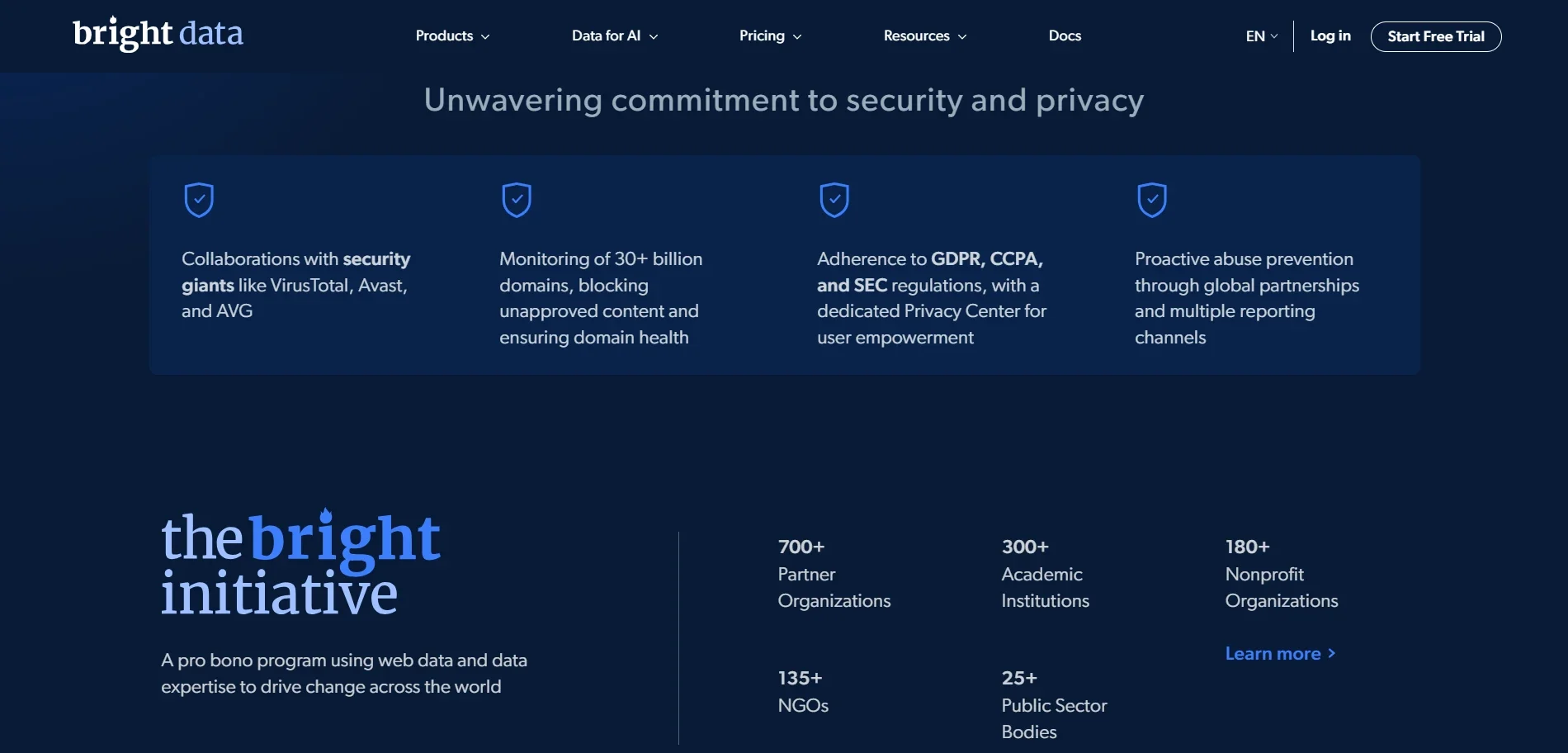
Decodo holds ISO/IEC 27001:2022 certification across both proxy and Scraping API products, EWDCI certification, and GDPR compliance. The ISO 27001:2022 certification was added following the rebrand and represents a significant step up in formal security posture. Decodo also follows an ethical IP sourcing policy and conducts KYC checks to prevent fraudulent account use.
For most businesses, Decodo’s compliance coverage is fully sufficient. The difference becomes relevant primarily for highly regulated enterprise sectors where CSA STAR or SOC 2 Type II documentation is a hard requirement in vendor procurement processes.
Customer Support
Support quality shapes the experience in ways that specifications cannot fully capture. Both platforms offer 24/7 support, but the experience and accessibility differ.
Decodo provides 24/7 technical support via LiveChat, an extensive Knowledge Hub with documentation and guides, and a Discord community of developers and scraping professionals. Support is available to all users regardless of plan tier. This is a meaningful distinction because many enterprise-focused platforms restrict premium support access to higher-tier customers. Community access through Discord also provides peer-to-peer troubleshooting and workflow tips that go beyond what documentation alone can offer.
Bright Data provides 24/7 support via email, with dedicated account managers assigned to enterprise customers. Larger clients get more personalized attention, but smaller users on lower tiers may find support less immediately accessible. Bright Data’s online documentation is comprehensive and covers integrations with Scrapy, Puppeteer, Selenium, Playwright, and BeautifulSoup in detail.
Decodo’s support model is more egalitarian: every customer gets the same access to live chat and community resources from day one. For teams that do not have dedicated data engineers and need responsive help across time zones, Decodo’s always-on LiveChat model is practically superior.
Free Trials and Getting Started
Both platforms offer ways to test the product before committing to a paid plan, though the structure differs.
Decodo offers a 3-day free trial with 100MB for residential proxies available to all new users. There is no credit card required to start, and the platform also offers a 14-day money-back option, giving users a generous window to evaluate the service against real workloads.
Bright Data offers a free trial on all products with no credit card required, structured as a 7-day trial but oriented primarily toward business customers. The KYC verification process applies during signup, which adds time before you can begin testing.
For developers and teams who want to start testing within minutes rather than days, Decodo’s instant self-service signup and no-friction trial access is a clear practical advantage.
Who Each Platform Is Best For
After comparing the two platforms across every major dimension, the user fit becomes clear.
Bright Data is the right choice when your organization runs Fortune 500-level data operations, requires SOC 2 Type II or CSA STAR compliance documentation for vendor approval, needs ready-made datasets from the marketplace without building pipelines, or wants a browser-based IDE for building and maintaining scrapers at scale. It is also the stronger choice when raw IP pool size is a hard requirement and your team has dedicated engineers to manage the platform’s complexity.
Decodo is the right choice for the vast majority of users: development teams, growing businesses, individual practitioners, and startups who need enterprise-grade performance without the enterprise price tag or enterprise-level procurement process. If faster response times, lower per-GB costs, instant onboarding, AI-ready integrations, and award-winning ease of use matter to your workflow, Decodo delivers on all of those fronts.
Final Verdict: Decodo Wins for Most Use Cases
Both Bright Data and Decodo are legitimate, high-quality proxy services that earn their place at the top of the market. Bright Data’s network scale, dataset marketplace, and comprehensive certification stack make it a defensible choice for large enterprises with complex requirements and established procurement processes.
But for the broader market, Decodo is the stronger overall pick right now and for the foreseeable future. Here is why it comes out ahead when you weigh the full picture.
Decodo outperforms Bright Data on the metrics that matter most in practice. Independent third-party benchmarks confirmed a 99.86% success rate and 0.63 second average response time for Decodo compared to 98.96% and 1.12 seconds for Bright Data. Faster and more reliable by the numbers that matter most.
Decodo’s pricing is genuinely accessible. With residential proxies from $1.50 per GB, ISP proxies from $0.27 per IP, and datacenter proxies from $0.02 per IP, Decodo is priced to scale with teams of any size. Bright Data’s costs are significantly higher and are harder to justify when performance metrics favor Decodo.
The onboarding experience is frictionless. Sign up, pick a plan, copy credentials, and go. No KYC gates, no waiting, no configuration overhead. The dashboard is clean, intuitive, and built for daily use by people who have other priorities beyond managing proxy zones.
The AI-ready integration stack with native MCP server, LangChain loader, n8n node, and OpenClaw support positions Decodo well for the direction the industry is moving. Data pipelines increasingly feed AI systems, and Decodo has built natively for that reality.
Multiple independent usability and user adoption awards, combined with Best Value Provider recognition for the fifth consecutive year, reflect what real users consistently report: Decodo delivers top-tier performance with a user experience that respects your time.
Unless your use case specifically requires Bright Data’s exclusive features such as SOC 2 Type II compliance, the dataset marketplace, or the browser-based Web IDE, Decodo gives you everything you need and more at a price point that makes sustainable scaling possible. For most data teams, developers, and growing businesses, Decodo is the smarter starting point and the harder platform to outgrow.
