

Short on time? Decodo and Webshare are our top picks for the best Telegram proxies, offering the strongest mix of speed, uptime, and pricing among the providers we tested.
Telegram has grown into one of the world’s largest messaging platforms, and its size is exactly why some governments try to restrict it. Iran, Russia, and Iraq have all blocked or throttled Telegram at various points, which pushed millions of users toward proxies just to keep the app working.
A good Telegram proxy does more than unblock the app. It also lets you scrape public data, manage several Telegram accounts from one device, and keep your real IP address out of the picture. The problem is that most proxy services fall short somewhere: shaky uptime, weak encryption, or IP pools too small to survive a ban wave.
We evaluated each provider below on compatibility, security protocols, geographic coverage, uptime, integrations, support quality, connection speed, and the overall size of the IP pool.
How We Ranked These Telegram Proxy Providers
Every figure in this guide (IP pool size, country coverage, uptime) was checked directly against the provider’s own product pages rather than pulled from older roundups. Proxy networks grow and shrink constantly, so a number that was accurate a year ago is often stale today. Where a provider publishes a specific stat, we used it; where they only give a range, we noted that too.
Best Telegram Proxies
1) Decodo
Decodo (formerly Smartproxy) runs residential, mobile, dedicated, and datacenter proxies with coverage across the United States, India, Germany, the United Kingdom, Canada, and Japan, among many other locations.
Setup is fast because Decodo’s proxies plug directly into third-party tools and its own scraping APIs, and the network draws from real mobile and desktop devices rather than server farms. The connection limits are generous enough that even heavy automation workflows and data-intensive scraping jobs run without throttling.
Decodo’s datacenter network adds hundreds of subnets and unlimited targets on top of that, and the provider’s own site lists more than 125 million IPs across 195-plus locations, which gives it one of the largest footprints in the proxy market.
For AI training data, SEO tracking, and large-scale scraping, that scale matters. More available IPs mean fewer repeated addresses per session, so CAPTCHA walls and geo-blocks are easier to route around without interrupting a running job.
Pros
- Strong session control for scraping, with fast response times
- Central dashboard for traffic and request monitoring
- Responsive customer support and clear documentation
- Ethically sourced network with transparent operating practices
- High connection limits for automation-heavy use cases
Cons
- Free trial window is short
Read our full Decodo review for pricing tiers and performance benchmarks.
2) Webshare
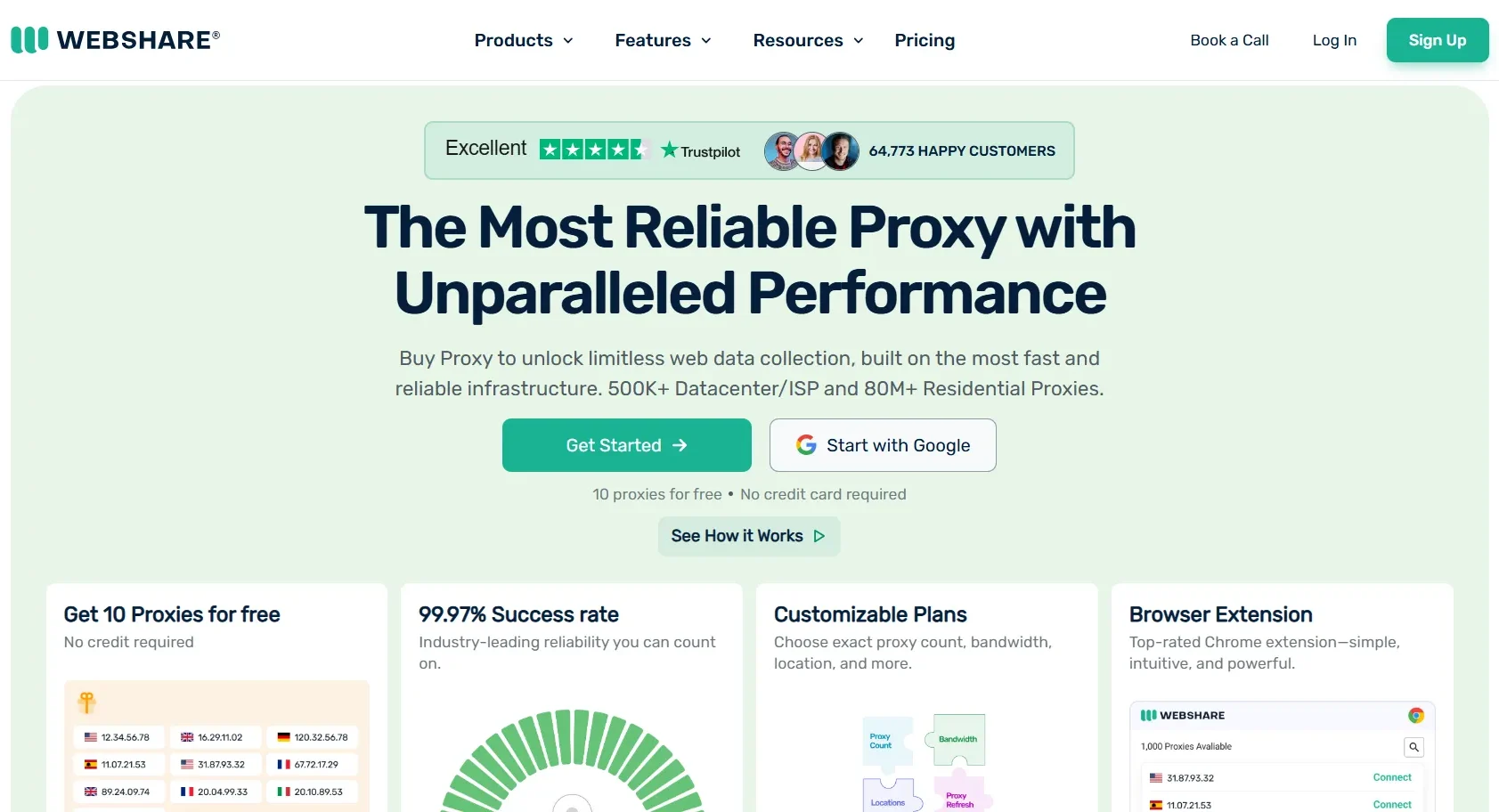
Webshare has built its reputation on being the budget-friendly option that still performs like a premium one. The network covers more than 80 million IPs across 195 countries, and it’s built specifically to get around CAPTCHA walls, geo-restrictions, and IP bans during large-scale data collection.
Its datacenter tier includes over 400,000 high-speed IPs with a 99.97% uptime rating, which holds up well for price monitoring, SEO rank tracking, and other scraping jobs that need consistency more than raw anonymity. For jobs that need a higher trust signal, Webshare also offers static residential IPs sourced from major ISPs, which work well for account management, automation, and running a stable Telegram proxy connection.
Webshare recently rolled out city-level targeting on its residential plans, letting you narrow proxy selection down to a specific metro area instead of just a country. Combined with flexible plans that let you pick exact proxy counts, bandwidth, and locations, it scales cleanly from a solo project to a small team’s workload. A browser extension makes day-to-day management approachable even without technical setup experience.
Pros
- 99.97% uptime across the datacenter network
- Large, well-distributed global IP pool
- City-level targeting on residential plans
- Budget-friendly pricing without a steep learning curve
- Dashboard built for tracking proxy usage in real time
Cons
- Pay-as-you-go billing can add up at high volume
3) Bright Data

Bright Data is the largest proxy and web data platform on the market, and it serves everyone from enterprise data teams to social media marketing agencies and web scraping businesses.
The provider’s own network page lists more than 400 million monthly residential IPs across 195 countries, alongside dedicated ISP and datacenter pools. That scale is why Bright Data shows up so often in enterprise procurement conversations. Free geo-targeting down to the city, state, ZIP code, and ASN level is included, which is useful for anything that depends on precise location, including Telegram-adjacent profile work.
Pros
- Centralized dashboard for IP and traffic management
- Simple proxy manager interface for adjusting Telegram proxy settings
- One of the largest, most geographically complete IP networks available
- Extensive geo-targeting granularity down to city and ASN level
Cons
- Pricing sits well above budget-tier competitors
Read our full Bright Data review before committing to a plan.
4) Soax
Soax gives you a genuinely global pool to work with, drawing from more than 155 million IPs across 195-plus countries per its own product page, which is enough depth to route around most geo-restrictions Telegram runs into. The dashboard is built for managing rotating residential IPs without needing to touch a command line.
Built-in scraping tools mean you can pull data from Telegram at scale while the rotation logic handles IP and CAPTCHA bans in the background. Soax supports both SOCKS5 and HTTPS, and its IPv4 and IPv6 proxies can run static or rotating depending on the task.
Pros
- Built-in rotation technology tuned for consistent performance
- Full documentation and support coverage
- ISP and city-level geo-targeting
- No hard cap on proxy requests per server
Cons
- Live chat is the only technical support channel
- No dedicated browser extension or app
5) ProxyEmpire
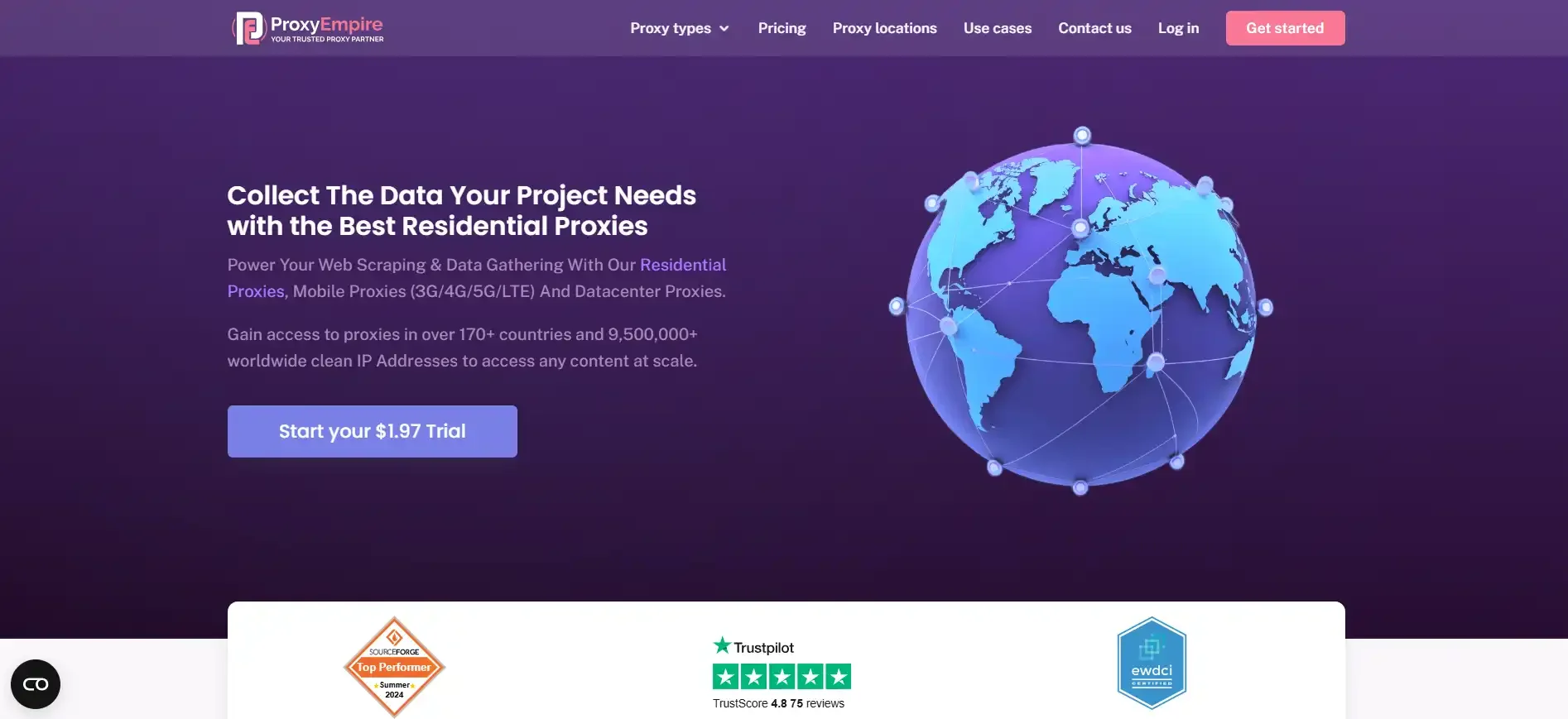
ProxyEmpire’s current network runs more than 30 million residential IPs across 170-plus countries, based on the provider’s own published figures, with granular targeting down to the country, region, city, and ISP level.
Where ProxyEmpire stands apart is its rollover data policy: unused bandwidth carries into the next billing cycle instead of expiring, which matters if your Telegram automation workload swings month to month. Mobile proxies pull from real carrier networks including Verizon, T-Mobile, and AT&T, covering 3G, 4G, and 5G connections, and every proxy type works with Telegram out of the box.
The dashboard is genuinely easy to navigate, and adding bandwidth or new packages takes a couple of clicks rather than a support ticket.
Pros
- Live coverage across a wide country list
- Unused bandwidth rolls over instead of expiring
- Legitimate ISP and carrier sourcing
- Supports both IP whitelisting and username/password authentication
Cons
- Bandwidth limits apply on every package
- No free trial
Also, Read:
- What are Shared Proxies?
- What Are Social Media Proxies?
- Best Residential Proxies
- Best Datacenter Proxies
- Best Twitter Proxies
Quick Comparison
| Provider | IP Pool | Countries | Best For |
|---|---|---|---|
| Decodo | 125M+ | 195+ | Overall performance and scraping APIs |
| Webshare | 80M+ | 195 | Budget-friendly with city-level targeting |
| Bright Data | 400M+ monthly | 195 | Enterprise scale and precise geo-targeting |
| Soax | 155M+ | 195+ | Deep ISP and city-level filtering |
| ProxyEmpire | 30M+ | 170+ | Rollover bandwidth and mobile carrier IPs |
Why Use a Telegram Proxy?
Every site and app you connect to can see your IP address, and that address maps back to your general location. A Telegram proxy sits between your device and the app, so Telegram sees the proxy’s IP instead of yours.
That matters for a few reasons beyond just unblocking a censored app. Online activity tracking has gotten more aggressive over the past few years, and a lot of that tracking starts with your IP address. Shopping sites, ad networks, and social platforms all use it to build a profile of your behavior, whether or not you’re logged in. Routing Telegram traffic through a proxy keeps that address out of the equation.
It also matters operationally. Anyone managing multiple Telegram accounts on one device risks getting flagged or banned if every account shares the same IP. Spreading accounts across different proxy IPs is the standard fix.
How to Choose the Best Telegram Proxy
A few things separate a reliable Telegram proxy from one that will cause problems mid-session:
- Protocol support. Look for HTTPS and SOCKS5 compatibility at minimum. These handle encryption properly and are what most Telegram proxy setups expect.
- Server location. A proxy server closer to Telegram’s own infrastructure will generally load faster and hit fewer delays during scraping or heavy messaging use.
- Paid over free. Free proxy lists are usually overloaded, poorly maintained, and a real risk to your data. The security tradeoff isn’t worth what you save.
- Pool size and geographic spread. A wider IP pool means you have somewhere to go if your current exit node gets flagged or blocked.
Frequently Asked Questions
What are the benefits of using a Telegram proxy?
A Telegram proxy improves your effective connection speed for the app, supports data scraping, and helps automate account management. It masks your real IP address, lets you rotate across multiple addresses while browsing, and helps you get around network-level bans. For anyone running several Telegram accounts on one device, a proxy with API-friendly integrations makes multi-account management far more manageable.
How do you choose the best Telegram proxy?
Prioritize HTTPS and SOCKS5 support for security, pick a server location close to Telegram’s own infrastructure for speed, and skip free proxy services entirely since they carry real privacy and security risk. Also confirm the provider has a large enough global pool that you have backup IPs if your primary one gets blocked.
Are Telegram proxies safe to use?
Yes, when you use a reputable paid provider. Telegram’s own encryption combined with a proxy from a legitimate service keeps your messages and personal information private. The main risk comes from free or unvetted proxy sources, not from the concept of proxying itself.
Do Telegram proxies work in countries where Telegram is blocked?
Yes. That’s one of their primary use cases. A proxy with servers outside the restricted region lets you route around the block and reach Telegram’s servers normally, which is why usage spikes in countries like Iran and Russia whenever restrictions tighten.
Conclusion
All five providers above can get you a working Telegram proxy connection, but they land in different spots depending on what you’re optimizing for. Decodo and Webshare offer the best overall balance of performance, coverage, and price for most Telegram use cases, which is why they top this list. Bright Data is worth the premium if you’re operating at enterprise scale and need the largest possible IP pool with granular targeting. Soax and ProxyEmpire are strong picks if ISP-level filtering or rollover bandwidth matter more to your workflow than raw network size.
Whichever provider you choose, a Telegram proxy gives you private, unrestricted access to the app, including in countries where it’s officially blocked.
