

Understanding how social media data is collected and structured has become essential for teams building analytics tools, training AI systems, enriching business records, or constructing large-scale social graph models. We compared 5 well-known providers of social media data and examined the exact types of datasets they supply, along with the platforms they support.
What we found is that the landscape is often misunderstood. Many assume all vendors offer the same form of information, but that is far from the truth. Some organisations specialise in gathering large volumes of public posts, reactions, comments, or conversation threads for behavioural modelling and content analysis.
Others are completely different in scope, focusing on the identities behind those profiles, their career histories, their skills, and the wider corporate structures they belong to. Because buyers frequently confuse these categories, choosing the right provider becomes unnecessarily complicated.
A clearer understanding of these two groups helps teams evaluate solutions with greater confidence, especially when seeking reliable sources to support ongoing data needs, audit requirements, or downstream analytical workloads.
Social Data Providers: Two Key Types
Before reviewing the individual vendors, it is helpful to recognise that companies in this sector fall into two broad groups. One group focuses on social content, meaning public posts, captions, conversations, and engagement information. The other group specialises in identity-level data such as profile links, work history, company information, and demographic fields. Keeping these two categories in mind makes the evaluation process much easier.
Social content dataset providers offer raw or enriched public information. Their datasets include posts, text, images, or video metadata, hashtags, conversation threads, and various forms of engagement. These datasets are commonly used for AI model training, sentiment research, or platforms that analyse content behaviour.
Identity and profile dataset providers, in contrast, organise public profile information rather than posts. Their focus lies in social handles, biographies, employment records, education history, skills, and organisational structures. These datasets play a major role in CRM enrichment, sales intelligence, recruiting platforms, and business analytics.
The Best Social Media Dataset Providers
1. Cognism

Cognism positions itself primarily as a software platform combined with a business identity dataset. The company does not supply consumer platform content, such as TikTok or Instagram posts. Instead, it concentrates on professional identity information. Cognism maintains a large catalogue of publicly sourced professional profiles that include names, roles, responsibilities, seniority indicators, career timelines, industry classifications, and company affiliations. Its coverage includes public social links, especially LinkedIn-style fields that help organisations qualify leads or understand decision makers.
Beyond identity information, Cognism emphasises verified business contact details, including email addresses and phone numbers. It also maintains structured company-level information, including size brackets, growth signals, hiring momentum, industry categories, and technology adoption indicators. Data is delivered through its user dashboard, API integrations, CRM connectors for platforms like Salesforce and HubSpot, and scheduled exports for enterprise subscribers. Cognism typically operates on annual contracts with usage-based pricing tiers.
2. Coresignal

Coresignal’s strength lies in detailed public profiles and organisational datasets rather than content. The company gathers information from public user profiles across platforms such as Reddit, GitHub, Stack Overflow, and other tech and professional communities. These profiles commonly include usernames, display names, biographies, profile links, activity metrics such as reputation points, commit statistics, or karma scores, as well as skill tags and interest categories.
Along with profile information, Coresignal also maintains extensive company datasets. These include employee lists, company metadata, industry classification, funding information, and company-to-employee relationship structures. The provider also includes limited creator metadata for YouTube and Instagram, although without full content extraction. Data is offered through bulk files in formats such as JSON, CSV, and Parquet, with updates at weekly or monthly intervals. Pricing usually depends on dataset size, the number of fields, and the refresh frequency.
3. People Data Labs

People Data Labs focuses exclusively on social profile information. Unlike Bright Data or Oxylabs, which capture posts, comments, and engagement behaviour, People Data Labs does not provide content datasets. Instead, it provides large-scale identity data that includes social links for platforms such as LinkedIn, Facebook, Twitter, X, Instagram, GitHub, Quora, Pinterest, and YouTube (as profile references).
Delivery options include enrichment APIs for individuals or bulk uploads, search endpoints, and fully licensed datasets delivered through cloud storage such as S3, Snowflake, Azure, or GCP. Their pricing framework operates on credits for API usage and separately licensed bulk subsets, such as consumer social or email datasets. A small free tier is available for testing.
4. Oxylabs

Oxylabs offers custom social datasets with a strong emphasis on YouTube. Rather than distributing ready-to-download marketplace datasets, Oxylabs specialises in tailored data acquisition. It can retrieve user profile information, including display names, biographies, follower counts, public locations, and external profile URLs. For content, its capabilities include titles, captions, media metadata (including thumbnails or video indicators), engagement counts, hashtags, tagging behaviour, and posting timestamps.
Oxylabs can also extract comment-level data, including text, author details, reactions, reply depth, and thread structure. The company delivers datasets in formats such as CSV, JSON, and Parquet directly into cloud buckets on Amazon S3, Google Cloud, or Azure. Refresh cycles may be daily, weekly, hourly, or real-time. Pricing is custom and depends on the number of platforms involved, the dataset size, and the required update frequency.
5. Bright Data
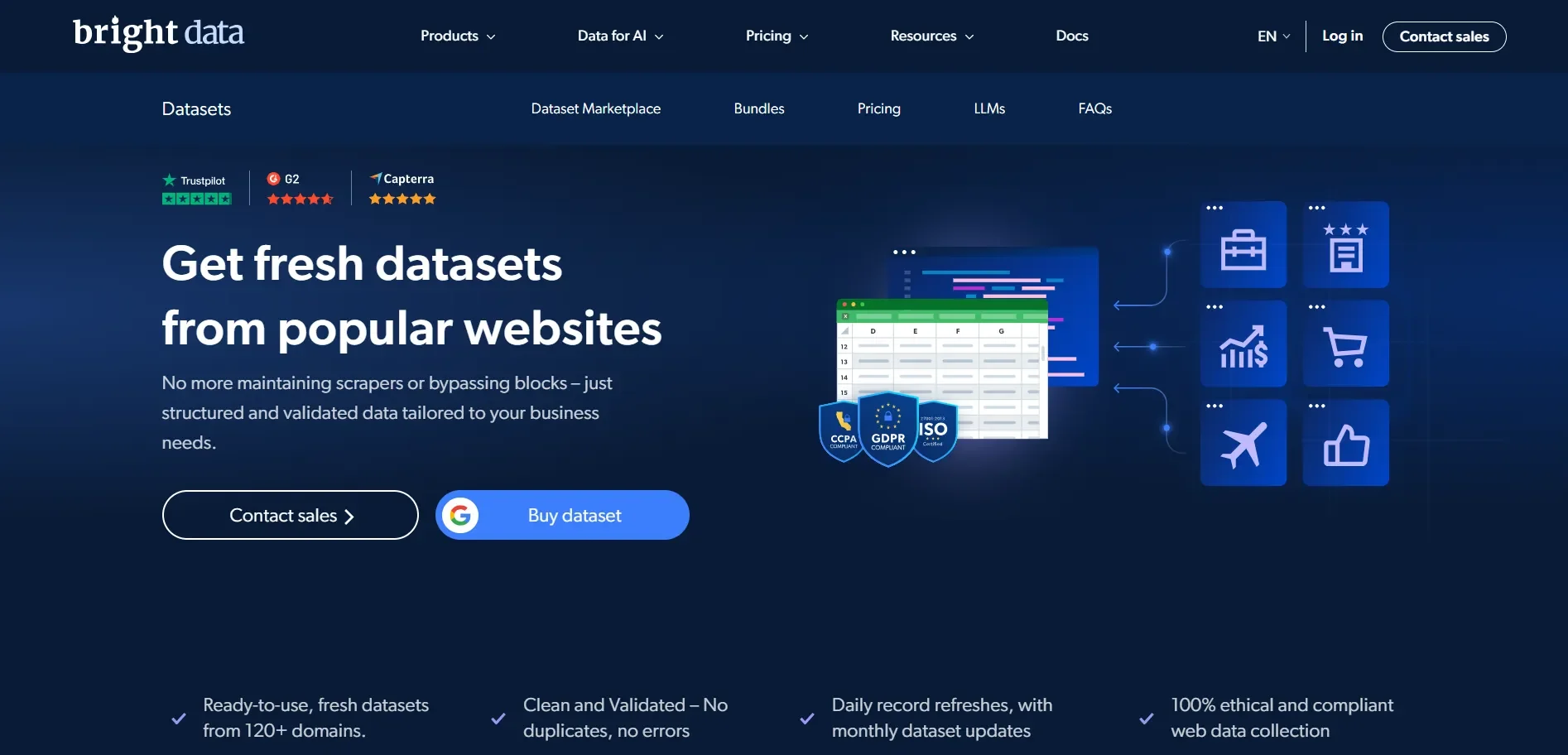
Bright Data is one of the most extensive public data platforms, offering more than thirty ready-made datasets across numerous social networks, including Instagram, Facebook, TikTok, LinkedIn, Reddit, Pinterest, Quora, Bluesky, and X. The provider structures its social datasets into three layers: profiles, posts, and comments.
The profile layer includes usernames, biographies, follower and subscriber counts, business page details, and engagement averages. The post layer contains captions, titles, video or image metadata, hashtags, view counts, like counts, share counts, timestamps, and category fields. Comment datasets include discussion text, commenter metadata, reactions, reply structure, timestamps, and indicators of discussion activity. Data is available as bulk files in formats such as CSV, JSON, NDJSON, and Parquet, with API access for real-time updates. Pricing depends on whether buyers choose one-time access to a dataset or ongoing API usage.
Conclusion
By separating social media datasets into two clear categories, those built around public conversations and those focused on structured identity information, businesses can evaluate their options with far greater accuracy. This distinction prevents misleading comparisons and helps teams align their selection with real operational priorities.
Whether your organisation needs large-scale public interactions for analysis or detailed professional and company-level insights for decision making, understanding these categories ensures you invest in data that truly supports your long-term strategy.
