

LinkedIn datasets have become increasingly valuable for both professionals and businesses across a wide range of industries. As the world’s largest professional networking platform, LinkedIn contains an enormous amount of structured professional data that can be leveraged for recruitment, sales intelligence, market research, and competitive analysis.
By utilizing LinkedIn datasets effectively, companies can make data-driven decisions, refine outreach strategies, and gain deeper insights into industries and professional trends. In this guide, we’ll explore what LinkedIn datasets are, how they are used, and which providers are considered the best in today’s market, helping you choose the right solution for your specific needs.
What Is a LinkedIn Dataset?
A LinkedIn dataset refers to a structured collection of professional data sourced from the LinkedIn platform. This data is derived from publicly accessible information and includes details such as professional profiles, job postings, company pages, employee roles, skills, industries, locations, and connections.
LinkedIn data represents a vast pool of user-generated professional information. It captures real-time insights into career paths, hiring trends, organizational growth, and skill demand across industries. Businesses commonly use these datasets for sales prospecting, recruitment, market intelligence, and professional networking.
In short, a LinkedIn dataset transforms raw LinkedIn data into organized, usable data to support strategic business activities.
Use Cases of LinkedIn Datasets
1. Lead Generation and Sales Prospecting
LinkedIn is the world’s largest professional network, hosting over 1 billion users and more than 67 million companies across 200+ countries and territories. This makes it a powerful source for identifying high-quality business leads.
Sales teams use LinkedIn datasets to:
- Identify decision-makers and relevant stakeholders
- Segment prospects by industry, job title, company size, or location
- Personalize outreach by analyzing career history, interests, and professional connections
Additionally, LinkedIn data can reveal information about upcoming events, conferences, and company expansions, creating opportunities for timely and relevant engagement.
2. Talent Sourcing and Recruitment
Recruiters rely heavily on LinkedIn datasets to streamline talent acquisition. These datasets contain detailed professional information, including education, work experience, certifications, skills, and career progression.
LinkedIn datasets help recruitment teams:
- Quickly identify qualified candidates
- Run targeted searches based on role-specific skills
- Support employer branding and workforce planning
- Analyze talent availability within specific regions or industries
By leveraging structured LinkedIn data, organizations can reduce hiring time and improve candidate quality.
3. Market Research and Competitive Analysis
LinkedIn datasets are also highly effective for understanding market dynamics and competitor positioning. Companies can analyze workforce trends, hiring patterns, and skill demand across industries.
With LinkedIn data, businesses can:
- Identify emerging job roles and in-demand skills
- Track competitor hiring activity and company growth
- Benchmark their workforce against similar companies
- Discover potential partners, clients, or acquisition targets
These insights help organizations stay competitive and anticipate market shifts.
Top 5 Best LinkedIn Dataset Providers
With so many data providers available, choosing the right LinkedIn dataset provider can feel overwhelming. Each provider differs in data coverage, freshness, compliance standards, and delivery formats.
In the next section, we’ll break down five leading LinkedIn dataset providers, highlighting what they offer, their strengths, and the types of businesses they are best suited for, so you can confidently select the provider that aligns with your goals.
1) Kaggle
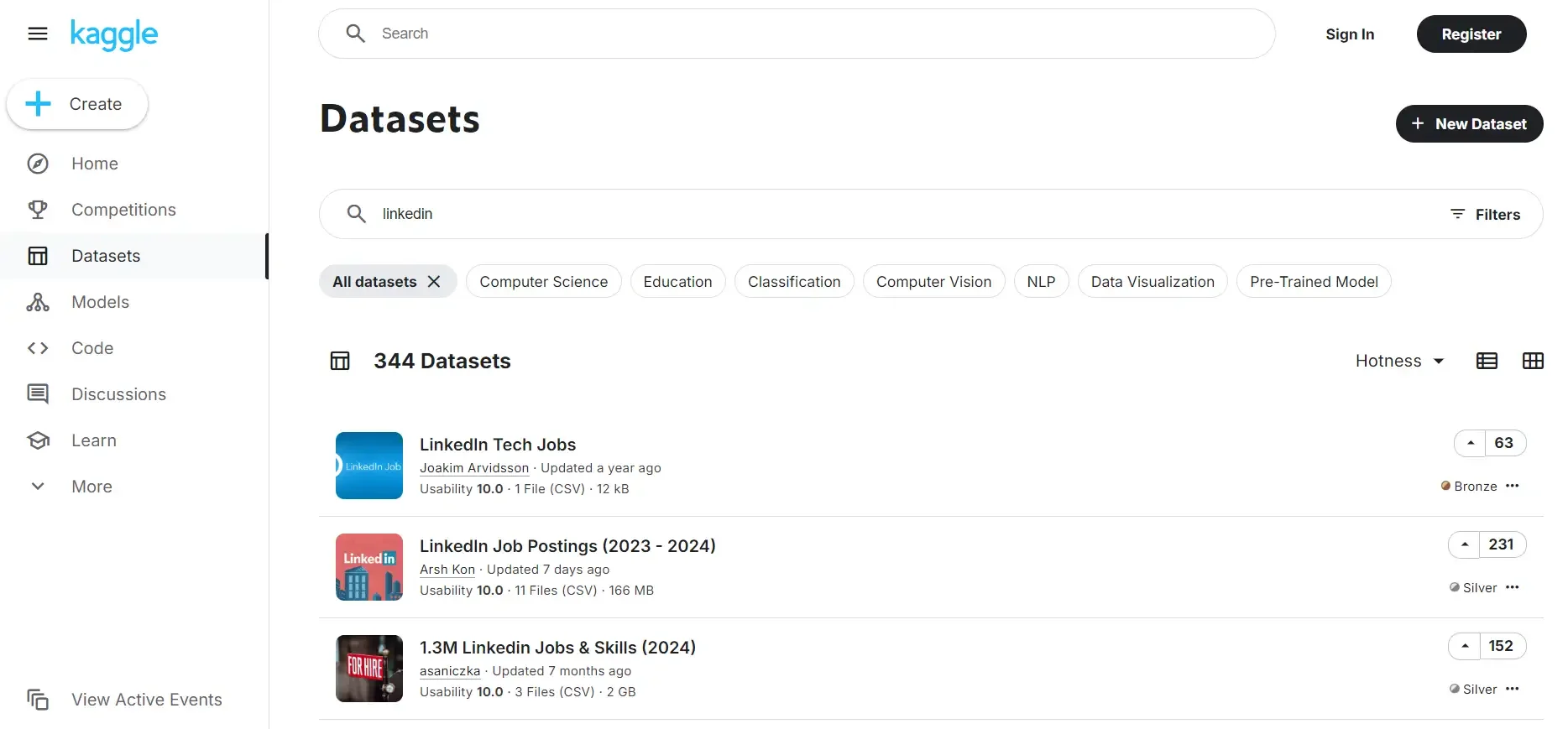
With an abundance of highly diverse datasets that nearly encompass every topic under the sun, Kaggle not only hosts numerous competitions that help AI and machine learning professionals from around the world, with varying levels of experience, gain practical experience, but also helps solve urgent problems through user contributions.
LinkedIn datasets are not directly provided by the site; instead, it allows dataset publishers to provide their collected data in an open, readable way. Verify the data source to make sure it complies with LinkedIn’s terms of service before using any dataset from Kaggle.
Kaggle offers a variety of datasets, including text, audio, and image formats, making it an excellent platform for locating the finest datasets for building machine learning models.
2) Data.world
Data.world is a very intuitive platform for individuals who are well-versed in database concepts and SQL. Data professionals, researchers, and organizations can access LinkedIn-related datasets published on the site.
Several third-party visualization tools are incorporated within a public data portal and immediately interface with the datasets being queried. Before we implemented data, our organization lacked a centralized data repository and a dependable method of sharing and compiling data.
3) Datarade
You get access to a variety of data sets, and the many data classifications make navigating a breeze. We also have excellent support staff, a user-friendly interface, and a simple UX. Well-organized data guarantees efficiency and top performance.
With Datarade, you may discover the perfect LinkedIn datasets. Users get access to hundreds of databases and datasets to explore. Take a look at free data samples.
If you are a business owner seeking ideas for your startup or expansion, Datarade is the way to go. It provides the right data to create procedures that closely match your company’s requirements.
4) Bright Data
Bright Data LinkedIn Datasets provide a comprehensive view of all public LinkedIn listings for business decisions, including jobs, profiles, and companies. There are more than 583 million records, and you can also download a sample of LinkedIn data for free.
LinkedIn datasets provide a comprehensive view of businesses, people, and job ads (including name, title, skills, dedication, experience, etc.). This data can improve investment signaling, talent sourcing, and lead creation. The dataset comprises all major data.
Bright Data unblocks access and provides 24/7 IP rotation to secure website data access; their rigorous data validation process checks every step of data acquisition.
5) Coresignal
As a provider of millions of regularly updated data records, Coresignal offers businesses new web data on organizations, professionals, and tech products.
Coresignal allows data-driven choices with a constantly updated LinkedIn database and a free data sample. Make better use of your talent intelligence by leveraging up-to-date LinkedIn data, available whenever needed.
Companies, jobs, and members are the three main categories in this professional network’s massive database, administered by Coresignal.
How to Access LinkedIn Datasets
There are several ways to access LinkedIn datasets, depending on your business goals, technical expertise, and the level of detail you require. From direct data access methods to third-party solutions, each approach has its own advantages and limitations. Below are the most common and widely used options.
1. Web Scraping
Web scraping is one of the most commonly used methods to collect publicly available LinkedIn data. Using automated tools or scripts, information such as public profiles, job listings, company pages, and role descriptions can be extracted at scale.
This approach is particularly useful for:
- Large-scale data collection projects
- Market research and workforce analysis
- Lead generation and sales intelligence
Web scraping enables organizations to collect large datasets across industries, locations, and job roles. However, it requires technical expertise, proxy infrastructure, and careful handling to ensure data accuracy and consistency. Additionally, scraped data often needs cleaning and structuring before it can be used effectively.
2. Data Enrichment Services
Data enrichment services enhance existing datasets by adding LinkedIn-derived insights to customer or prospect records. These services combine LinkedIn data with CRM, marketing, or sales databases to provide a more complete professional profile.
Data enrichment is commonly used by:
- Marketing teams for account-based marketing (ABM)
- Sales teams for improved targeting and personalization
- Business intelligence teams for segmentation and profiling
It’s important to note that enrichment services usually improve only specific data points—such as industry, job title, or company size—rather than delivering full LinkedIn profiles. As a result, they often provide high-level insights rather than deep, profile-level details.
If you need richer datasets that combine LinkedIn data with multiple external sources, working with a dedicated third-party data provider may be a better option.
3. LinkedIn APIs
LinkedIn offers a range of APIs that allow developers to access certain types of LinkedIn data programmatically. These APIs are primarily designed for approved partners and applications and are commonly used for integrations with recruitment tools, CRMs, and analytics platforms.
Some commonly referenced APIs include:
- LinkedIn Profile API – Provides access to limited profile-related data
- LinkedIn Company API – Offers information such as company descriptions, industries, and employee headcount
Using LinkedIn APIs enables structured and reliable data access but comes with strict access controls and usage limitations. The amount of available data is often limited, and approval is required for most use cases, making APIs more suitable for specific integrations than for large-scale dataset collection.
4. Third-Party Data Providers
Third-party LinkedIn data providers specialize in collecting, structuring, and delivering LinkedIn datasets to businesses. These providers typically offer data through APIs, downloadable datasets, or custom data feeds.
They are ideal for organizations that:
- Need large, ready-to-use LinkedIn datasets
- Want industry- or role-specific data
- Prefer not to manage scraping or infrastructure internally
Many providers offer customized datasets tailored to specific industries, job functions, locations, or business objectives. This makes third-party providers a practical solution for recruitment firms, sales teams, data analysts, and market research companies seeking scalable and efficient access to LinkedIn data.
Choosing the Right Access Method
The best way to access LinkedIn datasets depends on your goals:
For large-scale raw data – Web scraping or third-party providers
For enhanced CRM insights – Data enrichment services
For controlled integrations – LinkedIn APIs
For customized, ready-made datasets – Third-party data providers
Understanding these options will help you select the most efficient and scalable approach for accessing LinkedIn datasets that align with your business needs.
Frequently Asked Questions
What is the difference between scraping LinkedIn data vs. using LinkedIn datasets?
Scraping LinkedIn data offers flexibility and real-time collection but requires technical setup and maintenance. Pre-built LinkedIn datasets save time, reduce operational effort, and are easier to use, though customization may be limited depending on the provider.
What information does a LinkedIn dataset contain?
A LinkedIn dataset may include profile IDs, names, job titles, current companies, industries, locations, experience, education, company size, follower counts, websites, subsidiaries, posts, and other professional and organizational attributes based on requirements.
What is the file format of a LinkedIn dataset?
LinkedIn datasets are commonly delivered in CSV, JSON, NDJSON, JSON Lines, or Parquet formats. Many providers also offer optional GZIP (.gz) compression to reduce file size and improve data transfer efficiency.
How often are LinkedIn datasets updated?
Update frequency depends on the provider and dataset type. Some datasets are refreshed daily or weekly, while others are delivered as periodic snapshots or custom updates based on business needs and subscription plans.
Who typically uses LinkedIn datasets?
LinkedIn datasets are widely used by recruiters, sales teams, market researchers, data analysts, startups, and enterprises for talent sourcing, lead generation, competitive analysis, workforce planning, and business intelligence initiatives.
Conclusion
LinkedIn datasets support competitive analysis, growth tracking, and identification of key industry players, enabling data-driven decisions. They also strengthen recruitment, sales intelligence, and CRM analytics. Access is available through specialized third-party providers offering APIs, scraping tools, or customized datasets.
The providers listed above are among the top LinkedIn dataset providers in the market, known for data accuracy, scalable delivery, and customization options. They serve diverse use cases, including recruitment, sales intelligence, market research, and industry-specific analytics.
More on Dataset:
