
Bright Data is one of the largest web data infrastructure providers on the market, and its pricing page reflects that scale. Instead of one flat subscription, the company sells eight separate product lines (proxies, unlocking APIs, scraper tools, datasets, and managed data acquisition), each billed on its own unit, whether that’s per gigabyte, per IP, per successful request, or per record. That structure is useful once you understand it, but it makes “how much does Bright Data cost” a genuinely hard question to answer with a single number.
This guide breaks down every current Bright Data pricing tier, product by product, so you know exactly what you’d pay before you sign up.
Bright Data Pricing at a Glance
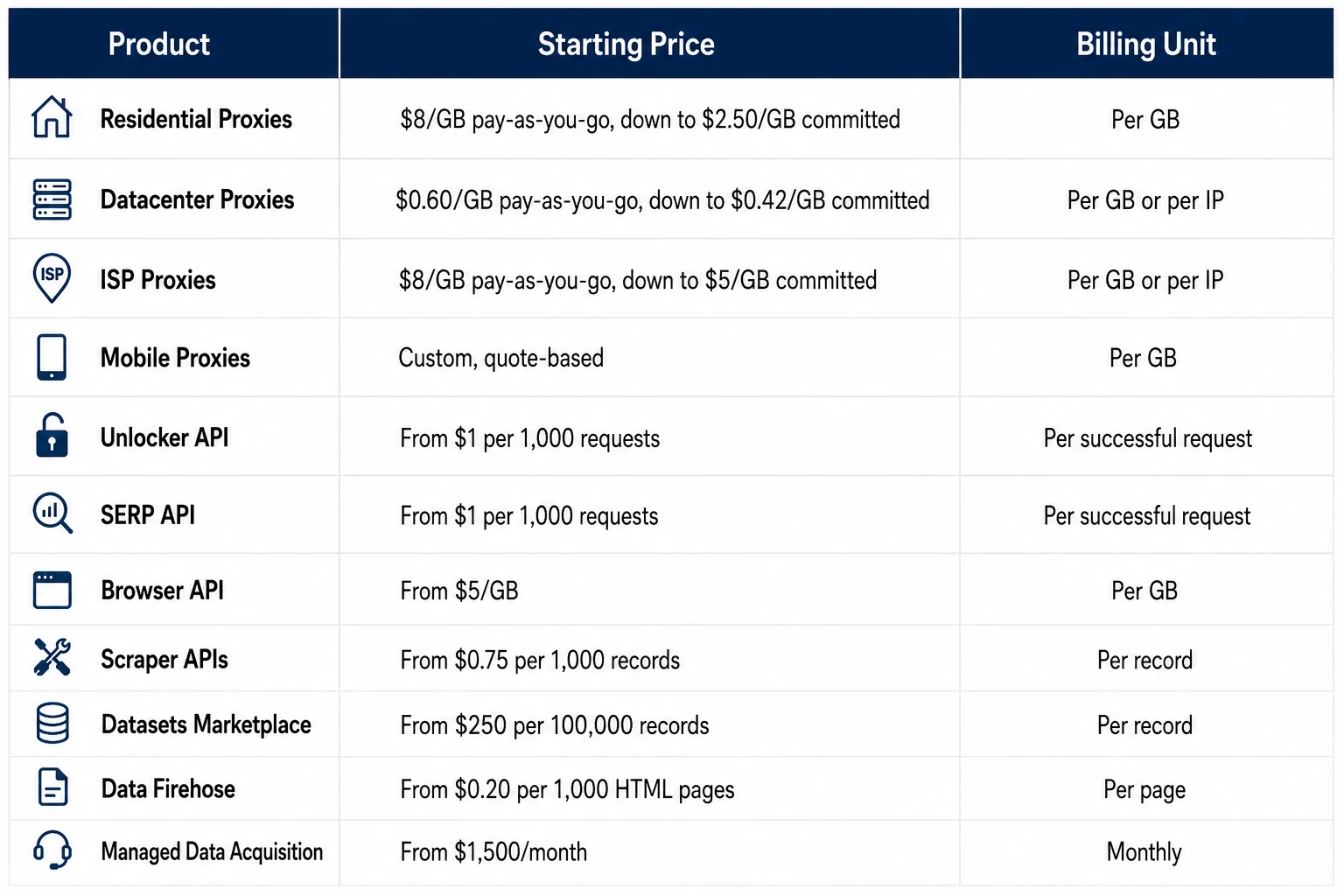
Every plan below is pulled directly from Bright Data’s live pricing pages, so treat the numbers as accurate for the current billing cycle, but always confirm the exact rate in your dashboard before committing, since Bright Data runs recurring promotions (the RESIGB50 code currently knocks 50% off residential proxies for the first three months).
Proxy Infrastructure Pricing
Proxies are Bright Data’s original business and still its biggest product line. Four networks are available: residential, datacenter, ISP (also called static residential), and mobile. Each has its own pricing table, and each is available pay-as-you-go or on a committed monthly plan.
Residential Proxies Pricing
Residential proxies route traffic through real devices rather than servers, which makes them the hardest proxy type for bot detection systems to flag. Bright Data’s residential network covers 400M+ IPs across 195 countries, with country, state, city, and ZIP-code targeting included at no extra cost.
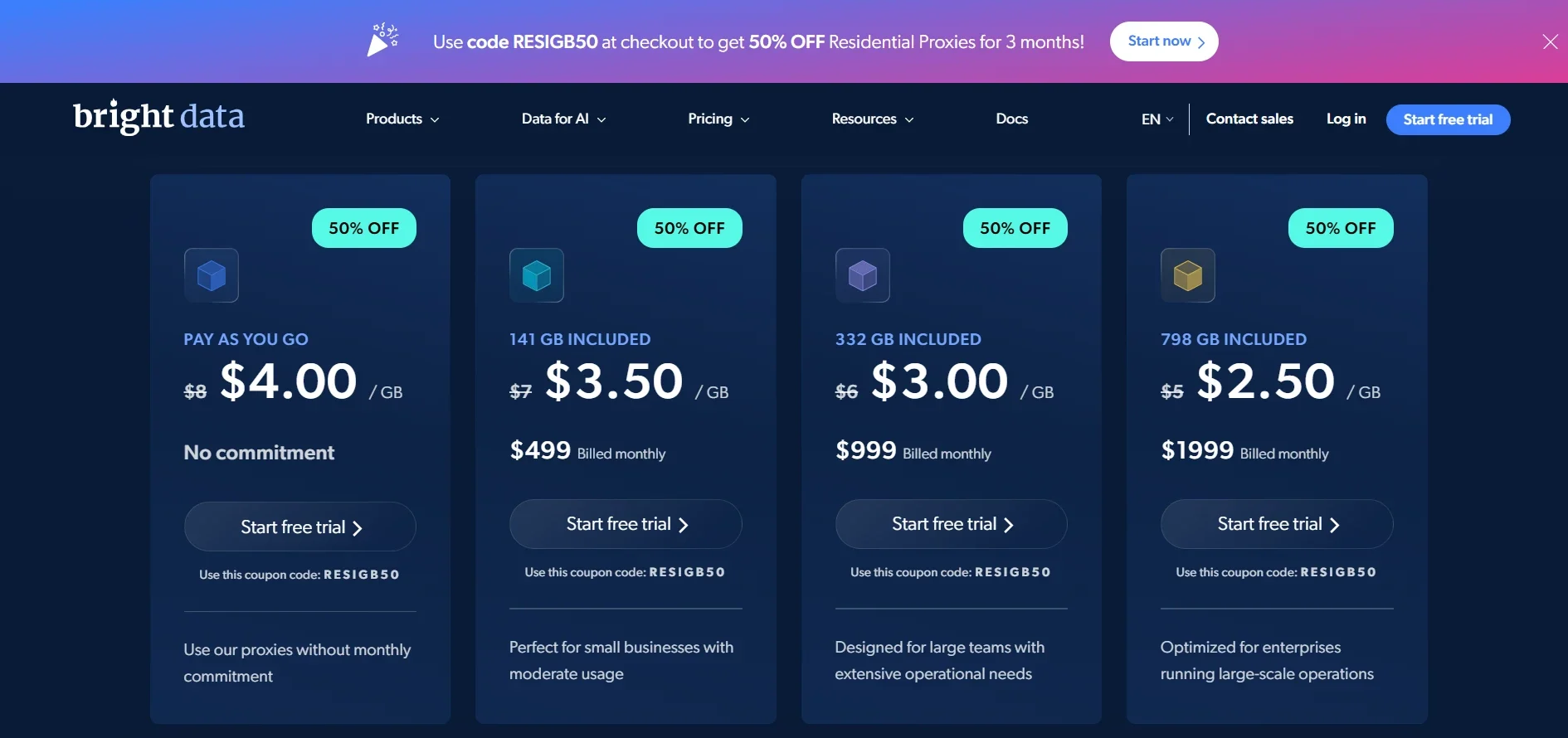
| Plan | Bandwidth Included | Price per GB | Monthly Cost |
|---|---|---|---|
| Pay As You Go | No commitment | $8.00/GB | Usage-based |
| Growth | 141 GB | $7.00/GB | $499 |
| Business | 332 GB | $6.00/GB | $999 |
| Premium | 798 GB | $5.00/GB | $1,999 |
| Enterprise | 1 TB+ | Custom | Custom |
A recurring 50% promotional code (RESIGB50) currently drops these to roughly $4.00, $3.50, $3.00, and $2.50 per GB, respectively, for the first three months of a new account, so the effective entry price for testing the network is often half the list rate above.
The pattern across every tier is the same: the more bandwidth you commit to monthly, the lower your per-GB rate falls. A team burning through 100 GB a month on the pay-as-you-go plan would spend $800; the same 100 GB on the Growth plan (once the 141 GB allowance is factored in) works out closer to $499 flat, which is why most regular users move off pay-as-you-go fairly quickly.
Datacenter Proxies Pricing
Datacenter proxies are the cheapest option in Bright Data’s stack because the IPs originate from server infrastructure rather than real consumer devices. That makes them a poor fit for sites with aggressive bot detection, but a strong fit for high-volume, low-sensitivity scraping, internal tooling, or ad verification on unprotected targets. Bright Data sells datacenter proxies three ways: a per-GB shared pool, a per-IP shared pool, and a per-IP dedicated pool.
Shared pool, billed per GB:
| Plan | Bandwidth Included | Price per GB | Monthly Cost |
|---|---|---|---|
| Pay As You Go | No commitment | $0.60/GB | Usage-based |
| Growth | 1 TB | $0.51/GB | $499 |
| Business | 2 TB | $0.45/GB | $999 |
| Premium | 5 TB | $0.42/GB | $1,999 |
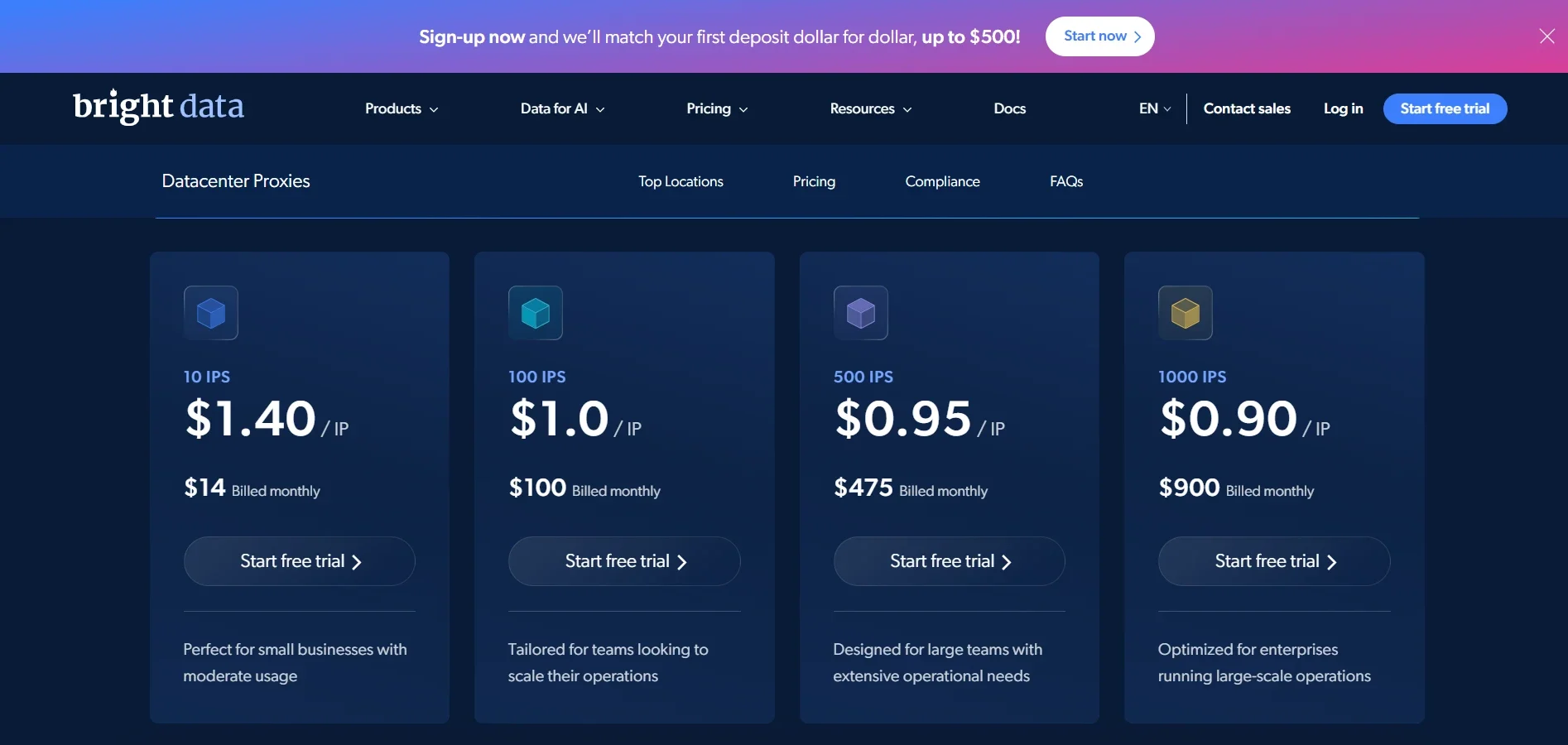
Shared pool, billed per IP:
| IPs | Price per IP | Monthly Cost |
|---|---|---|
| 10 | $1.40 | $14 |
| 100 | $1.00 | $100 |
| 500 | $0.95 | $475 |
| 1,000 | $0.90 | $900 |
Dedicated pool, billed per IP:
| IPs | Price per IP | Monthly Cost |
|---|---|---|
| 10 | $2.20 | $22 |
| 100 | $1.70 | $170 |
| 500 | $1.50 | $750 |
| 1,000 | $1.30 | $1,300 |
Every per-IP datacenter plan carries a 100 GB fair-use allowance per IP each month; a 10-IP plan gives you 1 TB to split across those IPs however you need, and additional charges apply only once you exceed that pooled allowance.
ISP Proxies Pricing
ISP proxies (also marketed as static residential proxies) combine a real ISP-issued IP address with a fixed, non-rotating connection, which suits account management, checkout flows, and any workflow that needs a consistent identity across a session. Like datacenter proxies, Bright Data prices ISP proxies both per GB and per IP.
Billed per GB:
| Plan | Bandwidth Included | Price per GB | Monthly Cost |
|---|---|---|---|
| Pay As You Go | No commitment | $8.00/GB | Usage-based |
| Growth | 71 GB | $7.00/GB | $499 |
| Business | 166 GB | $6.00/GB | $999 |
| Premium | 399 GB | $5.00/GB | $1,999 |
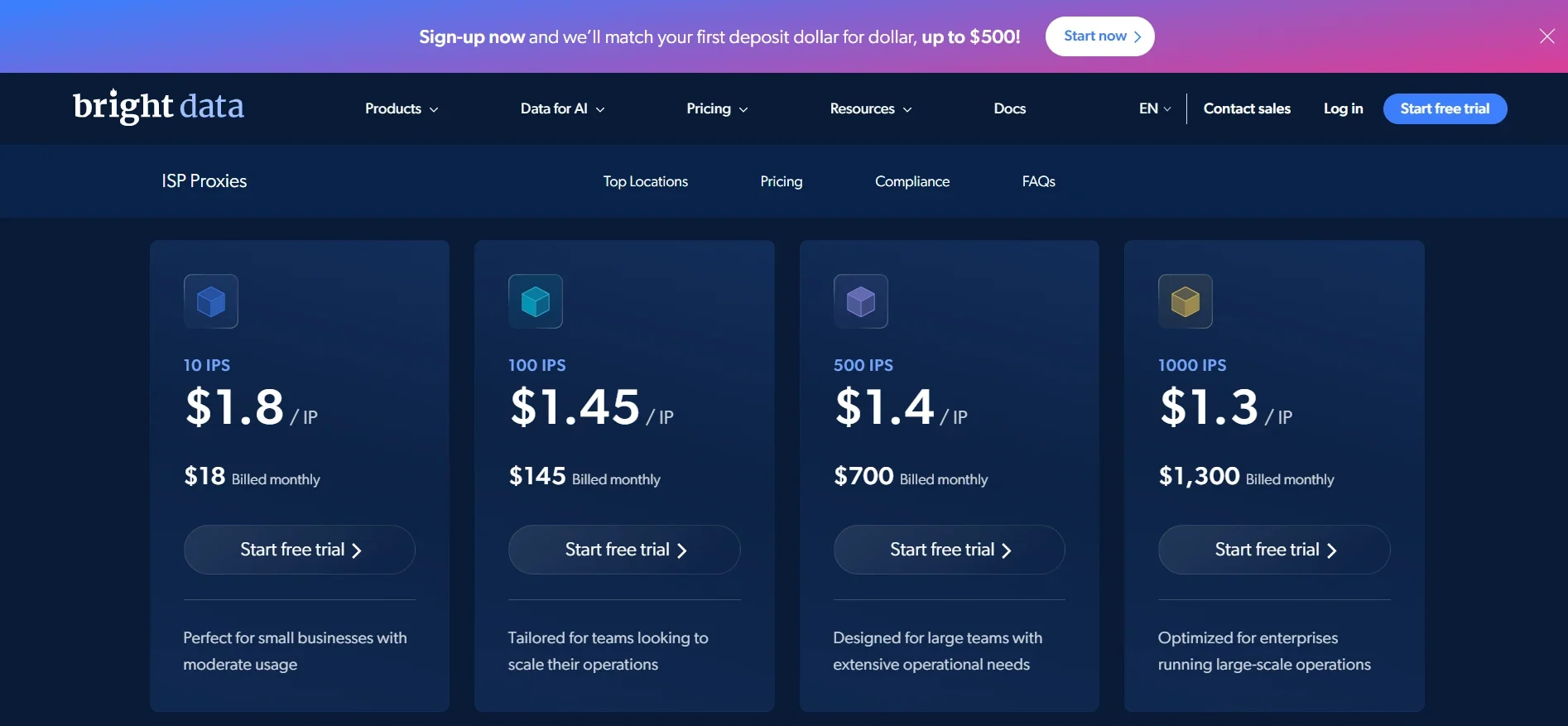
Shared pool, billed per IP:
| IPs | Price per IP | Monthly Cost |
|---|---|---|
| 10 | $1.80 | $18 |
| 100 | $1.45 | $145 |
| 500 | $1.40 | $700 |
| 1,000 | $1.30 | $1,300 |
Dedicated pool, billed per IP:
| IPs | Price per IP | Monthly Cost |
|---|---|---|
| 10 | $3.50 | $35 |
| 100 | $2.75 | $275 |
| 500 | $2.60 | $1,300 |
| 1,000 | $2.50 | $2,500 |
As with datacenter, each ISP IP carries a 100 GB monthly fair-use allowance, so the per-IP plans work out cheaper than the per-GB plans once your usage per IP climbs past that threshold.
Mobile Proxies Pricing
Mobile proxies route traffic through real 3G, 4G, and 5G carrier connections, and they carry the highest trust score of any proxy type on the platform, since carrier-issued IPs are the least likely to appear on a datacenter or residential blocklist. Bright Data doesn’t publish a fixed public rate table for mobile bandwidth the way it does for its other three networks; pricing is quoted per account based on target countries, carrier mix, and expected volume. If mobile is the only network that reliably gets past a target’s bot detection, budget for a premium over residential rates and request a quote directly rather than relying on a third-party estimate, since figures circulating online for this product vary widely and change often.
Web Access APIs Pricing
Where proxies hand you raw IP access and leave the unblocking work to you, Bright Data’s Web Access APIs handle the CAPTCHA solving, browser fingerprinting, and retry logic on their end, and you’re billed only for requests that come back successfully.
Unlocker API starts from $1 per 1,000 requests and includes a free tier for new accounts. It’s the tool Bright Data recommends for general-purpose scraping: send a target URL, and it returns clean HTML or JSON without you managing proxy rotation yourself.
SERP API also starts from $1 per 1,000 requests and comes with a free tier. It’s purpose-built for search engine results pages across Google, Bing, DuckDuckGo, and Yandex, returning parsed, structured results rather than raw HTML.
Browser API starts from $5/GB and gives you a cloud-hosted Chromium instance, connected via Playwright, Puppeteer, or Selenium, for targets that need clicks, scrolling, or form submissions rather than a single page fetch.
Crawl API starts from $1 per 1,000 requests and is aimed at multi-page crawl jobs where you need to follow links across a domain rather than fetch one URL at a time.
Data Feeds Pricing
This is Bright Data’s collection of pre-built and managed scraping tools, aimed at teams that would rather receive structured data than build a scraper from scratch.
Scraper APIs start from $0.75 per 1,000 records (a 25% discount off the $1 list rate at the time of writing) and cover more than 250 supported websites, including LinkedIn, major e-commerce platforms, and social media sites. You define the target and the fields you need; Bright Data returns structured records.
Scraper Studio starts from $1 per 1,000 requests and is the no-code option, letting you point the tool at a website and turn it into a repeatable data pipeline without writing extraction logic.
Datasets Marketplace starts from $250 per 100,000 records for pre-collected, ready-to-use datasets spanning e-commerce, real estate, LinkedIn, and social media. Free samples are available for most datasets before you commit to a purchase.
Data Firehose starts from $0.20 per 1,000 HTML pages and streams real-time web data as it’s collected, rather than as a static snapshot.
Data and Insights Pricing
At the top of Bright Data’s product stack sit two managed services aimed at larger buyers who want data delivered rather than infrastructure to run themselves.
Retail Intelligence provides real-time e-commerce insights and AI-generated recommendations, with published pricing starting around $2,000 per month depending on the scope of monitoring required.
Managed Data Acquisition starts from $1,500 per month and is Bright Data’s fully outsourced option: their team builds, runs, and maintains the scraping pipeline on your behalf, which suits enterprises that need the data but don’t have engineering resources to spend on scraper maintenance.
How Bright Data Billing Actually Works
A few mechanics apply across every product line and are worth understanding before you commit to a plan:
- Billing cycle. Committed plans renew on the 1st of each month, and if you join mid-month, your first payment is prorated to the days remaining in that billing cycle.
- Minimum commitments don’t roll over. If your usage falls short of your monthly commitment, the unused balance doesn’t carry into the next month; your billing resets fresh on the 1st.
- KYC applies to residential and mobile. Datacenter and Web Unlocker access don’t require it, but activating full residential or mobile proxy access involves a short compliance check, sometimes including a brief video call, to confirm you’re a legitimate business or individual user.
- Auto-recharge is optional but recommended. You can set a fixed top-up amount that triggers once your balance drops to 25%, which avoids the account suspension that follows running your balance to zero.
- Bandwidth is metered precisely. Billed bandwidth includes request headers, request data, response headers, and response data, measured down to the megabyte with no rounding.
- Refund window. Unused prepaid balance is refundable for 30 days after your last account activity; enterprise contracts negotiate their own refund terms.
What Actually Drives Your Bright Data Bill
The list prices above are the starting point, but four factors tend to move a real invoice up or down more than the plan tier itself.
Geo-targeting precision. Country-level targeting is included free across every proxy network. Narrowing down to a specific city, ZIP code, or ASN doesn’t carry a separate line-item fee on Bright Data’s published tables, but it does affect how efficiently you consume bandwidth, since tighter targeting pulls from a smaller slice of the IP pool and can mean more retries on some targets.
Success rate on the target site. With proxy networks, you pay for bandwidth whether a request succeeds or fails, so a site that blocks 30% of your attempts effectively raises your real cost per successful page by roughly the same margin. This is the main reason datacenter proxies, despite the low list price, sometimes end up more expensive in practice than residential proxies on protected targets: you’re paying for a lot of failed attempts. For more ways to reduce scraping costs beyond picking a cheaper proxy tier, see our dedicated guide.
Which product you pick for the job. Web Unlocker and SERP API bill only for successful requests, which removes the failed-attempt problem entirely, but at a materially higher per-request cost than raw proxy bandwidth. For difficult targets at moderate volume, that trade often works out cheaper overall than running your own retry logic on top of raw proxies. For simple targets at high volume, raw datacenter or residential proxies are usually the cheaper route.
Session control. Sticky sessions, which hold the same IP for an extended period rather than rotating on every request, are included on Bright Data’s proxy plans, but sessions that need to stay alive for longer windows can consume more bandwidth per task than a quick rotating request would, simply because the connection stays open longer.
None of these are hidden fees; they’re just usage patterns that change how much bandwidth or how many requests a given job actually burns through, which is why two accounts on the identical plan can end up with very different monthly invoices.
Free Trial and Promo Codes
Every new Bright Data account gets trial credit usable across all products, plus a recurring free tier of 5,000 monthly credits for the Unlocker API, SERP API, Web Scraper API, and Scraper Studio that renews every month regardless of whether you’re on a paid plan. Sign-up also currently comes with a first-deposit match up to $500, and the RESIGB50 code cuts residential proxy pricing in half for the first three billing cycles. Since promotions rotate, it’s worth checking the current offer in your dashboard before you commit to a tier.
Which Bright Data Plan Should You Choose?
The honest answer depends entirely on what you’re trying to scrape and how much of it you’re doing each month.
Occasional or one-off jobs (under 10 GB/month): Pay-as-you-go on whichever proxy type fits your target is the right call. There’s no minimum commitment, and you only pay for what you use.
Regular scraping on unprotected or lightly protected sites: Start with datacenter proxies. At $0.60/GB pay-as-you-go, they’re roughly 13 times cheaper than residential, and plenty of targets never actually require the disguise a residential IP provides. Only move up to residential once you’re consistently hitting 403 or 429 errors. Our guide on how to avoid IP blocks walks through the warning signs before you need to switch.
Scraping sites with real anti-bot protection (retail, travel, social platforms): Residential proxies are the default here. If your volume clears roughly 50 GB a month, a committed plan will more than pay for itself against the pay-as-you-go rate.
Account management, checkout flows, or anything needing a persistent identity: ISP proxies are purpose-built for this. The static IP behaves like a residential connection without the cost of paying for rotation you don’t need.
Search engine data at scale: The SERP API is nearly always cheaper than building your own residential-proxy-plus-headless-browser pipeline for the same volume of Google or Bing queries.
No engineering resources to maintain scrapers: Managed Data Acquisition or the Datasets Marketplace get you the output without the infrastructure overhead, at a real cost premium.
Bright Data vs Oxylabs vs Decodo: Pricing Comparison
Bright Data isn’t the only large-scale proxy provider, and its pricing sits at the premium end of the market. Here’s how the entry-level residential rate compares against two of the more commonly cited alternatives, based on each provider’s own published pricing as of mid-2026.
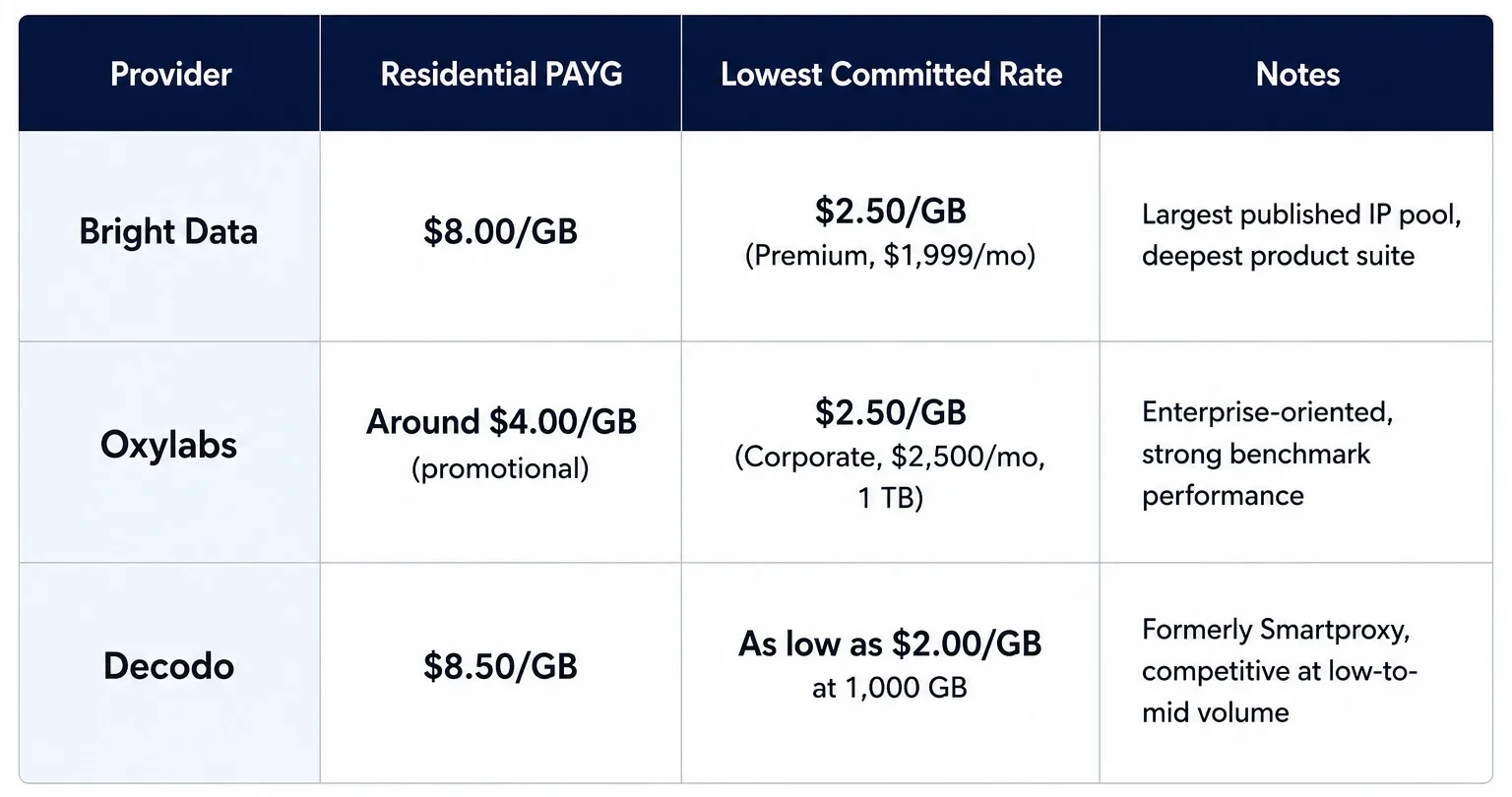
Bright Data and Decodo list similar pay-as-you-go entry prices, while Oxylabs’ promotional rate currently undercuts both at the low end. Where Bright Data tends to justify its position is pool size, geographic depth, and the breadth of adjacent tools (SERP API, Browser API, Datasets Marketplace) bundled under one account, which matters more once a project outgrows a single proxy type. Pricing on all three platforms changes often enough that it’s worth checking current rates directly before deciding based on list price alone.
Frequently Asked Questions
Is there a free version of Bright Data?
No permanent free tier, but new accounts get trial credit across all products plus a recurring 5,000 monthly credits for the Unlocker API, SERP API, Scraper API, and Scraper Studio.
Can I use Bright Data without a monthly commitment?
Yes. Every proxy type and most API products offer a pay-as-you-go option with no minimum spend.
Do I need to go through KYC to use Bright Data?
Only for residential and mobile proxy access. Datacenter proxies and the Web Unlocker API don’t require it.
What’s the cheapest way to start with Bright Data?
Datacenter proxies at $0.60/GB pay-as-you-go, or the free monthly credit allowance on the Unlocker and SERP APIs if your use case fits within it.
Does Bright Data offer discounts for higher volume?
Yes, across every proxy product, the per-GB or per-IP rate drops as your committed monthly plan size increases, and enterprise accounts above the published tiers negotiate custom pricing directly.
Is Bright Data cheaper than building an in-house scraping setup?
Usually only at moderate to high volume. Below a few hundred dollars a month in proxy spend, the engineering time to maintain your own rotation, retry, and CAPTCHA-handling logic often costs more than simply paying Bright Data’s rate. Above that volume, the calculation shifts depending on how much of that infrastructure work you’re already doing for other reasons.
What happens if I exceed my monthly commitment?
Bright Data emails you once you’ve used 85% of your account balance so you can top up. If you don’t, the account keeps running until your balance hits 100%, at which point it’s suspended until funds are added, so auto-recharge is the safer default for any account running production workloads.
Conclusion
Bright Data’s pricing isn’t complicated once you separate it by product. Proxies are billed by bandwidth or by IP, APIs are billed by successful request, and managed services carry a flat monthly floor. The pay-as-you-go tier on any product is the right starting point if you’re testing a target or running a one-off job; committed monthly plans only pay off once your usage is predictable enough to justify locking in a lower rate. Datacenter proxies remain the cheapest entry point into the platform by a wide margin, while residential and ISP proxies exist specifically for the targets that datacenter IPs can’t get past.
Quick Links:
