
Decodo works well for a lot of proxy workloads, so replacing it is rarely a decision made without a reason. The trigger is usually practical: unused bandwidth disappears at the end of the billing cycle, pay-as-you-go traffic costs more per gigabyte, sticky sessions stop at 30 minutes, or a project has reached the point where enterprise support and contract flexibility matter more than a self-service dashboard.
That is where a Decodo alternative becomes worth investigating.
The market also looks different depending on what you are actually buying. Someone looking for inexpensive residential bandwidth for a small scraper has very different priorities from an enterprise team that needs managed unblocking, datasets, browser infrastructure, compliance documentation and a dedicated account manager. A long-running authenticated workflow may care more about session duration than the headline price per gigabyte.
This comparison covers seven Decodo alternatives, using pricing, pool sizes and product information published by the providers on October 9, 2026. That date matters because proxy pricing changes frequently. Decodo, for example, now publishes a residential pool of 115M+ IPs, whereas older comparisons often quote a much smaller figure.
The providers covered here are Bright Data, Oxylabs, IPRoyal, DataImpulse, Webshare, SOAX and Proxy-Seller. Decodo itself remains in the comparison as the baseline.
Decodo Alternatives at a Glance
The table below gives you the quickest way to narrow the list. Pool sizes and prices are published vendor figures rather than results from a common benchmark, so they are useful for building a shortlist, not for predicting exactly how a provider will perform against your targets.
| Provider | Published residential pool | Lowest published entry point | Where it stands out |
|---|---|---|---|
| Decodo | 115M+ IPs | $11.25 for 3GB, or $4/GB pay as you go | ZIP and ASN targeting, scraping API and Site Unblocker |
| Bright Data | 400M+ IPs | $8/GB pay as you go, plans from $499/month | Large proxy pool, datasets, Unlocker and Scraper APIs |
| Oxylabs | 100M+ IPs | $30/month for up to 5GB | Enterprise support and proxies combined with Web API |
| IPRoyal | 64M+ IPs | $7 for 1GB subscription or $7.35 pay as you go | Traffic does not expire and sticky sessions up to 7 days |
| DataImpulse | 90M+ IPs | $5 introductory pack for 5GB, then $1/GB | Low published per-GB pricing and no traffic expiry |
| Webshare | 80M+ IPs | $3.50/month for 1GB promotional price | Low-cost plans and a free proxy tier |
| SOAX | Not stated on pricing page | Free Sandbox, top-ups at $5/GB, plans from $200/month | Country-tier pricing and combined residential/mobile billing |
| Proxy-Seller | 47M+ IPs | $3.50/GB test rate, volume plans from $1.45/GB | City and ISP targeting plus compliance documentation |
The numbers reveal several different approaches to the market. DataImpulse has the lowest published residential rate in this group. Bright Data advertises the largest residential pool. Webshare has particularly low displayed prices at smaller volumes, although those prices are promotional. IPRoyal and DataImpulse stand apart for keeping purchased traffic available until it is used.
SOAX takes another route altogether. Its pricing depends on the country tier of the traffic, which can make it expensive for some destinations and attractive for others.
For a quick shortlist, DataImpulse deserves attention when raw cost per gigabyte is the priority. Webshare is worth testing for smaller monthly workloads. IPRoyal becomes interesting when unused bandwidth and long sessions are important. Bright Data and Oxylabs are aimed further up the procurement ladder, while Proxy-Seller combines granular location targeting with compliance documentation. SOAX is particularly relevant when traffic is concentrated across specific countries.
Decodo itself remains competitive, especially for buyers who value detailed location targeting and managed scraping products without moving into a larger enterprise contract.
What Decodo Offers Today
Decodo is the company formerly known as Smartproxy. The rebrand took place in 2025, and the former smartproxy.com domain now sits under decodo.com. That is why older Smartproxy review articles can still be relevant when researching the service.
The current residential product lists more than 115 million IPs across more than 195 locations. It supports HTTP(S) and SOCKS5 connections, rotating and sticky sessions, and targeting at continent, country, state, city, ZIP code and ASN levels without an additional targeting charge.
Decodo publishes a 99.92% success rate, an average response time below 0.5 seconds and 99.99% uptime. Those figures come from the company’s stated testing methodology, which used a custom Python script and requests to a global CDN. They provide a useful reference point, but they should not be treated as a universal benchmark. A scraper hitting a heavily protected ecommerce site will face a different environment from a request sent to a CDN.
Decodo’s monthly residential pricing currently looks like this:
| Plan | Monthly price | Effective rate |
|---|---|---|
| 3GB | $11.25 | $3.75/GB |
| 10GB | $35 | $3.50/GB |
| 25GB | $81.25 | $3.25/GB |
| 50GB | $150 | $3.00/GB |
| 100GB | $275 | $2.75/GB |
| Enterprise, 250GB to 1TB | Custom | $2.50/GB down to $2/GB |
| Pay as you go | $4/GB | $4.00/GB |
The pricing becomes more complicated once the other proxy categories are included. Residential, mobile, ISP and datacenter products use separate pricing structures. The Decodo pricing information lists mobile proxies from $2.25/GB, static residential proxies from $0.27 per IP and datacenter proxies from $0.02 per IP.
There are also managed scraping products. Site Unblocker starts at $0.95 per 1,000 requests, Web Scraping API starts at $0.09 per 1,000 requests, and Fast Search API starts at $0.40 per 1,000 requests. The Web Scraping API uses credits that increase according to request complexity, so the published starting price should be viewed as the entry point rather than a universal page-fetching cost.
Decodo has also expanded its developer tooling. Its current offering includes an MCP server for AI agents, SDKs for Python, TypeScript and Go, a command-line tool, and integrations with n8n and LangChain.
New users can access a three-day residential trial with 100MB. There is also a 14-day money-back option for a first purchase under the provider’s stated conditions, including not having used the trial and consuming no more than 20% of the purchased traffic.
Those capabilities explain why Decodo remains a serious baseline. The case for switching is less about Decodo being a poor proxy provider and more about another provider fitting a particular workload, billing model or procurement requirement better.
Why Look for a Decodo Alternative?
A search for the Best Decodo Alternative usually starts with one specific limitation rather than general dissatisfaction.
Monthly traffic that does not carry forward
Decodo’s residential plans operate on a monthly billing cycle. Unused bandwidth does not roll into the following month.
That arrangement is easy to understand when traffic is steady. A team using roughly the same amount of residential bandwidth every month can select an appropriate plan and budget around it.
Project-based scraping is different.
Imagine a research team collecting product information heavily during the first week of a month and barely sending requests afterward. The team may buy enough bandwidth to handle the busy period, only to have a portion of it remain unused when the billing cycle ends.
DataImpulse and IPRoyal take a different approach by allowing paid traffic to remain available until it has been consumed. That feature can matter more than a lower advertised per-GB rate for workloads with unpredictable demand.
Pay-as-you-go is not always the cheapest route
Decodo’s pay-as-you-go residential option is priced at $4/GB and operates through Wallet credits. Traffic is purchased one gigabyte at a time.
That flexibility comes with a premium compared with the subscription plans. Ten gigabytes costs $40 through pay as you go, compared with $35 for Decodo’s 10GB monthly plan.
For an occasional project, that difference may be perfectly acceptable. A team using the service continuously will probably look at the subscription tiers instead.
There is another constraint: Decodo does not allow a subscription and pay-as-you-go setup to run simultaneously. That matters when a team wants a regular monthly allocation with a separate emergency pool.
Sticky sessions stop at 30 minutes
Decodo allows an IP to rotate on every request or remain sticky for up to 30 minutes.
That is enough for many scraping tasks. Some workflows need more time.
Consider a multi-step session involving authentication, several page requests and a final action. Keeping the same residential IP throughout the sequence can reduce the chance of the target site treating the activity as a new visitor halfway through.
IPRoyal advertises sticky sessions lasting up to seven days. That does not mean a residential IP is guaranteed to remain online for seven days; the device behind a residential connection can disconnect. It does give developers a longer requested session window and more control over how their scraper handles state.
The price gap becomes more noticeable at volume
The difference between providers can be modest at 10GB and substantial at 100GB.
Decodo’s 100GB residential plan is $275. Webshare’s displayed promotional price for 100GB is $225. DataImpulse’s published $1/GB rate implies approximately $100 for the same volume.
Those figures do not tell the whole story. Targeting, expiry, success rate, retries and the type of traffic you need can change the effective cost considerably. Still, the raw difference is large enough to justify testing alternatives when a project consumes hundreds of gigabytes.
Enterprise requirements can change the shortlist
Proxy selection becomes a procurement exercise once security, compliance and support requirements enter the picture.
Bright Data and Oxylabs offer broader product ecosystems that include managed scraping tools, browser infrastructure and enterprise services. Proxy-Seller also publishes certification and compliance documentation and offers account management at higher tiers.
A freelancer running a small scraper may never need those services. An organization putting proxy access through security review may consider them part of the purchase.
How This Decodo Alternatives Comparison Was Built
The pricing and feature information in this article comes from the providers’ published pricing and product pages as of October 9, 2026. Promotional pricing is identified where applicable, and information that a provider does not publish is left unspecified rather than filled in from an estimate.
There was no shared hands-on benchmark across all seven services. Performance figures quoted in the comparison come from individual vendors, and the testing methods are not identical. A 99.9% success rate from one provider should not automatically be interpreted as directly comparable with a 99.9% figure from another.
The best way to use this comparison is as a filtering exercise. Narrow the field using price, targeting, session requirements and product capabilities, then test two or three finalists against the actual websites and locations involved in your project.
1. Bright Data: Best Decodo Alternative for a Full Data Platform
Bright Data occupies a much broader part of the market than a basic residential proxy provider.
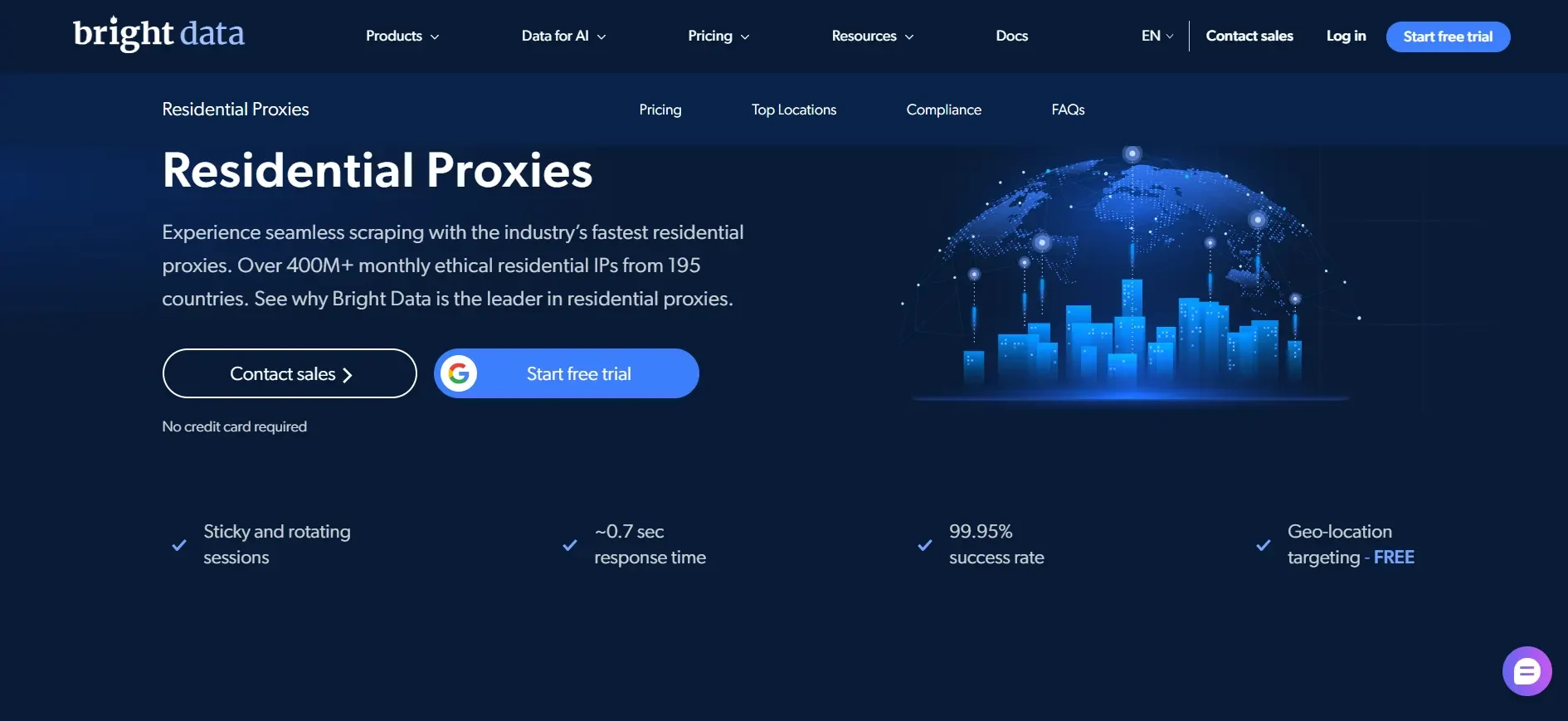
Its pricing page lists more than 400 million rotating residential IPs across 195 countries, with country, state, city and ZIP targeting. The platform also extends beyond proxy access into Unlocker API, SERP API, Browser API, Crawl API and Scraper APIs covering more than 800 websites. Its datasets catalog covers more than 900 domains.
That distinction matters when the project is really about obtaining structured information rather than simply routing HTTP requests.
A team collecting search results, product information or public web data may eventually need rendering, browser automation, retries, parsing or ready-made datasets. Building every layer internally can take considerably more engineering effort than managing a proxy endpoint.
Bright Data’s residential pay-as-you-go price is listed at $8/GB. At the time of the source check, a 50% promotion using the code RESIGB50 reduced the rate to $4/GB for three months, while another offer advertised matching an initial deposit up to $500.
Promotions should not be used as the foundation of a long-term budget. The list price is the safer number to model.
Monthly plans start at $499. The listed tiers include 141GB at $499, 332GB at $999 and 798GB at $1,999. Decodo’s largest standard residential plan is 100GB at $275, so these services are not aimed at exactly the same purchasing level.
Bright Data also requires KYC for residential and mobile access. The process can involve company verification and a short video call. Web Unlocker does not require the same KYC process.
For enterprise procurement, the additional verification may be a normal part of onboarding. For someone trying to run a small experiment immediately, it adds another step.
Against Decodo, Bright Data’s strongest arguments are network size, product breadth and enterprise infrastructure. The downside is the cost and complexity of entering the platform.
A detailed comparison is available in the Bright Data comparison. For readers who want to explore other providers at this level, see the Bright Data alternatives.
Best fit: organizations that need residential proxies alongside scraping APIs, browser tools, unblocking services or datasets and can support a higher monthly commitment.
2. Oxylabs: Best Decodo Alternative for Enterprise Support
Oxylabs takes a more unified approach to product pricing. Its pricing structure brings residential, mobile, ISP and datacenter proxies together with Search and Scrape endpoints, Web Unblocker and Agent Browser.
New accounts receive $5 in welcome credits that can be used to test the platform.
The residential network is listed at more than 100 million IPs, and the published plans are:
| Plan | Monthly price | Residential rate |
|---|---|---|
| Starter | $30 | $6/GB, up to 5GB |
| Basic | $100 | $5/GB, up to 20GB |
| Flexible | $500 | $4/GB, up to 125GB |
| Enterprise | From $2,500 | From $2.50/GB at 1,000GB+ |
Small-volume buyers will immediately notice the difference from Decodo. Decodo’s 10GB plan is $35. Oxylabs does not offer a similarly sized $35 tier; the next listed option is the $100 Basic plan.
The equation changes once managed services and support become part of the requirement.
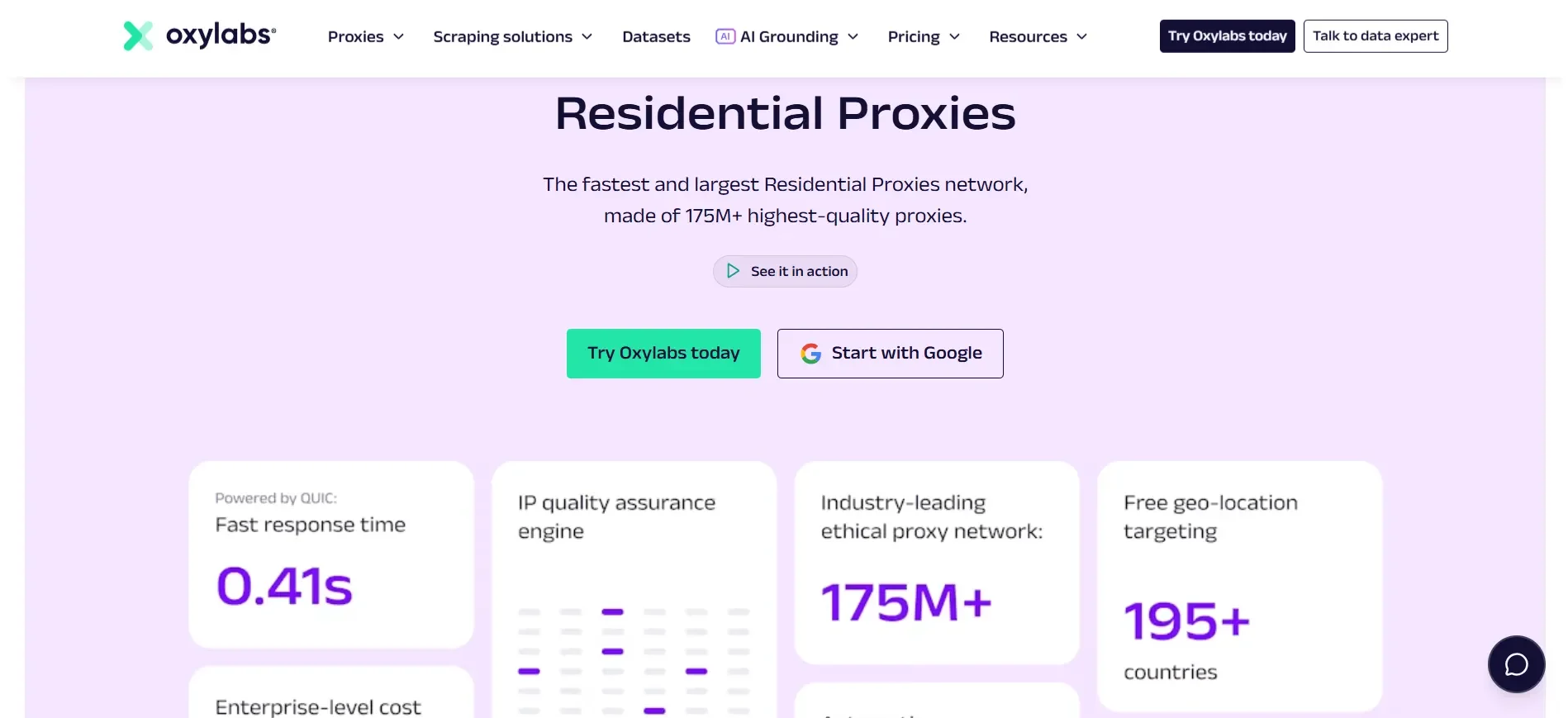
Oxylabs lists HTTP(S), HTTP3 and SOCKS5 support, sticky sessions, free geo-targeting, unlimited concurrent sessions, three proxy users and ten whitelisted IPs. Its published average success rate is 99.95%, with a reported average response time of 0.6 seconds.
Decodo reports a slightly faster average response time and a 99.92% success rate, but those numbers come from different testing environments. They are not a reliable reason by themselves to select one provider over the other.
Oxylabs also uses a KYC process for residential access. Its public pricing page does not advertise a standard pay-as-you-go residential option, making the monthly subscription tiers more important during budgeting.
The service becomes particularly relevant when the proxy purchase sits inside a broader managed scraping setup. A company may be willing to spend more on the network because it also wants support, API access and a contract covering multiple proxy types.
Best fit: established teams that want enterprise support and managed scraping capabilities under one commercial relationship and can justify at least a $100 monthly commitment.
3. IPRoyal: Best Decodo Alternative for Traffic That Never Expires
IPRoyal has one especially clear difference from Decodo: purchased residential traffic remains available until it is used.
That changes the economics for irregular projects.
Its residential network is listed at more than 64 million IPs across 195+ countries. Subscription and pay-as-you-go versions are available:
| Package | Subscription | Pay as you go |
|---|---|---|
| 1GB | $7.00/GB | $7.35/GB |
| 2GB | $5.95/GB | $6.25/GB |
| 10GB | $5.25/GB | $5.51/GB |
| Custom, 10TB+ | $1.75/GB | $1.84/GB |
The pricing is higher than Decodo at smaller volumes. Ten gigabytes costs $52.50 on the IPRoyal subscription, compared with $35 on Decodo.
So why consider it?
The answer is the lifetime of the traffic.
Suppose you need 10GB for a scraper but expect the project to consume that amount gradually over three months. A lower per-GB price is not necessarily valuable if the cheaper provider resets unused traffic every month. IPRoyal’s model lets the purchased bandwidth remain available.
Session control is another reason it appears on the list of Top alternatives to Decodo.
IPRoyal advertises sticky sessions of up to seven days, compared with Decodo’s 30-minute maximum. Automatic rotation can be configured at one, ten or 30-minute intervals, and users can request a new IP through the interface or API.
City-level targeting is supported. IPRoyal also sells a Web Unblocker starting at $1 per 1,000 requests. ISP proxies start at $1.80 per proxy, datacenter proxies at $1.39 per proxy and mobile proxies at $10.11 per day.
There is an important qualification around seven-day sessions. Residential proxies depend on real devices and connections, so a requested seven-day sticky session does not guarantee that the same IP will remain available for seven days. Application-level retry and session recovery logic remains useful.
The provider also has a KYC policy, so some accounts should expect identity verification.
Best fit: projects with uneven traffic, long session requirements or prepaid bandwidth that needs to remain available beyond a single billing month.
4. DataImpulse: Cheapest Decodo Alternative per Gigabyte
DataImpulse is the most obvious candidate when the first question is simply, “How little can I pay for residential bandwidth?”
The residential product advertises $1/GB, no subscription requirement and traffic that does not expire. Its published network contains more than 90 million IPs across 195 countries.
The pricing is straightforward:
| Package | Price | Volume | Rate |
|---|---|---|---|
| Intro, new users | $5 | 5GB | $1.00/GB |
| Basic | $50 | 50GB | $1.00/GB |
| Advanced | $800 | 1TB | $0.80/GB |
| Custom, 5TB+ | From $4,000 | Negotiated | Custom |
At 100GB, the difference from Decodo becomes substantial. DataImpulse’s published rate implies approximately $100, compared with $275 for Decodo’s 100GB residential plan.
That does not automatically make DataImpulse the cheapest solution for every scraper. The details of the traffic matter.
Country targeting is free, but the provider’s pricing information flags state, city, ZIP and ASN targeting as newer capabilities with additional costs. Decodo includes those selectors in its published residential plans.
For a scraper targeting a specific city, that difference should be included in the calculation before moving providers. A $1/GB headline rate is less useful if precision targeting adds a multiplier to the traffic.
DataImpulse supports HTTP(S) and SOCKS5, rotating and sticky sessions, API access and IP authorization. Setup guides cover Scrapy, Puppeteer, Playwright and Selenium.
The provider lists a 99.51% success rate and approximately one-second response time in its metrics. Another portion of its product information cites response times below 500 milliseconds for specific use cases, so these figures should be treated as vendor-reported metrics rather than a universal performance guarantee.
The residential service does not include a managed scraping API or unblocker. The customer supplies the scraping logic, rendering, retries and parsing.
That makes DataImpulse particularly interesting for technical teams that already own the scraping stack. It is less attractive for someone hoping to send a URL to an API and receive a clean result without maintaining browser and anti-bot logic.
Best fit: engineering-led scraping projects, SERP tracking, price monitoring and AI data collection where residential bandwidth cost is a major part of the budget and traffic volume varies.
5. Webshare: Best Decodo Alternative for Small Monthly Plans
Webshare has built its offering around self-service access and low entry prices.
Its rotating residential product lists more than 80 million IPs across 195 countries, along with HTTP and SOCKS5 support, 99.97% uptime and targeting by country, city, state, ZIP code and ASN.
The displayed pricing is:
| Monthly volume | Displayed price | Rate per GB | List price |
|---|---|---|---|
| 1GB | $3.50 | $3.50 | $7.00 |
| 10GB | $27.50 | $2.75 | $70.00 |
| 25GB | $65.00 | $2.60 | $175.00 |
| 100GB | $225.00 | $2.25 | $700.00 |
| 1,000GB | $1,500 | $1.50 | $7,000 |
| 3,000GB | $4,200 | $1.40 | $21,000 |
The displayed figures are promotional prices, with discounts shown against the higher list prices. That distinction is important when planning recurring costs.
At the promotional rate, Webshare’s 10GB package is below Decodo’s $35 plan. Its 100GB price is also lower than Decodo’s $275 plan.
There is another useful feature for developers who are still testing their setup: a free tier offering ten proxies and up to 1GB of bandwidth per month without requiring a credit card.
That can be enough to verify authentication, endpoint configuration and basic routing before spending money on a larger residential package.
Webshare’s refund window is relatively narrow for rotating residential traffic. Refunds can be requested within two days of payment when usage remains below 0.1GB.
The service also has limitations. Some websites are restricted on its residential network, and certain destinations require KYC before access. Monthly bandwidth remains tied to the subscription period, so Webshare does not solve the traffic-expiry issue that motivates some Decodo customers to switch.
Its residential product also does not position a managed scraping API or unblocker as part of the core offering.
For a developer who needs a small amount of residential bandwidth and wants to keep monthly spending low, those limitations may be acceptable.
Best fit: developers and smaller teams that want inexpensive monthly residential access, detailed targeting and a free environment for initial testing.
6. SOAX: Best Decodo Alternative for Country-Based Pricing
SOAX approaches proxy pricing differently.
Instead of assigning one residential rate to every destination, it uses credits and country tiers. Residential and mobile traffic share the same rate within each tier.
The current published structure is:
| Plan | Monthly fee | Included credits | Tier 1 | Tier 2 | Tier 3 |
|---|---|---|---|---|---|
| Sandbox | Free | None | $5.00/GB | $4.00/GB | $2.00/GB |
| Builder | $200 | 200 | $3.00/GB | $2.25/GB | $1.20/GB |
| Team | $500 | 500 | $2.20/GB | $1.65/GB | $0.90/GB |
| Scale | $1,500 | 1,500 | $1.50/GB | $1.15/GB | $0.60/GB |
| Enterprise | $3,000 | 3,000 | From $0.85/GB | From $0.55/GB | From $0.35/GB |
This means geography has a direct effect on the economics.
The United States is listed in Tier 1, while India is in Tier 2. A project using US residential traffic therefore costs more than one using Indian traffic under the same plan.
At 100GB of US traffic, SOAX’s calculator puts the cost at $300 on Builder, slightly above Decodo’s $275 100GB plan. For lower-cost country tiers, the calculation can look quite different.
At Scale, 1,000GB of Tier 1 traffic costs $1,500 in credits. Decodo’s top published enterprise rate of $2/GB would put the equivalent volume at $2,000.
There are also expiry rules to understand. SOAX credits purchased through Sandbox or a monthly plan expire after 60 days. That is more flexible than a monthly reset, but it is not equivalent to IPRoyal or DataImpulse’s non-expiring traffic.
Usage includes traffic in both directions, including retries and interrupted connections. That detail matters for scrapers that make many failed attempts, because the billed volume can be higher than the size of the final HTML responses.
SOAX supports country, region, city and ISP targeting on Builder and Team. ASN and ZIP targeting become available from Scale upward.
The pricing page does not state a residential pool size. That is not necessarily a weakness, but it means buyers should evaluate network coverage through testing rather than comparing an unavailable pool-size number with vendors that publish one.
Best fit: teams scraping known geographic markets that want residential and mobile traffic under a shared credit model and can forecast spending by country tier.
7. Proxy-Seller: Decodo Alternative for City and ISP Targeting
Proxy-Seller has been in the proxy market for around a decade and offers residential, ISP, mobile and datacenter proxies from the same account.
Its residential product lists more than 47 million IPs across 220+ locations, with city and ISP targeting, rotation by time or request, sticky sessions and unlimited concurrent sessions.
Published performance is a 99.5% success rate and approximately 0.35 seconds average response time.
The residential pricing has three broad levels:
- Test traffic at $3.50/GB
- Volume plans from $1.45/GB
- Enterprise packages from $0.30/GB through sales
Purchased residential traffic remains valid for 30 days, and the provider does not require a recurring subscription.
That makes the model different from Decodo. You buy a package, use it during its validity period and purchase another package when necessary.
At 10GB, the $3.50 test rate is equivalent to Decodo’s 10GB effective rate. The more meaningful savings appear when moving into the provider’s larger volume plans.
Compliance is another notable part of the offering. Proxy-Seller publishes ISO/IEC 27001:2022 and ISO 9001:2015 certifications and references GDPR and CCPA compliance, with DPA and SCC documents available on request.
Enterprise customers can also receive a premium SLA, dedicated account management and a proof of concept using their workload.
A three-day trial is listed at $1.99, while refund or replacement requests can be made within 24 hours of purchase under the stated conditions.
The residential pool is smaller than Decodo’s published 115M+ figure, and the residential offering does not list a managed scraping API or unblocker. Teams working against difficult anti-bot systems may therefore need to handle more of the retrieval process themselves.
The benefit is breadth within the proxy catalog. A project can test residential, ISP and datacenter traffic through one provider rather than opening separate accounts.
The distinction between datacenter and residential proxies becomes important when a target treats different IP categories differently. Having multiple options available under one account can make those tests easier to manage.
Best fit: buyers that need city or ISP targeting, documented compliance and optional account management without starting with a large recurring commitment.
Best Decodo Alternative for Web Scraping: Proxy Network or Managed API?
The phrase Decodo alternative for web scraping can describe two very different products.
That distinction should be settled before comparing prices.
A raw residential proxy provides an IP route. Your software sends the request, manages the browser if one is required, handles retries, interprets responses, parses the page and decides whether the result is valid.
A managed scraping API moves more of that work to the provider. You submit a URL or structured request, and the service can handle proxy selection, retries, rendering and, depending on the product, anti-bot challenges and CAPTCHA solving.
The billing model usually changes too. Raw proxies are commonly charged by bandwidth. Managed services often charge by request, credits or records.
Here are the published starting points from the providers that offer managed products:
| Provider | Managed product | Published starting price |
|---|---|---|
| Decodo | Site Unblocker, Web Scraping API, Fast Search API | $0.95, $0.09 and $0.40 per 1,000 requests |
| Bright Data | Unlocker API, SERP API, Scraper APIs, Browser API | From $1 per 1,000 requests for Unlocker and SERP; Scraper APIs from $0.75 per 1,000 records; Browser API from $5/GB |
| Oxylabs | Web API, Web Unblocker, Agent Browser | Included within subscription model, with rates on product pages |
| IPRoyal | Web Unblocker | From $1 per 1,000 requests |
| SOAX | Data scraping services | See product pages |
These are entry-level figures. Rendering, difficult locations, retries and anti-bot complexity can change the actual cost.
The choice is easier when the architecture is considered.
A team already running Playwright, Selenium or Puppeteer may prefer cheap raw residential traffic because it retains complete control. Another team may have no interest in maintaining browser infrastructure and would rather pay for a managed API.
A hybrid setup can also work.
Routine pages can be routed through lower-cost residential bandwidth from DataImpulse, Webshare or IPRoyal. Difficult targets can then be sent through a managed product from Decodo, Bright Data or Oxylabs.
That approach limits the amount of expensive managed traffic without forcing the engineering team to build an elaborate unblocking system for every target.
For AI-oriented data pipelines, Decodo’s MCP server and SDKs and Bright Data’s browser and data products are also relevant considerations.
Decodo Alternatives: Price Comparison at 10GB and 100GB
Comparing proxy prices by simply looking at the advertised rate can be misleading. Some providers have monthly minimums, others use promotional prices, and several use country-specific rates.
The following comparison uses the published pricing available on October 9, 2026:
| Provider | About 10GB | About 100GB |
|---|---|---|
| Decodo | $35, 10GB plan | $275, 100GB plan |
| Webshare | $27.50 promotional, $70 list | $225 promotional, $700 list |
| DataImpulse | $50 top-up covers 50GB, or $5 for 5GB for new users | About $100 at $1/GB |
| IPRoyal | $52.50 subscription, $55.10 pay as you go | Not itemized; custom pricing from 10TB |
| SOAX | $50 on Sandbox at US rate | $300 on Builder at US rate |
| Oxylabs | $100 Basic plan, up to 20GB | $500 Flexible plan, up to 125GB |
| Bright Data | $80 list or $40 with stated promotion | $800 list or $400 with stated promotion |
| Proxy-Seller | $35 at test rate | Volume plans from $1.45/GB |
Promotions are the obvious caveat. Webshare’s displayed residential prices are discounted against its published list prices, while Bright Data’s figures include a promotion available at the time of the source check.
There is also a more important practical issue: bandwidth is only part of the cost.
Suppose one provider costs $1/GB but returns a large proportion of failed or blocked requests. Your scraper may have to repeat the same page several times. A nominally more expensive provider that produces valid responses on the first attempt could have a lower effective cost.
The same principle applies to data quality. A successful HTTP response does not prove that the requested page was returned. A blocked page, CAPTCHA screen or bot-detection message can still arrive with a technically successful HTTP status.
Testing should measure valid output, not just connection success.
Top Alternatives to Decodo by Use Case
There is no useful universal ranking for proxy providers because the buying criteria change dramatically between projects.
| Situation | Providers to shortlist | Why |
|---|---|---|
| Lowest published cost per GB | DataImpulse, then Webshare | $1/GB at DataImpulse and low promotional monthly pricing at Webshare |
| Uneven or seasonal traffic | DataImpulse, IPRoyal | Purchased traffic remains available until used |
| Small monthly plan | Webshare, Proxy-Seller | Low entry prices and testing options |
| Very long sticky sessions | IPRoyal | Sticky sessions requested for up to seven days |
| Enterprise procurement and support | Bright Data, Oxylabs, Proxy-Seller | KYC, support, SLAs and compliance options |
| Largest published pool | Bright Data | 400M+ IPs |
| Managed unblocking and datasets | Bright Data, Oxylabs, Decodo | Broad API, scraping and data products |
| Residential and mobile under one budget | SOAX | Shared credit model and country-tier rates |
| City and ISP targeting | Proxy-Seller | Granular location targeting and compliance documentation |
There is also a perfectly reasonable eighth option: do not switch.
Decodo’s location targeting, scraping APIs, developer tooling and relatively accessible entry plans can make it the most practical choice even when another provider has a lower advertised price.
A comparison is useful only when it identifies a meaningful improvement.
How to Choose a Decodo Alternative Without Wasting a Month
Switching proxy providers involves more than changing a hostname in a configuration file. Credentials need to be replaced, geographic coverage needs to be tested, concurrency needs to be checked and billing has to be understood.
Start by identifying the exact problem with the current setup.
Is monthly bandwidth expiring? Is the problem the 30-minute sticky-session limit? Are residential costs becoming too high? Does the team need an API that handles difficult targets? Is procurement asking for certifications or an account manager?
Those answers reduce the shortlist quickly.
Next, decide whether the project needs a proxy network or a managed retrieval service.
A team with its own browser automation and parser may have little reason to pay a managed API fee. Another team might spend more on engineering than it saves on bandwidth by trying to maintain its own unblocking system.
The initial payment deserves as much attention as the advertised unit price.
A provider charging $1/GB may require a $50 minimum top-up. Another might charge a $200 monthly fee before traffic is considered. A third may advertise $2/GB but require a larger package.
Write down:
- Minimum payment
- Included traffic
- Effective per-GB rate
- Expiry period
- Renewal behavior
- Targeting charges
- Session limits
- Concurrent connection limits
- Refund conditions
- KYC requirements
- API or browser costs
Targeting deserves particular scrutiny.
A scraper that only needs country selection has a much simpler purchasing decision than one that needs a particular city, ZIP code or ASN. Decodo, Bright Data and Webshare list granular selectors. DataImpulse indicates additional costs for some precision targeting. SOAX limits some targeting capabilities to higher plans.
Traffic lifetime should be checked at the same time.
The providers in this comparison use several different models: monthly resets, 30-day package validity, 60-day credit expiry and non-expiring balances.
Once two or three providers remain, run a controlled test.
Use the same permitted URLs, country, concurrency, retry rules and request patterns. Record valid responses, failed requests, completion time and bandwidth consumption.
Do not measure only HTTP status codes. Confirm that the returned page contains the information your application expected.
For production scraping, collect public information responsibly, follow applicable laws and the provider’s acceptable-use rules, respect target-site terms where applicable and keep request rates reasonable.
Should You Stay With Decodo?
Sometimes the best Decodo alternative is Decodo itself.
That conclusion is easy to miss in comparison articles because the point of a comparison is usually to encourage a switch. In practice, switching has its own costs.
A 3GB Decodo plan at $11.25 may be sufficient for a small project. ZIP and ASN targeting included in the plan can be valuable when location precision matters. The Web Scraping API and Site Unblocker can also eliminate development work that would otherwise fall to your engineering team.
There is also the existing integration to consider.
A scraper that already works reliably has value. Changing providers means testing new IPs, checking target compatibility, updating credentials, reviewing billing and dealing with any differences in session behavior.
Moving makes sense when there is a measurable problem to solve.
DataImpulse is compelling when the raw cost of residential bandwidth is becoming the dominant expense. IPRoyal has a clear advantage for long-lived traffic and sticky sessions. Webshare deserves a look when a small monthly plan is the priority. Bright Data and Oxylabs are more appropriate when proxy access becomes part of a larger managed data infrastructure.
The decision should come from that concrete difference rather than from a generic ranking.
Frequently Asked Questions About Decodo Alternatives
What is the best Decodo alternative?
The answer depends on which Decodo limitation you are trying to remove. DataImpulse has the lowest published residential price per gigabyte in this comparison. Webshare has low displayed monthly prices and a free proxy tier. IPRoyal is notable for non-expiring residential traffic and long requested sticky sessions. Bright Data and Oxylabs are stronger candidates for larger organizations that need managed scraping services, enterprise support and broader infrastructure. A useful shortlist starts with the constraint rather than a single overall ranking.
Is Smartproxy the same as Decodo?
Yes. Decodo is the new name for Smartproxy. The rebrand took place in 2025, and the former Smartproxy domain now operates under Decodo. That means searches for a Smartproxy alternative and searches for a Decodo alternative are essentially looking at alternatives to the same proxy service.
Which Decodo alternative is cheapest?
DataImpulse has the lowest published residential rate in this comparison at $1/GB, with its Advanced package reaching $0.80/GB at 1TB.
Webshare’s displayed monthly prices are also below Decodo’s at the listed volumes, although those figures are promotional rather than its published list prices.
SOAX can become cheaper for traffic from lower-cost country tiers, while Proxy-Seller’s larger packages start at a lower rate than its test pricing.
The correct comparison should include the minimum purchase, traffic expiry, targeting charges and plan fees rather than looking only at the advertised per-GB figure.
Which Decodo alternatives keep unused traffic?
DataImpulse and IPRoyal state that purchased traffic does not expire.
SOAX credits last 60 days. Proxy-Seller packages remain valid for 30 days. Webshare, Oxylabs and Bright Data operate around monthly billing structures.
For project-based scraping, this distinction can have a bigger effect on total cost than a small difference in the per-GB rate.
What is the best Decodo alternative for web scraping?
For self-managed scraping where bandwidth cost is the main concern, DataImpulse, Webshare and IPRoyal are worth testing.
For managed unblocking and structured scraping products, Bright Data and Oxylabs have broader product catalogs. Decodo also remains competitive because its Web Scraping API, Site Unblocker and Fast Search API allow teams to move beyond raw proxy access.
IPRoyal’s Web Unblocker provides another managed option starting at $1 per 1,000 requests.
A hybrid setup can be useful: inexpensive raw residential bandwidth for straightforward pages and managed APIs for targets that require more sophisticated handling.
Does Decodo offer a free trial?
Decodo offers new users a three-day residential proxy trial with 100MB.
There is also a 14-day money-back option for first purchases under the provider’s conditions. The stated requirements include not using the trial and consuming no more than 20% of the purchased traffic.
How big is Decodo’s IP pool compared with alternatives?
Decodo publishes more than 115 million residential IPs.
The other providers in this comparison publish the following figures:
- Bright Data: 400M+
- Oxylabs: 100M+
- DataImpulse: 90M+
- Webshare: 80M+
- IPRoyal: 64M+
- Proxy-Seller: 47M+
- SOAX: no residential pool figure stated on its pricing page
Those numbers should not be treated as a direct quality ranking. Providers can count IPs differently, and a huge global pool is less useful if the locations or types of IPs needed for your project are difficult to obtain.
For a location-sensitive scraper, test the actual countries, cities or networks you need.
Are residential proxies legal to use?
Residential proxies are legal in many jurisdictions, but legality depends on how the service is used, what information is collected and which laws apply to the activity.
Collecting public web information can be legitimate, but privacy rules may apply when personal data is involved. Accessing authenticated areas, bypassing technical restrictions or collecting certain categories of information can introduce additional legal concerns.
Check the proxy provider’s acceptable-use policy and the relevant rules for your project. For sensitive commercial or personal-data projects, legal advice is appropriate.
Which Decodo alternative is best for enterprise use?
Bright Data and Oxylabs are the most obvious enterprise-oriented choices in this comparison because their offerings extend beyond basic residential proxies into managed scraping, browser infrastructure and broader data products.
Proxy-Seller is also relevant for organizations that value compliance documentation, account management and location targeting without necessarily moving into the same spending range as the largest enterprise platforms.
The practical question is what procurement actually requires. A certification, SLA or dedicated support contact can matter more than a few cents of difference in bandwidth pricing.
Which Decodo alternative is best for long sessions?
IPRoyal has the clearest published advantage here, with sticky sessions requested for up to seven days. Decodo’s sticky sessions run for up to 30 minutes. Neither figure should be interpreted as an absolute guarantee that the same residential IP will remain available for the entire requested period. Residential IPs can disappear when the underlying device or connection goes offline.
For workflows involving authentication or multiple sequential requests, longer session controls can still provide useful flexibility.
Is DataImpulse really cheaper than Decodo?
On published residential bandwidth rates, yes. DataImpulse advertises $1/GB on its Basic package and $0.80/GB at 1TB, while Decodo’s 100GB residential plan costs $275, equivalent to $2.75/GB.
The difference becomes smaller when the project needs precise targeting that carries additional charges on DataImpulse. The fairest comparison is therefore not simply $1 versus $2.75. Calculate the cost of the actual locations, targeting precision and volume your scraper requires.
Is Webshare cheaper than Decodo?
At the displayed promotional rates in the source pricing comparison, Webshare is cheaper at the listed volumes.
Its 10GB promotional price is $27.50 compared with $35 for Decodo’s 10GB plan. At 100GB, Webshare displays $225 compared with Decodo’s $275.
Webshare also shows substantially higher list prices, so renewal pricing should be checked before using the promotional figure in a long-term budget.
Which Decodo alternative has the largest proxy pool?
Bright Data publishes the largest residential pool in this comparison at more than 400 million IPs.
Decodo lists more than 115 million, followed by Oxylabs at 100 million+, DataImpulse at 90 million+, Webshare at 80 million+, IPRoyal at 64 million+ and Proxy-Seller at 47 million+.
Pool size is useful context, but it is not a substitute for testing. The relevant question is how much usable coverage a provider can supply in the exact locations and proxy categories your application needs.
What should I test before switching from Decodo?
Test the actual workload rather than a generic benchmark. Use the same target URLs, countries, concurrency and retry logic across two or three providers. Measure valid page retrieval, failure rate, response time and bandwidth consumption. Also check session behavior, targeting accuracy, IP rotation, account limits and how the provider handles blocked responses. A proxy that looks inexpensive on a pricing page can become expensive if your application has to repeat requests frequently.
Final Verdict: Which Decodo Alternative Should You Choose?
The strongest Decodo alternatives are not interchangeable. Each one solves a different problem.
DataImpulse is the standout price-driven option, with a published residential rate of $1/GB and traffic that does not expire. It is particularly attractive when the engineering team already controls the scraping stack.
Webshare is easier to consider at the smaller end of the market. Its displayed promotional plans undercut Decodo at several volumes, and its free tier gives developers a straightforward way to test proxy integration before paying.
IPRoyal earns its place through non-expiring traffic and long requested sticky sessions. The per-GB price is higher at small volumes, so the reason to choose it is the billing and session model rather than a lower headline rate.
Bright Data is the broadest platform in the group. Its large residential pool, managed APIs, browser infrastructure and datasets make it much more than a basic proxy network, although the pricing and onboarding process reflect that broader offering.
Oxylabs sits in a similar enterprise-oriented category, with a unified subscription covering proxy and managed scraping products, plus enterprise support.
SOAX is most interesting when geographic distribution is predictable. Country-tier pricing can produce very different economics depending on where your traffic needs to exit.
Proxy-Seller brings city and ISP targeting, multiple proxy types and published compliance documentation into a relatively flexible package.
And Decodo remains a reasonable choice when the existing service already meets the technical requirements. Its 115M+ residential pool, detailed targeting, scraping APIs and developer tools give it a strong position, particularly for teams that do not need the additional complexity of a larger enterprise platform.
The best Decodo alternative is therefore the provider that fixes the specific problem behind the switch. Start with the constraint, compare the full cost of the workload, test the locations that matter and only then move production traffic.
