
Video editing on Android has come a long way. A few years ago, editing a serious project on a phone often meant dealing with limited timelines, basic transitions, slow exports, and watermarks unless you paid. Today, the situation is very different. Many Android video editors offer multi-track timelines, keyframe animation, AI-powered tools, chroma key, high-resolution exports, and features that would have required desktop software in the past.
That does not mean every editor is equally useful for every type of video. Someone making a 30-second Instagram Reel has very different requirements from someone putting together a 20-minute YouTube video. A template-based editor can save a lot of time for social content, while a more traditional timeline editor makes much more sense when you’re working with multiple layers, detailed audio, or longer footage.
This guide looks at ten of the best video editing apps for Android and similar platforms, covering both free and paid options. The list includes apps aimed at beginners, social media creators, YouTube editors, and users who want more advanced control from a mobile device.
The feature descriptions and pricing approaches below are based on what the developers currently advertise through their official listings and websites. App features, subscriptions, export limits, and free tiers can change after updates, so it is always worth checking the current terms before paying for anything.
1. CapCut
CapCut has become closely associated with short-form video, and that is hardly surprising given that it is developed by ByteDance, the company behind TikTok. The app is designed around quick editing, effects, templates, captions, and social-first content, but it has enough traditional editing tools to handle more than simple template-based clips.
The basic editing toolkit includes trimming, splitting, merging, transitions, text, filters, keyframe animation, picture-in-picture layers, and chroma key. Chroma key is particularly useful when you’re working with green-screen footage and want to replace the background.
CapCut also includes smart stabilization for shaky footage, automatic captions, and text-to-speech functionality. Its built-in library of music and sound effects can be useful when you’re putting together short-form content without wanting to search for separate audio resources.
Templates are where CapCut really stands out. If you’re creating TikTok videos, Instagram Reels, or YouTube Shorts, you can use existing formats and replace the clips with your own footage instead of building every transition and effect manually.
The app is free to download, but some features and assets are reserved for its Pro subscription. Watermarks and premium effects are worth checking before exporting a finished project because the exact limitations can change.
You can check the app’s current rating and download numbers on its official Play Store listing.
CapCut makes the most sense for creators who value speed and ready-made effects. It is less appealing if your priority is a traditional desktop-style editing workflow with maximum manual control.
2. LumaFusion
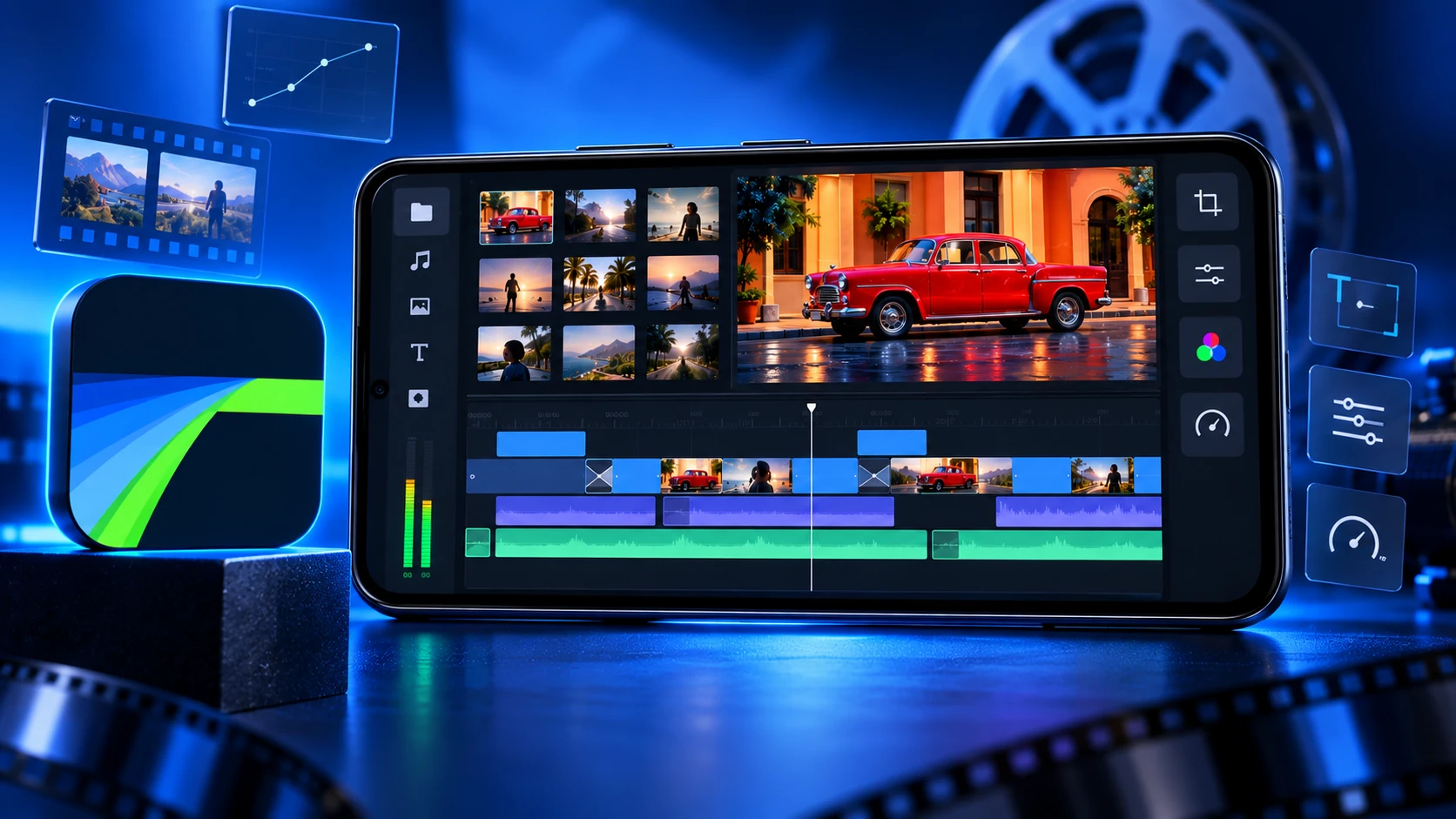
LumaFusion takes a very different approach. Rather than trying to make video editing feel like a collection of social media templates, it attempts to bring a proper non-linear editing experience to mobile devices.
The app is available on Android as well as Apple’s platforms and uses a one-time purchase model rather than relying entirely on a recurring subscription. That can make it attractive to users who expect to edit regularly and would rather pay upfront.
Its multi-track timeline supports video, audio, titles, and layered content. You can rearrange clips directly on the timeline and make detailed adjustments rather than relying heavily on automated effects.
Keyframing is another major strength. Many parameters, including visual and audio settings, can be animated over time. This gives you much more control when creating gradual changes in position, scale, opacity, or other settings.
The interface can also be rearranged into different layouts and works in portrait and landscape orientations. That is useful if you regularly move between vertical social media videos and traditional widescreen projects.
There is a learning curve. LumaFusion is considerably denser than a beginner-focused app such as CapCut or InShot. The extra complexity starts making sense when you’re editing longer YouTube videos, business content, interviews, or projects that require several tracks.
LumaFusion is particularly suitable for users who want their Android phone or tablet to function more like a compact editing workstation.
3. CyberLink PowerDirector
CyberLink PowerDirector has been around as a desktop video editor for years, and its Android version brings many familiar concepts to mobile.
The app uses a multi-track timeline where you can arrange video, audio, titles, effects, and transitions. Chroma key is available for green-screen projects, while the broader toolset is suitable for YouTube videos, marketing material, presentations, and social media content.
PowerDirector also connects with stock libraries such as Pexels and Pixabay, allowing users to bring additional images and footage into their projects. iStock content is available as a paid option.
The free version gives you enough functionality to understand how the editor works before deciding whether you need its premium features. Subscription plans unlock additional tools and remove restrictions that apply to free exports, including the free-tier HD limitation described by the developer.
There is also a practical consideration around permissions. The app requests broad access to the device’s media library, including when you’re working with or exporting projects. Anyone who pays close attention to app permissions should review what access is being requested before getting started.
PowerDirector is a good middle ground between a simple social editor and a professional-style mobile editor. Its biggest weakness is that some parts of the interface feel closer to desktop software than a tool designed specifically around touchscreen use.
4. Adobe Premiere Rush
Adobe Premiere Rush is designed for people who want a relatively straightforward editing experience while remaining inside the Adobe ecosystem.
The app works across Android, iOS, iPad, Windows, and macOS. It can be used for free with limitations, while paid plans provide access to additional features and cloud storage. Existing Adobe Creative Cloud subscribers should check their current plan before paying for another subscription.
Rush uses a magnetic timeline that automatically shifts clips when you move or resize material. Once you’re familiar with the system, this can make rough cuts quicker because you spend less time manually fixing gaps in the sequence.
The app also includes motion graphics, color adjustment tools, fonts, and effects. Creative Cloud synchronization allows projects to move between compatible devices, which is useful when you start an edit on your phone and want to continue on a desktop.
Premiere Rush is particularly suited to creators who publish regularly on YouTube, Instagram, or other social platforms and want a clean workflow without jumping straight into the complexity of full Premiere Pro.
Its effects and transitions library is not as extensive as what you’ll find in some competitors. That limitation is deliberate to an extent. Rush focuses more on efficient editing and publishing than on building elaborate visual effects.
For someone already using Adobe products for graphics, thumbnails, or other content, the ability to keep projects within the same ecosystem can be a significant advantage.
5. KineMaster
KineMaster is aimed at users who want to get into editing quickly without sacrificing too many advanced tools.
You can start using the app without creating an account, and its free version supports a surprisingly capable set of editing functions. It also supports 4K export, although free exports include a watermark.
The interface revolves around a combination of timeline editing and ready-made assets. You can trim and layer clips, add text, use transitions, apply effects, and work with multiple tracks. Chroma key is included for green-screen editing.
KineMaster also has an asset store containing additional effects, transitions, music, graphics, and other resources. Some assets are available for free, while others are tied to its subscription plans.
Templates can be particularly useful if you’re producing similar videos repeatedly. For example, a creator who publishes several branded social posts each week can build a recognizable format and reuse elements instead of recreating everything from scratch.
The downside is that KineMaster does not offer a straightforward permanent purchase option that eliminates the subscription altogether. If you regularly depend on premium assets, that recurring cost needs to be considered.
KineMaster works well for users who want more flexibility than a basic mobile editor while still keeping the learning process relatively approachable.
6. InShot
InShot has traditionally been known as an easy-to-use social media editor, but its feature set has expanded considerably.
The app combines video and photo editing in the same interface and now includes several AI-powered features. These include automatic captions, AI speech tools, AI cutout, background removal, and enhancement features designed to improve footage.
The standard editing tools cover trimming, splitting, merging, transitions, keyframe animation, chroma key, speed adjustments, and picture-in-picture layers. This makes it capable of handling everything from short social clips to more structured videos.
InShot supports exports up to 4K at 60fps according to its current feature information. That gives creators considerable flexibility when working with modern smartphone footage.
The app follows a free-to-download model, while InShot Pro Unlimited removes advertising and watermarks and provides access to premium effects, stickers, filters, and other assets. A one-time purchase option is also available, which gives it a different pricing approach from some subscription-only competitors.
InShot overlaps heavily with CapCut, particularly for Instagram, TikTok, and YouTube Shorts. The difference often comes down to interface preference rather than a huge gap in basic editing capability.
Its photo editing and collage functionality also gives InShot an advantage for people who create both static and video content.
7. VN Video Editor
VN Video Editor is worth considering if you want a free editor with a stronger focus on manual timeline control.
Exports do not carry a watermark, which immediately makes VN interesting for users who do not want to pay simply to remove branding from their videos.
The timeline resembles a simplified desktop editor. Clips can be arranged precisely, and the app provides detailed controls for zooming, selecting, trimming, and positioning material. Keyframe adjustments can be made with fine timing, which is useful for users who care about exact animation.
VN supports multiple layers for video, photos, stickers, and text. These elements can be animated with keyframes, allowing you to create custom movements instead of relying entirely on preset effects.
The app also includes curve speed controls, chroma key, masking, and HDR video editing on compatible devices. Export settings can be customized for resolution, frame rate, and bitrate, with support reaching up to 4K at 60fps.
Drafts are saved automatically, and projects can move between mobile and desktop environments. That makes VN particularly useful for someone who begins editing on a phone but eventually wants to finish the project on a larger screen.
VN does not lean as heavily into AI as some newer editors. For certain users, that is actually an advantage. If you prefer making your own cuts, transitions, keyframes, and timing decisions, VN provides the tools without constantly trying to automate the process.
It is closer in spirit to LumaFusion than to template-driven social editors, while remaining free to use.
8. Videoleap
Videoleap takes a more experimental approach to mobile video editing. Developed by Lightricks, it puts considerable emphasis on AI-powered creative tools.
Alongside standard editing functions, Videoleap includes AI image generation, AI filters, AI voice tools, and AI Recolour. These features allow creators to modify footage in ways that would traditionally require several separate applications.
Its AI Uncrop feature can extend the frame of a video, although the current functionality has limitations. For example, the feature described in the source material works on the first frame of a clip.
Videoleap offers a free trial, while full access requires either a subscription or a one-time purchase. Phone editing is limited to portrait orientation, while the tablet version supports both portrait and landscape.
AI-generated content also has additional restrictions around saving, making it important to test the free experience before committing to a paid plan.
Videoleap is most interesting for social creators who want unusual visual effects or AI-assisted transformations without having to combine several different apps.
It is not necessarily the strongest choice for traditional editing. Dedicated timeline editors such as VN or LumaFusion offer more depth when the primary goal is organizing long footage, building detailed sequences, and managing several tracks.
For that reason, Videoleap can work especially well as a creative companion to a conventional video editor.
9. Alight Motion
Alight Motion occupies a different category from most apps on this list. It is better described as a motion graphics and animation tool that also handles video than as a conventional video editor.
That distinction matters. If your goal is simply to cut clips together, add music, and upload the result, Alight Motion may be more complicated than necessary. If you’re creating animated titles, logo introductions, visual effects, or sophisticated motion graphics, its feature set becomes much more relevant.
The app supports multiple layers of graphics, video, and audio. It also provides vector and bitmap editing, giving creators more control over graphical elements directly from a mobile device.
There are more than 160 basic effect building blocks that can be combined to create custom effects. Keyframe animation is available across settings, while parent-child layer relationships make it possible to link elements together for more advanced animations.
The camera system can also be used for effects such as panning, zooming, and focus blur.
Alight Motion is free to use, although exports carry a watermark unless you subscribe or make a one-time purchase. Paid access also provides additional premium effects.
The learning curve is considerably steeper than that of a typical social video editor. You need to understand layers, keyframes, timing, and easing to get the most from it.
For motion graphics, however, that complexity is precisely what makes Alight Motion useful.
10. YouCut
YouCut is another strong option for anyone searching for a capable free Android video editor without wanting a watermark or constant banner advertising.
The app has added several AI-based features, including AI Avatar, automatic AI Captions, AI Cutout, and AI Enhance. These tools cover common tasks such as generating subtitles, removing backgrounds, and improving footage.
Its standard editing features include video splitting and merging, multi-layer editing, chroma key, green-screen support, and speed controls. The speed range extends from 0.2x to 100x, giving creators plenty of flexibility for slow-motion and fast-motion effects.
YouCut can also turn photos into videos through its slideshow functionality. Picture-in-picture layering is available as well, allowing multiple visual elements to appear within the same project.
The app supports HD exports without forcing users through the advertising experience found in some competing free editors. Some advanced AI features are available through in-app purchases.
YouCut and InShot come from the same publisher, so there are similarities between their interfaces and feature sets. YouCut feels slightly more focused on conventional video editing, while InShot places more emphasis on social sharing and photo-related features.
If you want a straightforward editor that covers everyday editing tasks without immediately putting a watermark on your work, YouCut is worth trying.
Frequently Asked Questions
What is the best free video editing app for Android?
KineMaster and YouCut are strong choices if you’re specifically looking for free editing tools. Both allow users to start without an account and support 4K export without requiring a subscription for that basic capability.
VN Video Editor is another particularly interesting option because its exports do not carry a watermark. CapCut and InShot are also useful free-to-start choices, although their premium plans become more relevant when you need additional effects, assets, or watermark-free output.
The best option ultimately depends on what you consider essential. Someone who needs templates may prefer CapCut, while an editor who wants precise timeline control may be happier with VN.
Is CapCut safe to use on Android?
CapCut is developed and maintained by ByteDance and is distributed through the official Google Play Store. Like other mobile editing apps, it can request access to media, camera, or microphone features depending on what you use.
Before installing or granting permissions, review what the app requests and make sure you’re comfortable with the access being provided. It is also sensible to keep the app updated and download it from the official store rather than unofficial APK sources.
Which Android video editing app is closest to a desktop editor?
LumaFusion and VN Video Editor are among the closest options if you want a desktop-style editing experience on Android. Both provide multi-track timelines, detailed controls, and keyframe-based editing.
PowerDirector is another option, particularly for users who already know its desktop counterpart. Its interface retains more of the traditional desktop-editor approach, although that can also make it feel slightly less optimized for touchscreens.
Do these Android video editors work without an internet connection?
Most basic editing functions can be used offline after the application and necessary assets have been installed. Cutting clips, adding text, arranging layers, and exporting a project generally do not require a continuous internet connection.
The situation is different for cloud-based and online features. Stock libraries, downloadable effects, AI services, and synchronization features may require an internet connection. Some AI processing can also take place remotely rather than directly on your phone.
If offline editing is important to you, test the specific features you depend on before starting a large project.
Can I edit 4K video on a mid-range Android phone?
You can edit 4K footage on many mid-range Android phones, but support for 4K does not necessarily mean the experience will be smooth.
Video editing puts considerable pressure on the processor, graphics hardware, memory, and storage. High-resolution footage can cause timeline playback to stutter, make scrubbing less responsive, and increase export times.
If your phone struggles with 4K projects, working with 1080p versions of your clips can make editing considerably easier. You can then use the original footage for the final workflow if the device and app can handle the export.
How to Choose the Best Video Editing App for Android
Choosing between the best video editing apps for Android and alike becomes easier once you decide what type of content you actually create.
For short social media clips, CapCut, InShot, and YouCut are practical choices. Their interfaces are relatively approachable, and templates, effects, captions, and social-oriented tools can reduce the amount of manual work involved.
YouTube creators working with longer videos may want something with a more traditional timeline. LumaFusion, VN Video Editor, and PowerDirector provide more control over multiple tracks and detailed editing.
If you’re already using Adobe products, Premiere Rush is worth considering because its cloud-based workflow can make moving between devices easier.
Motion graphics are a different story. Alight Motion is specifically designed around animation and visual effects, so it makes more sense for animated titles, intros, logos, and similar work than a conventional social editor.
Videoleap is worth considering when AI-powered creative effects are more important than traditional timeline depth.
Pricing is another factor. CapCut, InShot, KineMaster, and YouCut all follow a free-to-start approach with paid features layered on top. LumaFusion uses a one-time purchase model. PowerDirector, Premiere Rush, VN, Videoleap, and Alight Motion offer different combinations of free access and paid upgrades.
There is no universally better pricing model. A subscription can make sense if you regularly use premium features and receive ongoing updates. A one-time purchase may be preferable if you want to avoid recurring charges. A free editor can be perfectly adequate if you do not need premium effects or other locked features.
Storage should also be considered. AI tools, downloadable effects, stock footage, and large asset libraries can consume significant space. If your Android phone has limited storage, a simpler editor may be easier to manage than an application that continually downloads creative assets.
Finally, do not judge an editor entirely by its feature list. Install two or three apps and run the same short project through each. Pay attention to how quickly you can find tools, whether the timeline feels comfortable, how smoothly the phone handles playback, and how much control you have over the final export.
Those practical details often matter more than having dozens of features you never use.
Final Thoughts
The best video editing app for Android depends less on having the longest feature list and more on matching the software to your editing habits.
CapCut and InShot are strong choices for fast social content. YouCut and VN are appealing if avoiding watermarks is important. LumaFusion is better suited to people who want a more serious editing environment, while PowerDirector offers a useful middle ground between mobile simplicity and desktop-style functionality.
Premiere Rush makes the most sense for creators already working with Adobe, and Videoleap is particularly interesting for AI-assisted creative work. Alight Motion has a much narrower focus, but it can be the right tool when animation and motion graphics are the main goal.
There is also no reason to limit yourself to a single editor. A creator might cut a long video in VN or LumaFusion, create a specialized animation in Alight Motion, and then use another application for a particular social format.
Once your video is finished, you may also want to watch or share it on a larger screen. Our guide to streaming apps for Android TV covers some useful options for setting up your TV for video playback.
If music is an important part of your editing workflow, having reliable audio available offline can also help. Our list of offline music apps covers Android options that work without Wi-Fi.
And if you’re customizing your phone around content creation, our roundup of lock screen apps has more options worth exploring.
The easiest way to find your personal favorite is still to try a few editors with the same footage. Specs can tell you what an app is capable of, but actually editing with it tells you whether it fits the way you work.
