

Datacenter proxies remain the most cost-effective way to rotate IP addresses, bypass geo-restrictions, and keep your automation tools or scraping bots running without interruption. Whether you are tracking competitor prices, gathering market data, or running large-scale SEO research, datacenter proxies give you the speed and volume you need at a price that makes sense.
Proxy servers sit at the center of modern web scraping workflows. Every serious scraping operation eventually needs to route requests through clean, fast IPs to avoid blocks. Websites today detect and ban suspicious traffic quickly, and a good datacenter proxy provider is what keeps your pipeline moving. Without proper proxy coverage, even a well-written scraper can hit a wall within minutes.
This guide covers the best datacenter proxy providers currently available, based on hands-on testing, official pricing data verified from provider pages, and real-world performance factors.
What Are Datacenter Proxies?
A datacenter proxy works the same way any proxy does: it acts as the go-between for your device and the target server, masking your real IP. The difference is in the source. Datacenter proxies come from large commercial server clusters rather than home internet connections, which means faster speeds, more stable uptime, and better availability at scale.
Because these proxies do not tie back to a residential ISP, they can be easier for sophisticated websites to identify. That said, for the majority of use cases, including price monitoring, rank tracking, and scraping public data, they perform exceptionally well. Their stable infrastructure, speed advantage, and lower cost compared to residential proxies make them a default choice for businesses with consistent, high-volume proxy needs.
If you are new to the topic and want a clearer picture of how residential and datacenter options differ, our breakdown of residential proxies explained covers that in detail.
Top 10 Best Datacenter Proxy Providers
- Oxylabs – Overall Top Pick
- Webshare – Fast and Affordable
- Decodo – Reliable and Cost-Effective
- Bright Data – Industry-Leading Success Rates
- IPRoyal – Market-Leading Speed
- Proxy Empire – Lightning Fast
- NetNut – High Performance
- Storm Proxies – Pick for IT Services
- Rayobyte – Large Proxy Pool
- Infatica – Ethically Sourced
1) Oxylabs
Oxylabs operates one of the largest datacenter proxy pools on the market, with over 2 million dedicated IPs spanning 188 countries. Coverage includes the US, UK, Germany, Canada, Japan, Australia, and dozens of additional locations, with city and state-level targeting available across all of them. Shared proxy access includes a pool of 42,000 IPs across 30 countries, with the option to hold sticky sessions for as long as needed or cycle them with each new connection.
The platform gives users the choice between pay-per-IP and pay-per-traffic billing, with no hidden fees on either model. For anyone running scraping pipelines or competitive intelligence tools at scale, their unlimited bandwidth policy with fair usage terms is a meaningful advantage. Each dedicated IP comes with up to 100 concurrent sessions and 100GB of data included.
Oxylabs consistently ranks among the top performers for datacenter proxy speed and success rates, which holds up in practice for high-volume data tasks.
Oxylabs Key Features:
- 2M+ dedicated datacenter IPs across 188 countries, with city and state targeting
- Unlimited bandwidth per IP with a fair usage policy and no extra charges
- Pay-per-IP or pay-per-traffic billing with transparent, fixed pricing
- 99.9% uptime guarantee and auto-retry system built in
- Integrates with popular third-party scraping tools and automation frameworks
- 5 free IPs on signup with no credit card required
Pricing: Starting at $1.20/IP (plans from $50/month)
Pros:
- Massive IP pool with deep geographic coverage
- Unlimited bandwidth with no overage surprises
- High success rates, independently verified
- 24/7 live support and dedicated account manager
- Flexible billing suits both small and enterprise users
Cons:
- Dashboard may feel complex for first-time proxy users
2) Webshare
Webshare is the easiest entry point for fast, anonymous proxies without a big upfront commitment. New users get 10 free datacenter proxies and 1GB of monthly bandwidth with no credit card required, and those free proxies never expire. The platform supports both HTTP and SOCKS5 protocols, and lets you configure country, bandwidth, threads, and speed from a clean dashboard.
Network speeds across Webshare’s infrastructure exceed 100 Gbps, backed by dedicated gigabit lines that maintain stable connections even during peak load. Uptime sits at 99.97% across more than 50 countries. Datacenter proxies start at $0.05 per IP, and shared datacenter plans begin at $2.99 per month, putting Webshare among the most budget-accessible providers on this list. Private datacenter proxies are available from $0.74 per proxy.
For anyone running scraping jobs at scale who needs predictable costs and solid speed, Webshare hits the right balance without forcing you into enterprise pricing from day one.
Key Features:
- Fully configurable proxy lists with control over country, threads, bandwidth, and speed
- Dedicated gigabit lines for consistent performance
- No data sharing with third parties
- Free tier available with no time limit
Pricing: Starting at $0.05/IP (shared plans from $2.99/month)
Pros:
- Coverage across 50+ countries at affordable rates
- Strong datacenter performance for the price
- The free plan lets you test before committing
- Scales smoothly as usage grows
Cons:
- Advanced enterprise features are limited on lower tiers
3) Decodo
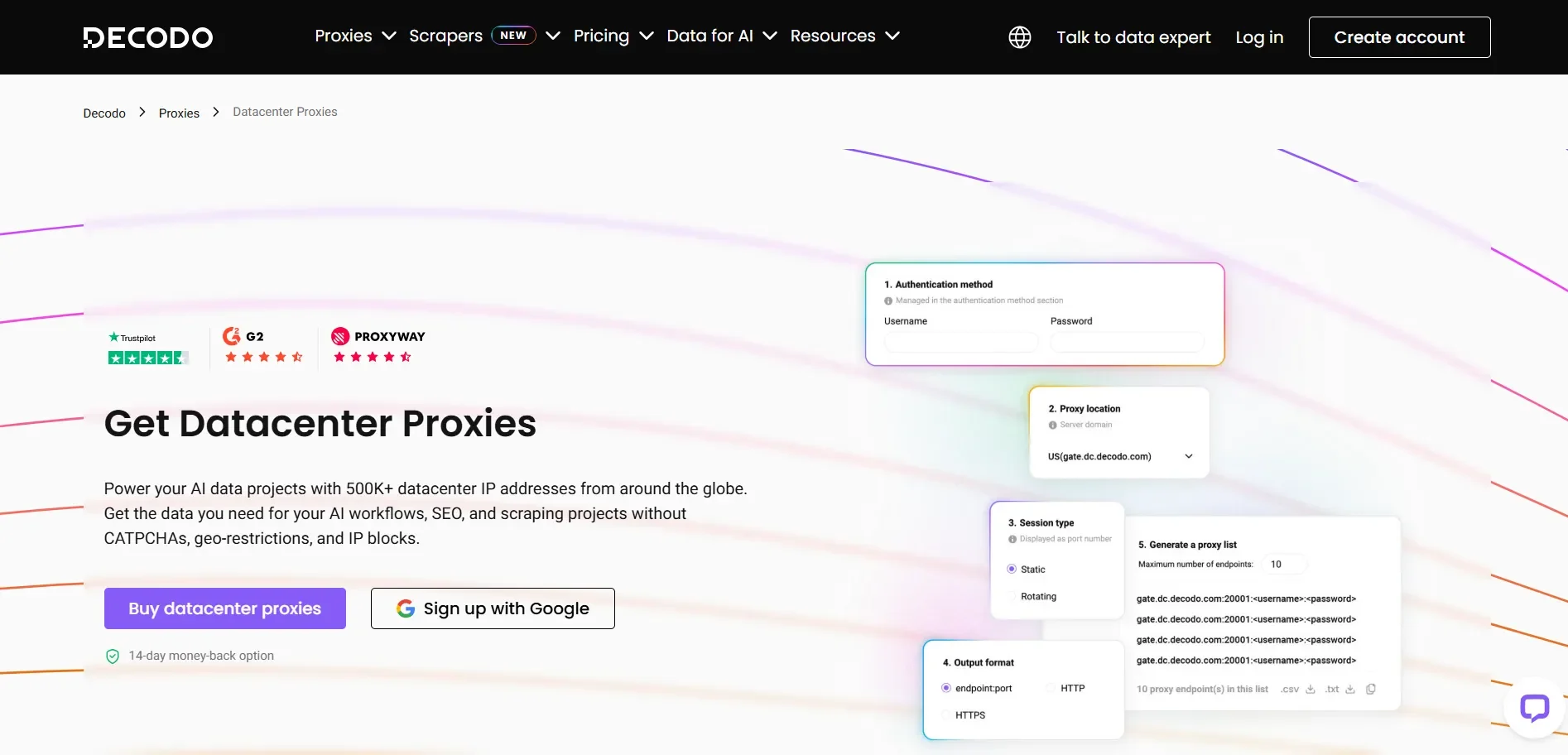
Decodo (formerly Smartproxy) has built a reputation as one of the best-value datacenter proxy providers for developers, businesses, and data teams running serious operations. Its network covers 500,000+ datacenter IPs across 15+ countries, including the US, UK, Germany, France, Canada, and Australia, with average response times under 0.3 seconds and 99.99% uptime.
The platform offers a single endpoint setup that removes the complexity of managing multiple proxy connections. Authentication works via username/password or IP whitelisting, and real-time analytics give you visibility into bandwidth, request volume, and overall performance. Unlimited traffic plans are available for large-scale operations, and pay-per-GB plans start at $0.60/GB for datacenter proxies, making it one of the most cost-efficient picks on this list.
Decodo is also a member of the Ethical Web Data Collection Initiative, which matters if compliance and responsible sourcing are part of your requirements.
Read our Decodo Review for more details on its full feature set.
Key Features:
- Single endpoint management for simplified proxy operations
- IP whitelisting and credential-based authentication
- Real-time dashboard with bandwidth and performance monitoring
- High-speed proxies with sub-0.3s average response time
Pricing: Starting at $0.026/IP; Pay-per-GB from $0.60/GB
Pros:
- Competitive pricing for datacenter proxy volume
- Consistent 99.99% uptime with fast response
- Flexible billing, including unlimited traffic options
- EWDCI-compliant sourcing
Cons:
- Rotating IP configuration has a slight learning curve for new users
4) Bright Data
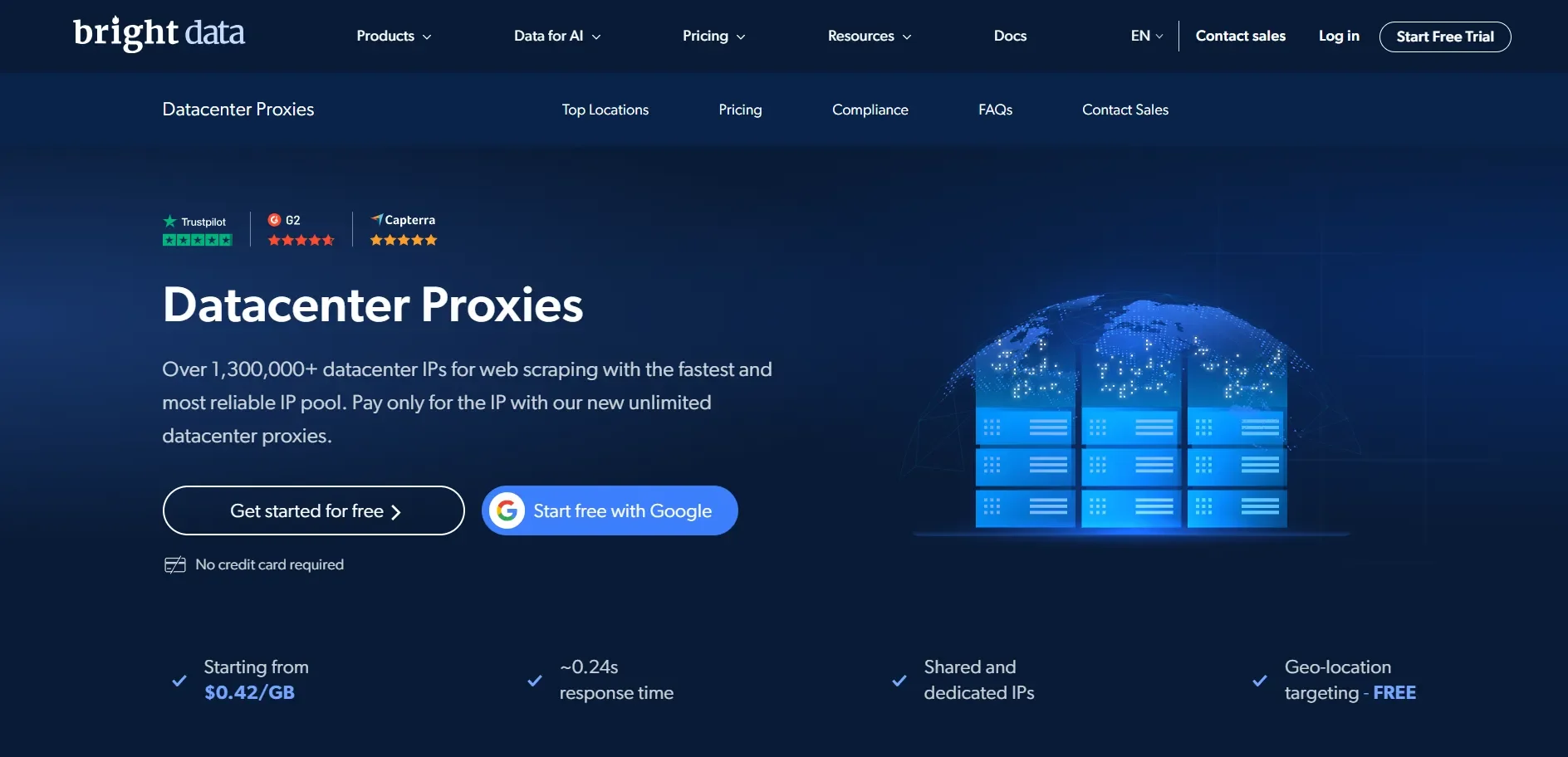
Bright Data operates one of the most capable datacenter proxy networks available, with over 1.3 million shared and dedicated IPs across 98 countries. The platform covers at least 50 global locations with city and country-level targeting as standard, and rotation is fully configurable: you can rotate with each request, hold sticky sessions, or let failed IPs auto-replace in real time.
Datacenter proxy pricing starts at $0.90/IP for dedicated proxies or $0.077/GB for shared bandwidth-based plans. Pay-as-you-go is available at $0.60/GB, which suits projects with unpredictable volume. Bright Data’s network maintains 99.99% uptime with a live status monitor, and the platform integrates cleanly with popular scraping frameworks and automation tools.
The platform is particularly strong for enterprise-level use cases where compliance matters: Bright Data is one of the few providers to offer a 7-day free trial for registered businesses, and their infrastructure is 100% compliant with relevant data collection standards.
Key Features:
- 1.3M+ datacenter IPs across 98 countries, shared and dedicated
- Pay-per-IP, pay-per-GB, or pay-as-you-go billing options
- 99.9% success rate with auto IP replacement on failure
- Real-time network status monitor with live uptime tracking
- 7-day free trial available for registered businesses
Pricing: Starting at $0.90/IP; bandwidth plans from $0.077/GB
Pros:
- Excellent global coverage with deep targeting options
- Flexible billing to match varied project sizes
- High success rate consistently reported across targets
- Seamless third-party integration
Cons:
- Among the pricier options for smaller volumes
- Some regional proxies may show minor inconsistencies
Read our Bright Data Review for a full breakdown.
5) IPRoyal
IPRoyal sits in a strong position for users who need fast, dedicated datacenter IPs without overspending. The provider covers residential, datacenter, mobile, and sneaker proxy types under one platform, with a library of over 8 million IPs and a customer support team available around the clock.
Their datacenter proxies are dedicated per user, with both UDP and TCP connection support, unlimited traffic, and clean API access for easy integration. Businesses use IPRoyal for market research, data scraping, app testing, social media account management, and price monitoring. Uptime consistently holds at 99.9%, and pricing starts at just $1.39 per proxy, making it one of the more accessible options for teams that need private, high-speed IPs without committing to a large monthly plan.
Key Features:
- 99.9% uptime with unlimited traffic per proxy
- Dedicated IPs with UDP/TCP support
- API access for tool integration
- Ethically sourced proxy network
Pricing: Starting at $1.39/proxy
Pros:
- Competitive pricing for dedicated datacenter proxies
- Strong privacy and security standards
- Broad country coverage for datacenter IPs
- Reliable live support
Cons:
- No mobile app for proxy management
- Entry-level free proxies can be slower
6) Proxy Empire
ProxyEmpire approaches datacenter and residential proxies with a bandwidth-first billing model rather than per-IP charges. That means you pay for the data you actually use, which works well for projects with variable traffic patterns. The residential proxy pool sits at 5.3 million IPs, and bandwidth-based plans start at $45 for 3GB.
The platform lets you browse safely, bypass geographic restrictions, and pull data from target sites across the globe. ProxyEmpire’s interface makes it easy to adjust settings on the fly, and unlimited data rollover means unused bandwidth carries over to your next billing cycle rather than disappearing. New users can try the service for just $1.97 before committing to a full plan.
Pros:
- Bandwidth billing eliminates per-IP cost surprises
- Clean, adjustable interface
- Unlimited data rollover between billing periods
- Accessible trial at $1.97
Cons:
- Brand recognition is lower compared to larger providers
7) NetNut
NetNut’s datacenter offering leans into ISP-sourced proxies that blend the detection-resistance of residential IPs with the speed and stability of datacenter infrastructure. The network includes 150,000 shared datacenter IPs, with multiple users splitting the cost, keeping prices lower than dedicated alternatives. For simpler scraping jobs, they offer 110,000+ US datacenter IPs.
Beyond their datacenter pool, NetNut also operates 52 million rotating residential proxies globally, giving users a single provider for varied use cases. US datacenter plans start at $100/month for 100GB of bandwidth, with no concurrency limits, so you can open as many simultaneous connections as your project requires.
NetNut is built for teams that want to run scraping infrastructure at scale without micromanaging connection counts. Their target unblocking approach works well when paired with proper session management.
Pros:
- ISP-grade proxies with residential-level stealth
- No concurrency limits on datacenter plans
- 52M+ rotating residential IPs for cross-type coverage
- Dedicated account manager included
Cons:
- Entry pricing is higher, better suited for enterprise use cases
8) Storm Proxies
Storm Proxies serves businesses and IT teams that need dedicated, private proxy infrastructure at an accessible price point. The provider offers three proxy types: rotating residential proxies, private dedicated datacenter proxies, and backconnect rotating proxies that combine both datacenter and residential IPs in one pool.
The datacenter IP pool draws from more than 70,000 addresses, the majority hosted in the US and Europe. Storm Proxies does not publicly disclose its total server count, but the IPs are internally hosted, meaning you are the sole user of any dedicated proxy you purchase. Plans start at $14 and cover rotating residential (1 port), dedicated IPs (5 proxies), and backconnect proxies (10 threads), with unlimited bandwidth included across all tiers.
Pros:
- Very affordable pricing across all plan types
- Straightforward setup and clean interface
- 24-hour residential proxy refund window
- Unlimited bandwidth
Cons:
- Geotargeting options are limited compared to larger providers
- Support response times can vary
9) Rayobyte
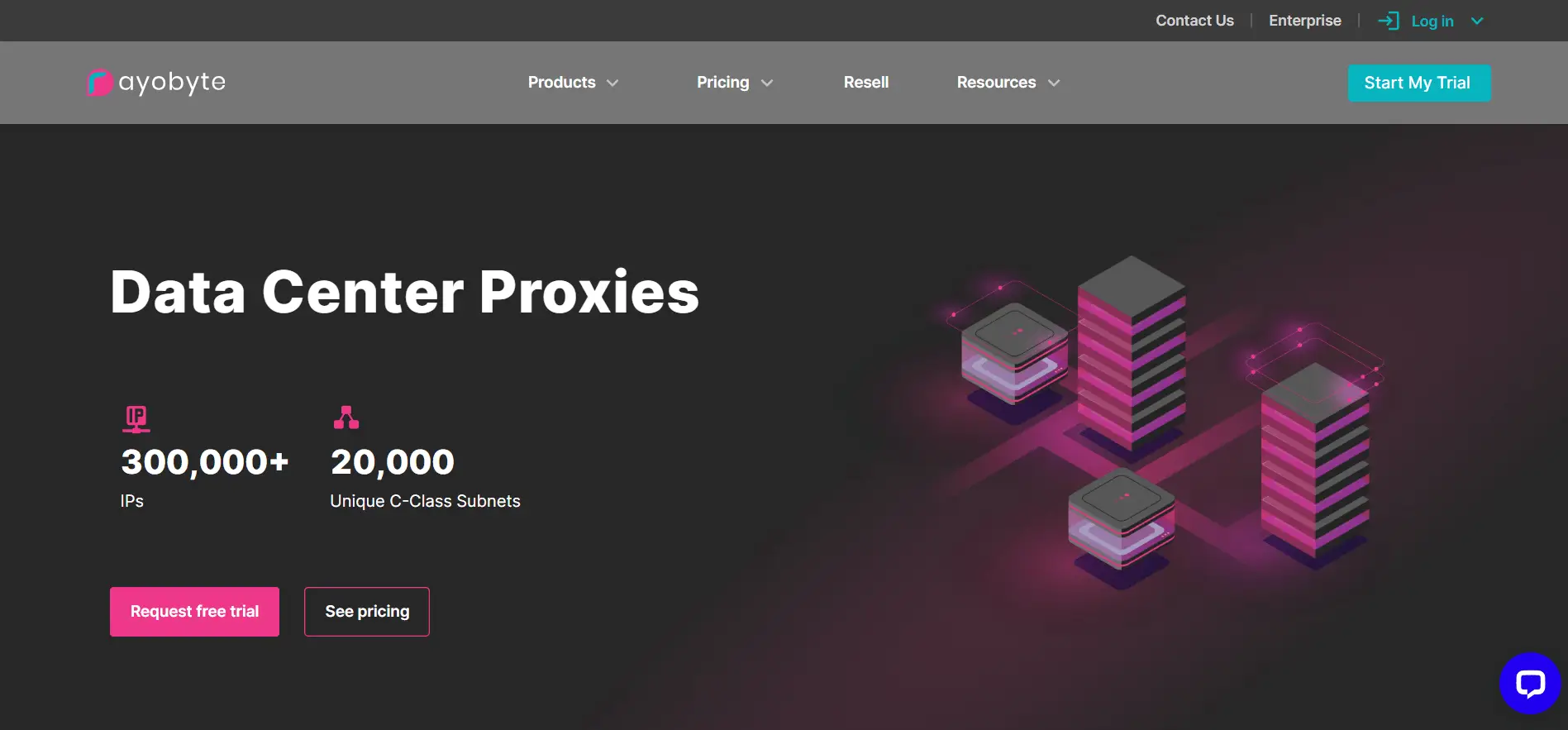
Rayobyte provides dedicated, semi-dedicated, and rotating datacenter proxies with no caps on bandwidth, domains, or concurrent threads. Users who need virgin IPs for sensitive tasks such as account registration or search engine scraping will find them here, alongside automatic proxy replacements that run once per month.
Dedicated datacenter coverage spans 26 countries, with the bulk of the IP pool based in the US. Additional targeting is available across Southeast Asia, South America, and Western Europe. The proxy pool exceeds 200,000 IPs, and connection speeds reach up to 1 Gbps. Dedicated plans start at $12.50 for 5 IPs ($2.50/IP), while shared plans begin at $4 for 5 IPs ($0.80/IP), making Rayobyte a flexible option for teams that want cost control at different usage levels.
For teams running job data extraction or similar large-scale scraping projects, the unlimited threads and bandwidth policy removes a common friction point.
Pros:
- Unlimited bandwidth, domains, and threads
- Fast connections up to 1 Gbps
- Custom plan options for specific project needs
- Responsive customer support team
Cons:
- Use cases are narrower than all-in-one proxy platforms
- The feature set is more limited relative to top-tier providers
10) Infatica
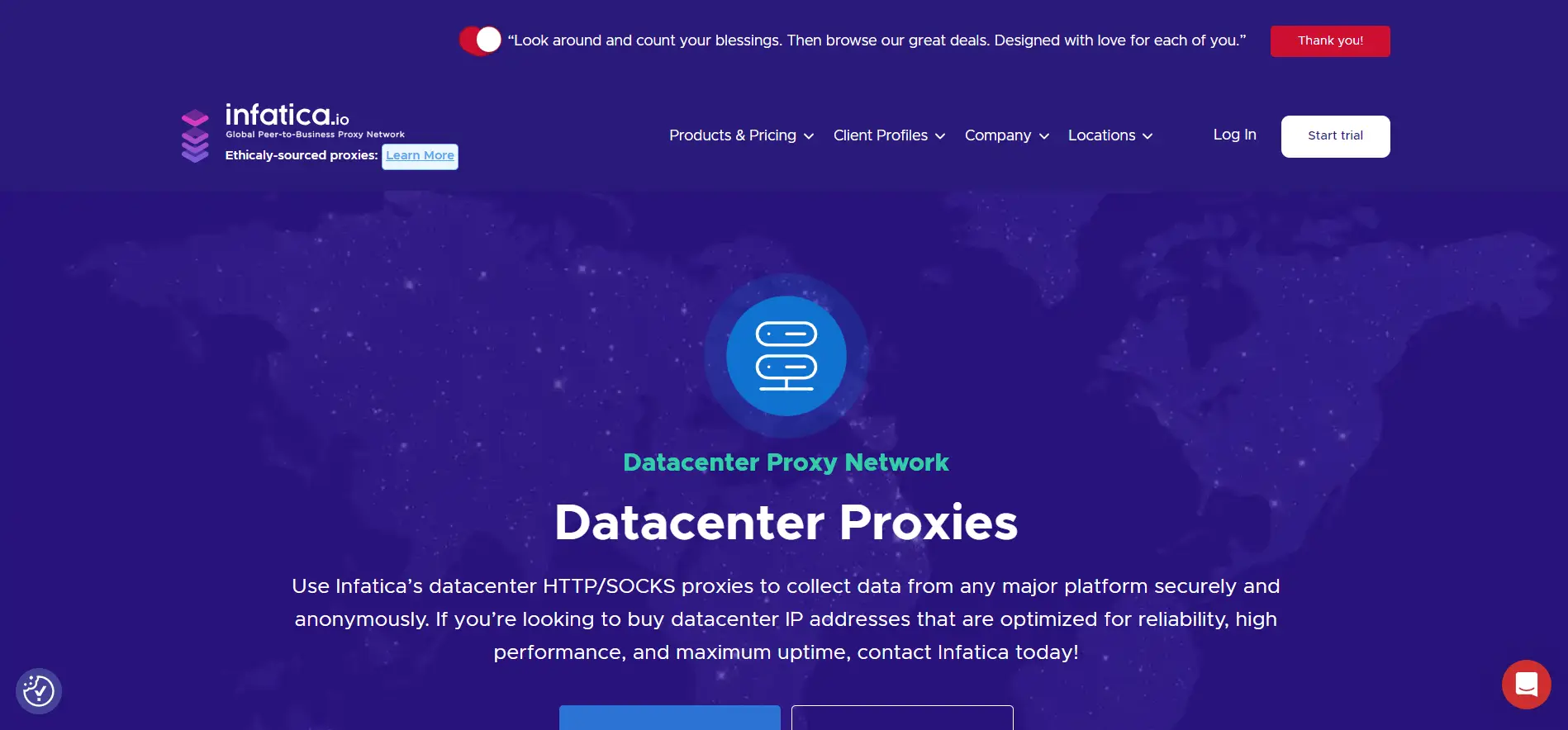
Infatica started as a premium residential proxies provider but has since expanded into mobile, datacenter, and web scraping API services. The Singapore-based company operates a proxy pool exceeding 10 million IPs with end-to-end data encryption built in, and its pricing is designed to stay competitive with or below mid-range rivals at higher data volumes.
For scraping operations that involve structured data collection, Infatica’s web scraping proxy service gives fresh IPs that are not shared with neighbouring users on the same plan. Subscription plans add fees based on data transfer, with pricing starting at $96. SOCKS5 support is included, and the platform includes built-in performance and uptime monitoring so you can track proxy health over time.
Pros:
- Multiple proxy types under one platform
- Unlimited bandwidth on available plans
- Competitive pricing for higher data volumes
- SOCKS5 support and uptime monitoring included
Cons:
- Geotargeting options are limited
- Authentication methods could be broader
What Are Datacenter Proxies Used For?
1) SEO Monitoring
SEO professionals use datacenter proxies to run rank tracking tools, keyword scrapers, and competitor analysis platforms without triggering CAPTCHA systems or IP bans. The speed and volume that datacenter proxies provide make them a natural fit for tools that need to send hundreds of search queries in a short window. Tasks like tracking SERP positions across multiple locations or auditing backlink profiles benefit from a clean, fast proxy layer.
2) Scraping Public Sites
Web scraping is the most common reason teams reach for datacenter proxies. When your scraper sends repeated requests from a single IP, the target site flags it quickly. Rotating datacenter proxies let you distribute that traffic across hundreds or thousands of different addresses, keeping your collection pipeline running smoothly. For teams scraping real estate listings or e-commerce product data at volume, a reliable datacenter proxy pool is essential.
3) Testing and Deploying Apps
Developers use datacenter proxies during app testing to simulate requests from different locations and verify that localized features behave as expected. Proxy servers ensure that location-sensitive services work correctly across regions, and in parallel testing environments, assigning unique IPs to each test client prevents result contamination from shared addresses.
4) Price Monitoring
Retail, travel, and hospitality companies use datacenter proxies to pull competitor pricing data at scale from public web pages. This kind of continuous price monitoring helps businesses stay competitive, adjust their own pricing dynamically, and catch market shifts early. Since price pages often have IP restrictions or CAPTCHA layers, datacenter proxies are the practical solution for avoiding those barriers without slowing down collection frequency.
5) Social Media Account Management
Managing multiple social accounts from a single IP is a fast way to trigger platform-level blocks. Datacenter proxies add a separate IP layer for each account, protecting identities and enabling geo-targeted operations. Tools built on Selenium or Puppeteer integrate cleanly with datacenter proxies for automated social media workflows at scale.
6) Buying Limited-Release Products
Sneaker bots, ticket bots, and retail automation tools rely on datacenter proxies to bypass per-user purchase limits on high-demand items. When a site restricts how many units a single IP can add to a cart, proxies let users spread requests across multiple IPs to get around those caps. Datacenter proxies are a common choice for this use case because of their speed and availability in bulk.
7) Geo-Restricted Access
Companies gathering competitive intelligence often encounter geo-blocks that restrict access to content based on the user’s apparent location. Assigning an IP from the relevant country via a datacenter proxy resolves that issue without needing a VPN, which can be slower and harder to scale. This approach is widely used for market research that spans multiple regions.
8) Faster Speeds
Datacenter proxies pull their IP addresses from cloud servers with dedicated high-speed connections, which typically outpace residential IPs in raw throughput. For speed-sensitive tasks like financial data collection or time-critical scraping, that performance edge matters. The tradeoff is that datacenter IPs are more visible to detection systems than residential ones, so the right use case is important.
9) Web Scraping Rotation
Websites that detect heavy scraping activity will blacklist a single IP quickly. Rotating datacenter proxies cycle through a pool of addresses, either with each request or on a timed interval, to keep scraping activity looking distributed and normal. This is a core technique for avoiding CAPTCHA blocks at scale and keeping data collection pipelines healthy.
10) An Affordable Solution
For businesses with high proxy volume needs, datacenter proxies are consistently the most cost-efficient option. They do not rely on residential devices or mobile networks, which keeps infrastructure costs down. Most providers offer bulk pricing that drops per-IP or per-GB costs significantly at scale, making datacenter proxies the logical choice when budget and volume both matter.
FAQs
Are proxies legal?
Proxy use depends on the jurisdiction and how the proxy is being used. Proxy servers themselves are not illegal in most countries, but using them to circumvent terms of service, access restricted systems, or collect private data without permission can create legal exposure. Always review the terms of the platforms you access.
What is the fastest datacenter proxy?
Oxylabs is widely regarded as one of the fastest datacenter proxy providers, with average response times around 0.6 seconds and independently verified performance benchmarks. Decodo also posts strong speed figures with sub-0.3 second average response times across its datacenter network.
How do I choose the right datacenter proxy?
Start by deciding whether you need dedicated or shared proxies. Dedicated proxies give you exclusive use of an IP, which is better for sensitive tasks. Shared proxies cost less and work well for general scraping. From there, compare pool size, geographic coverage, pricing model (per IP vs. per GB), and how well each provider integrates with the tools you already use.
Are datacenter proxies detectable?
Yes, to an extent. Because datacenter IPs originate from cloud servers rather than ISPs, their source can often be identified through IP reputation databases and ASN-level filtering. Most websites can detect them if they check. That said, for the majority of public data collection tasks, they work fine. For targets with strong anti-bot systems, rotating residential proxies tends to have lower detection rates.
Conclusion
Choosing the right datacenter proxy provider comes down to matching your use case with the right balance of price, pool size, geographic reach, and speed. For large-scale enterprise scraping with the highest success rates, Oxylabs and Bright Data are the top-end options. For cost-conscious teams who need solid performance without the premium price tag, Webshare, Decodo, and IPRoyal cover the middle ground well. Smaller or more specialized needs are served by providers like Storm Proxies, Rayobyte, and Infatica.
Try a free tier or short trial before committing to a paid plan. Understanding how well a provider handles your specific targets, whether you are monitoring search results, scraping app store review data, or pulling product prices, will save you from locking into the wrong contract. The best datacenter proxy is the one that keeps your pipeline running reliably at the cost your project can sustain.
