
Disclosure: Some links in this article are affiliate or sponsored links. If you buy through them, we may earn a commission at no extra cost to you. Our opinions are our own.

Travel businesses run on information that changes by the hour. A hotel rate that looks competitive at 9 a.m. can be undercut by a rival listing before lunch. A flight route that was profitable last quarter can quietly lose demand the next. Anyone trying to plan pricing, marketing, or product strategy around the travel industry eventually hits the same wall: the data lives across hundreds of disconnected platforms, and pulling it together by hand simply does not scale.
This is exactly the gap that dedicated travel data providers fill. Whether you need a structured travel dataset for historical analysis or a live scraper that pulls fresh hotel and flight prices every few minutes, the right partner can save months of engineering work. Below is a hands-on comparison of the ten best travel data providers and databases worth evaluating, ordered by overall fit across business types rather than a single “best overall” ranking, and based on what each company actually states on its own website rather than marketing claims borrowed from review sites.
Why Travel Data Has Become a Competitive Necessity
Global travel has not slowed down. International tourist arrivals continued climbing through 2025, with Europe remaining the most visited region on the planet, anchored by France, Spain, and Italy. In the United States, the hotel sector alone has grown into a market worth hundreds of billions of dollars in annual revenue, and air travel demand has crossed milestones that were unthinkable a decade ago.
For a market this large, even small data advantages compound quickly. Teams that can see competitor pricing in real time adjust their own rates before they lose bookings. Teams that can track review sentiment across regions catch service problems before they become public relations issues. Teams that understand seasonal booking patterns plan promotions around actual demand instead of guesswork. The World Travel & Tourism Council regularly publishes figures putting the sector’s global GDP contribution in the trillions, a scale that makes manual data collection effectively impossible past a certain point.
The catch is that no single travel platform gives you the full picture. Airlines, hotel chains, OTAs (online travel agencies), and metasearch engines all operate as separate silos. Anyone building a pricing intelligence proxy strategy for other industries already knows this problem; travel just multiplies it across far more sources, each with its own anti-bot defenses, rate limits, and regional content variations. Tourism arrival figures tracked by UN Tourism show just how large that fragmented market has become, which is exactly why dedicated travel data infrastructure now exists as its own category.
What Counts as Travel Data
Before comparing providers, it helps to separate travel data into the categories that actually show up in datasets and scraping tools:
- Flight data: schedules, fares, routes, airline performance, and booking trends.
- Hotel data: room rates, availability, amenities, occupancy, and guest reviews.
- Activity and tour data: ticket pricing, time slots, popularity, and ratings.
- Car rental data: fleet availability, daily rates, and pickup locations.
- Destination data: local events, attractions, and seasonal travel patterns.
- Behavioral and intent data: what travelers search for, click on, and abandon mid-booking.
- Review and sentiment data: star ratings, written feedback, and management responses.
Most providers package this raw information in one of two ways: as a pre-built travel dataset you can download and plug straight into a spreadsheet or BI tool, or as a live scraping API that fetches current data on demand. Mature data programs usually combine both, leaning on datasets for trend analysis and scrapers for anything time-sensitive, like dynamic pricing.
How These Travel Data Providers Were Evaluated
Each provider below was assessed on the same criteria, so the comparison stays fair across very different business models:
- Market coverage: which travel verticals and source platforms are actually supported.
- Infrastructure: proxy network size, country reach, and uptime were disclosed.
- Data timeliness: live extraction, scheduled dataset refreshes, or both.
- Compliance posture: GDPR alignment and stated data-collection ethics.
- Accessibility: whether a free trial, sample dataset, or transparent pricing exists.
No two providers compete on identical ground here; some are infrastructure-first scraping companies, others are dataset marketplaces, and a couple are fully managed service shops, so the goal is to help you match the right type of provider to your actual use case rather than crown one universal winner.
At a Glance: All 10 Providers Compared
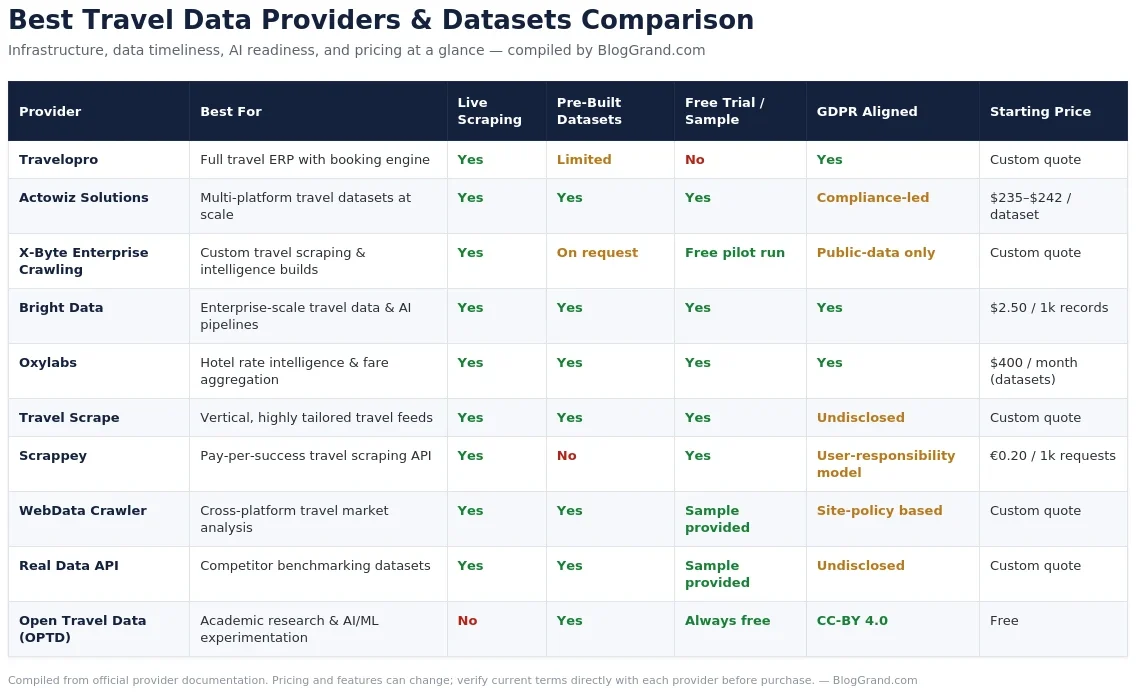
The 10 Best Travel Data Providers & Databases
1. Travelopro
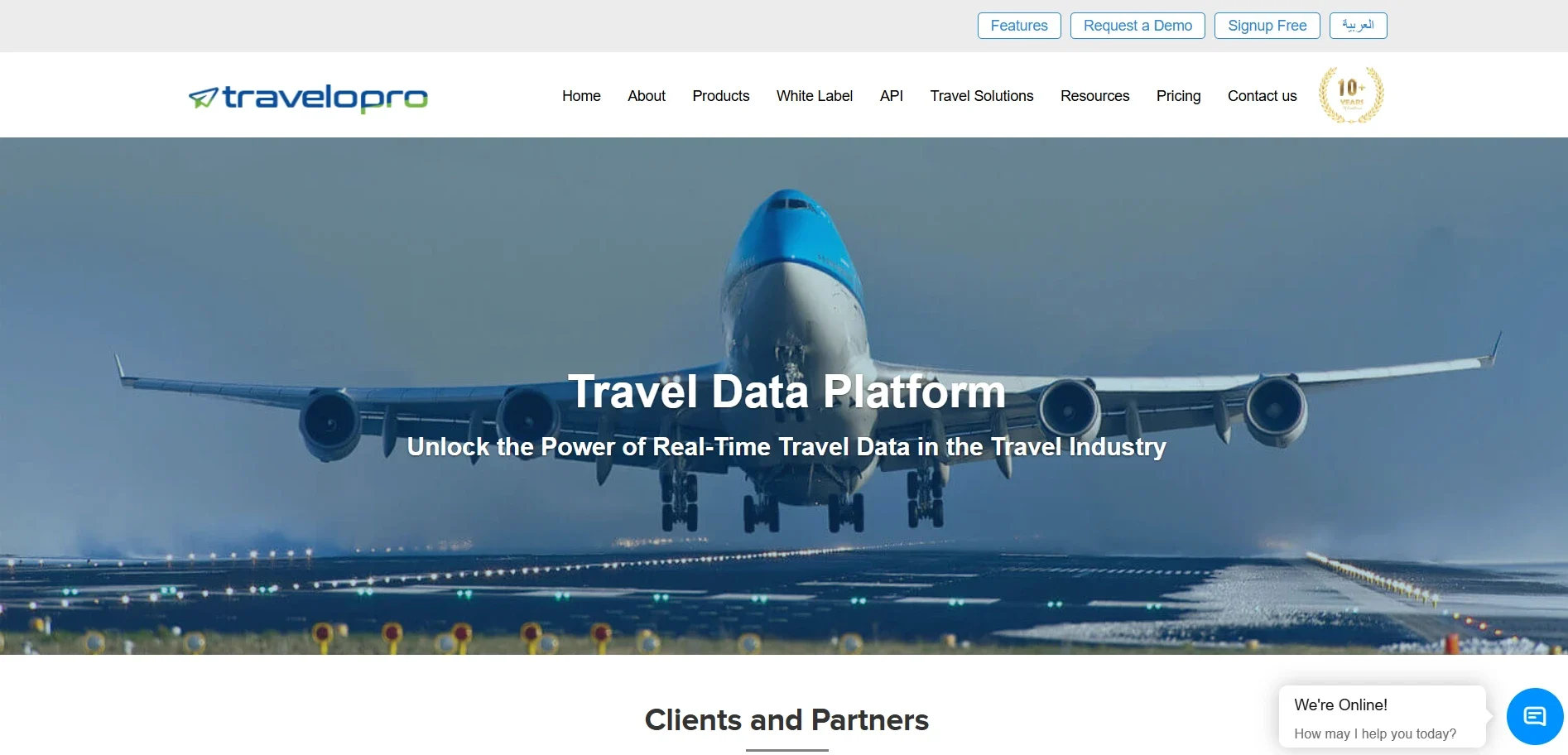
Travelopro takes a different approach than the scraping-first providers on this list. It is a complete travel technology stack: booking engines, white-label OTA portals, and GDS integrations layered on top of a travel data platform. Rather than just selling raw data, Travelopro positions itself as infrastructure for travel businesses that need both the data and the booking systems built around it.
Its data layer connects to multiple Global Distribution Systems, including Amadeus, Sabre, and Galileo, alongside B2B wholesale suppliers, giving it broad reach across flights, hotels, car rentals, transfers, and holiday packages. Because it serves OTAs and travel agencies directly, the platform also captures customer-side data: booking behavior, demographics, and itinerary patterns that pure scraping tools rarely touch.
Market coverage: Flights, hotels, car rentals, sightseeing, holiday packages, and tours, plus customer and demographic data drawn from its booking infrastructure.
Compliance: States full GDPR compliance.
Pricing: Multiple plans available, with pricing disclosed only after a demo request.
Best suited for: Travel agencies, OTAs, and corporate travel platforms that need a combined booking engine and data layer rather than a standalone scraper.
2. Actowiz Solutions
Actowiz Solutions runs one of the more transparent dataset catalogs in this space, with individually priced travel datasets covering more than ten major platforms, including Expedia, Booking.com, Agoda, MakeMyTrip, Skyscanner, and Trivago. Each dataset ships with a documented schema covering fields like destination, departure, and return dates, airline, hotel rating, and price, which makes it easier to evaluate fit before committing.
The company backs this with real operational scale: more than 4,000 client engagements across over 50 countries, a stated 7+ years of experience, and weekly crawling volume in the hundreds of millions of pages. Expedia itself appears among its publicly listed travel-sector clients, alongside airlines like SpiceJet.
Market coverage: Pricing, bookings, travel dates, destinations, hotel amenities, and guest reviews, sourced from platforms spanning Expedia, Booking.com, Agoda, MakeMyTrip, Skyscanner, Trivago, Ctrip, KAYAK, Priceline, and Qunar.
Compliance: ISO 9001 and ISO 27001 certified, with data collection scoped to public web sources only.
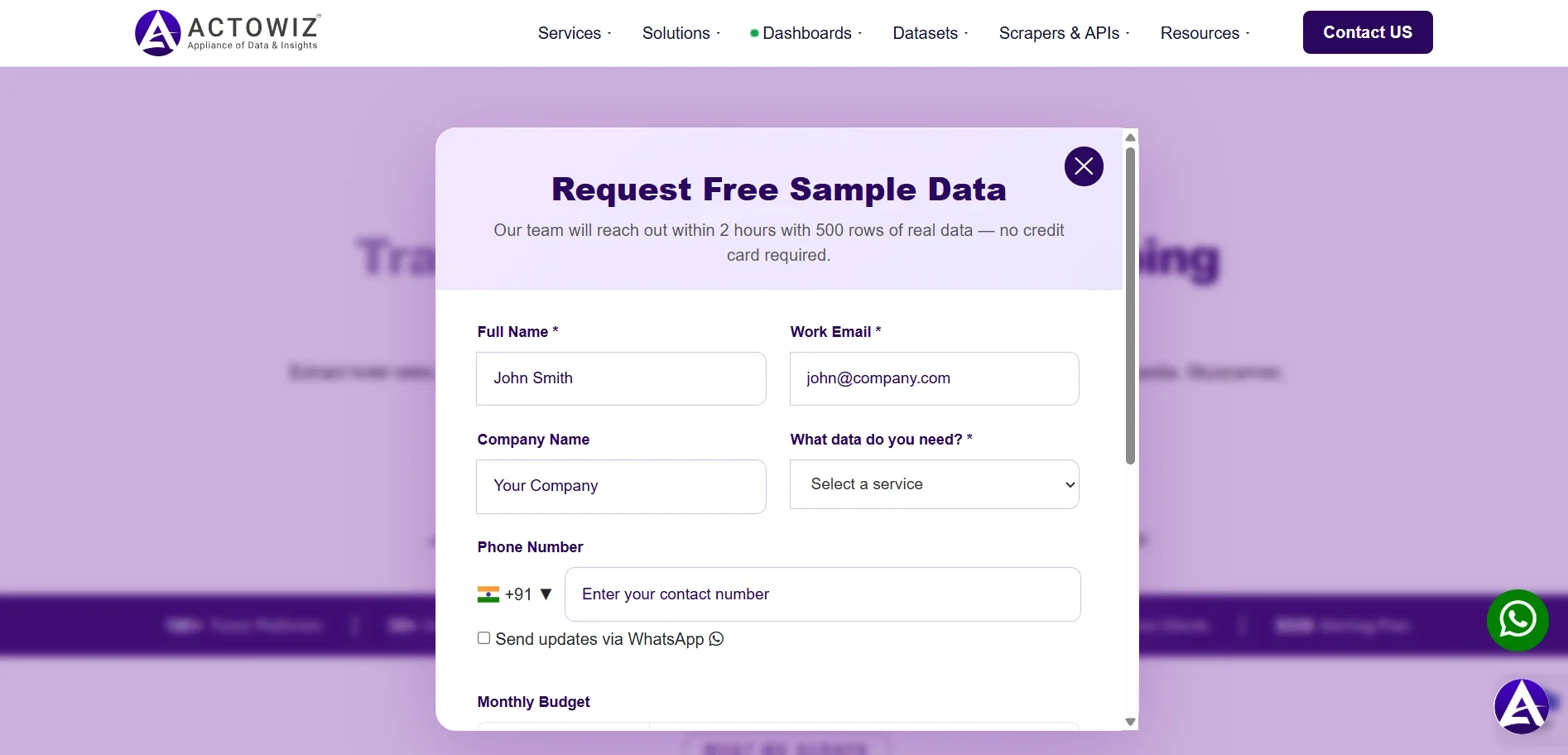
Pricing: Individual travel datasets are listed from roughly $235 to $242, with broader plans starting from $500 per month and free 500-row samples available within hours of a request.
Best suited for: Analysts who want to browse and price individual travel datasets upfront rather than going through a sales call first.
3. X-Byte Enterprise Crawling
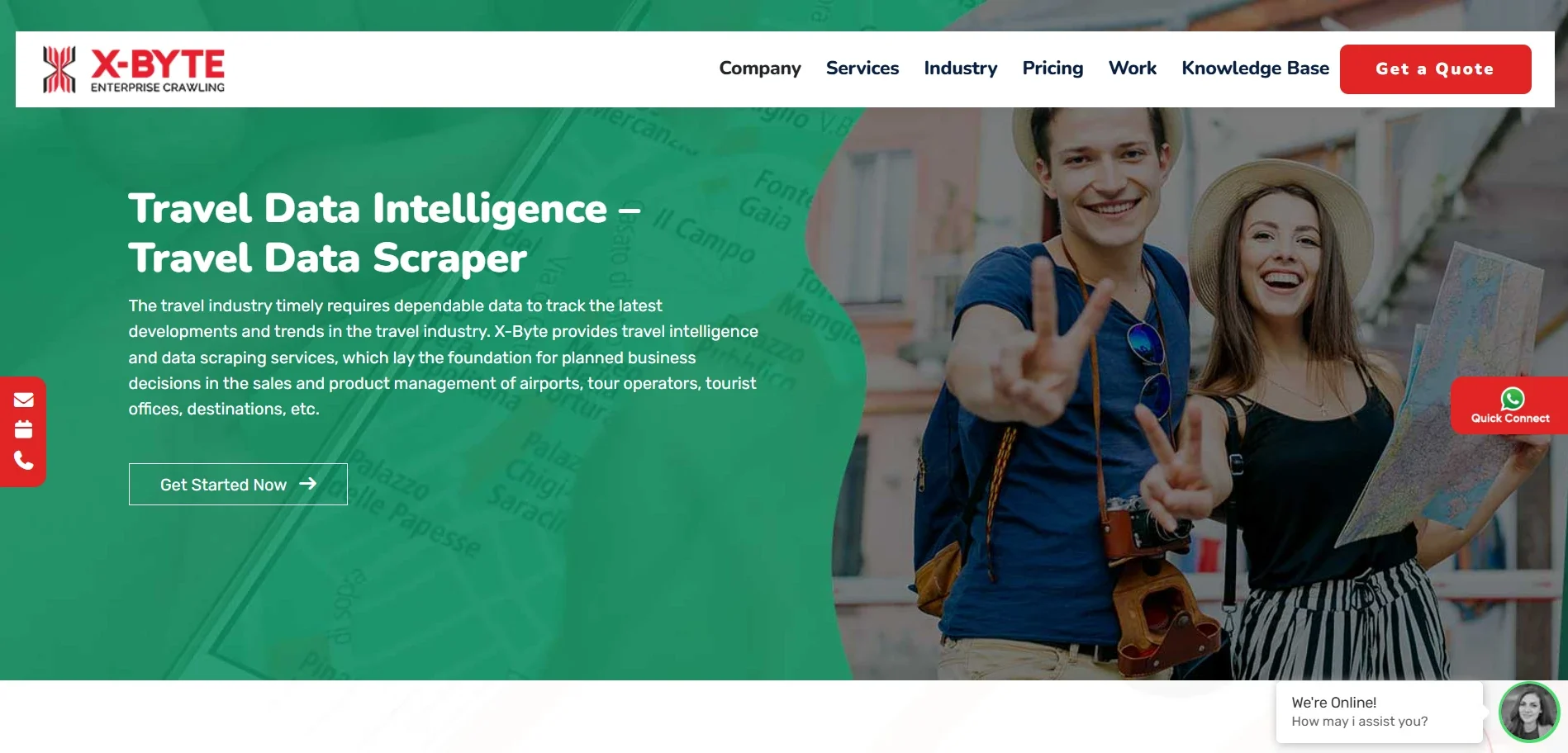
X-Byte has been operating as a web scraping and data extraction company for more than a decade, with a dedicated travel intelligence division covering airline, hotel, and vacation rental data. Its service model leans heavily toward managed: rather than self-serve dashboards, X-Byte assigns data specialists to scope each project around the client’s specific business targets.
The travel offering breaks into four practical buckets: airline route and fare monitoring, hotel listing and pricing extraction, vacation rental data from platforms like Airbnb and HomeAway, and car rental data covering pricing and fleet availability. The company operates from offices in the United States, Germany, and India, giving it coverage across time zones for ongoing data delivery.
Market coverage: Flight prices and route monitoring, hotel listings with amenities and reviews, vacation rental property details, and car rental pricing and availability.
Compliance: States that it extracts only publicly available data and does not collect personal or identity-related information.
Pricing: Custom quotes following a free pilot run.
Best suited for: Companies that prefer a fully managed, white-glove scraping engagement over a self-serve API.
4. Bright Data
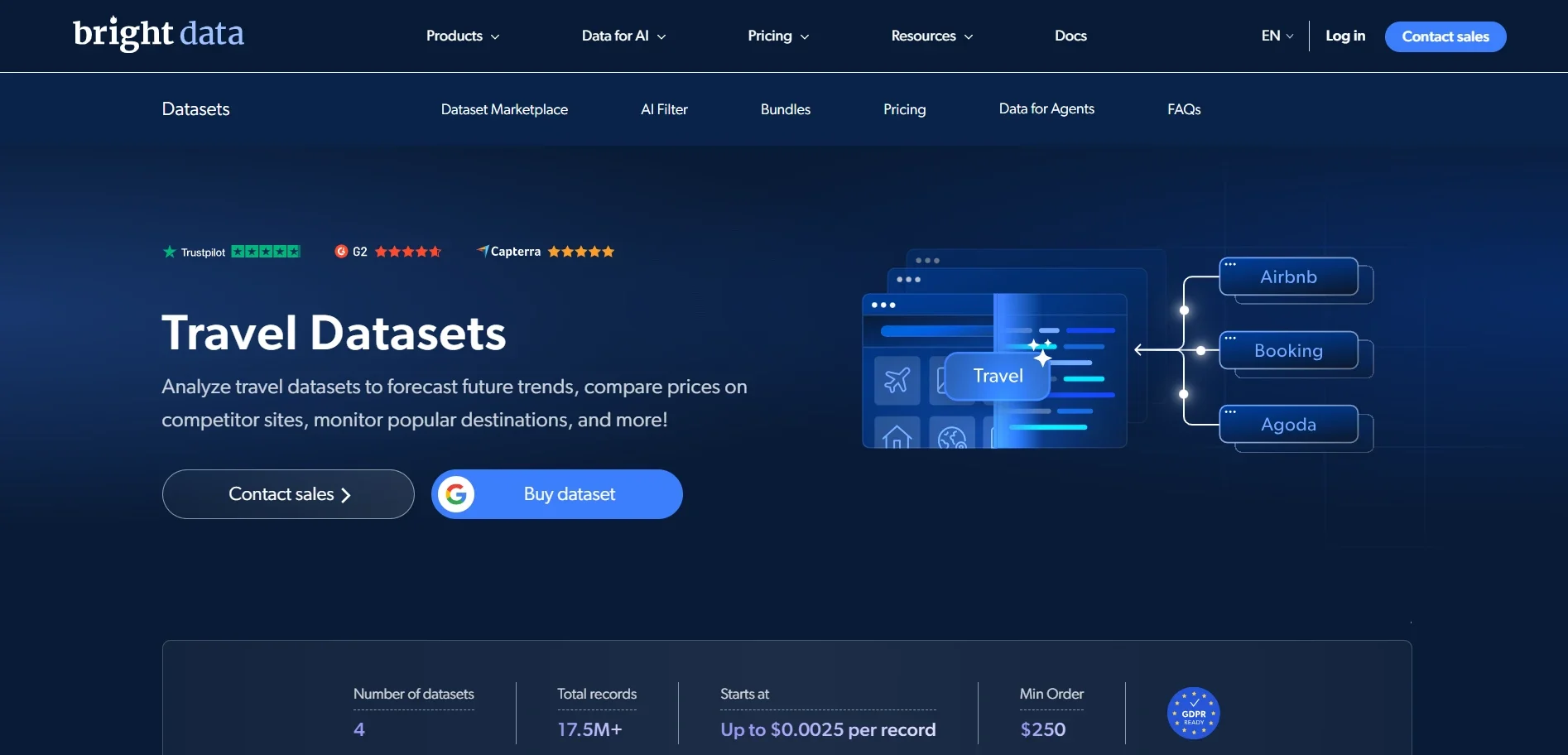
Bright Data began as a proxy network provider and has since grown into one of the most complete web data infrastructure companies in the industry. Its travel offering is split into three parts: curated travel datasets, an on-demand travel scraper, and a fully managed data acquisition service for companies that would rather hand off the entire pipeline.
The infrastructure behind all three is substantial. Bright Data operates a proxy network spanning more than 195 countries, with automated CAPTCHA solving, IP rotation, and support for bulk scraping of up to 5,000 URLs in a single request. Datasets are delivered in JSON, NDJSON, CSV, and other formats, with optional historical access via an archive API for trend analysis over time.
Market coverage: Hotel and flight prices, availability, fare calendars, amenities, star ratings, activity bookings, traveler reviews, competitor pricing, and social travel content from sources including Airbnb, Booking.com, Agoda, Trip.com, Tripadvisor, Expedia, and Google Flights.
Compliance: Aligned with GDPR and CCPA, with SOC 2 Type II and ISO 27001 certification, and data sourced only from publicly accessible pages.
Pricing: Free trial and sample datasets are available. Travel datasets start around $2.50 per 1,000 records, while the scraping solution starts near $1.50 per 1,000 records.
Best suited for: Enterprise teams that need both historical travel datasets and live scraping in one ecosystem, plus AI agent integration through MCP support.
5. Oxylabs
Oxylabs is a long-established web intelligence company that built a dedicated solution for travel and hospitality on top of its broader proxy and scraping infrastructure. Rather than treating travel as an afterthought, Oxylabs ships purpose-built tools for two specific jobs: travel fare aggregation and hotel rate intelligence.
The scale here is hard to ignore. Oxylabs reports a network of more than 170 million proxy IPs across 195 countries, an average uptime near 99.95%, and a client base exceeding 15,000 companies globally, including names like Forbes and Stanford appearing among its public case studies. For travel specifically, its Web Scraper API handles JavaScript-heavy hotel and flight sites without manual workarounds, while its Datasets product offers either ready-made or fully custom data acquisition. Much of this reliability traces back to the same residential proxy infrastructure that powers Oxylabs’ broader scraping stack outside of travel.
Market coverage: Ticket pricing, accommodation availability, local competitor rates, and dynamic pricing patterns, with documented scrapers for platforms like Skyscanner, Google Hotels, Google Flights, Trip.com, and Expedia.
Compliance: ISO/IEC 27001:2022 certified products, with ethical sourcing limited to public data only.
Pricing: Standard datasets start from $400 per month, custom managed acquisition starts from $800 per month, and the Web Scraper API itself starts as low as $0.25 per 1,000 results, with a free trial available.
Best suited for: Hospitality and OTA teams that specifically need hotel rate intelligence and fare aggregation, backed by a proxy network mature enough to handle the most defended travel sites.
6. Travel Scrape
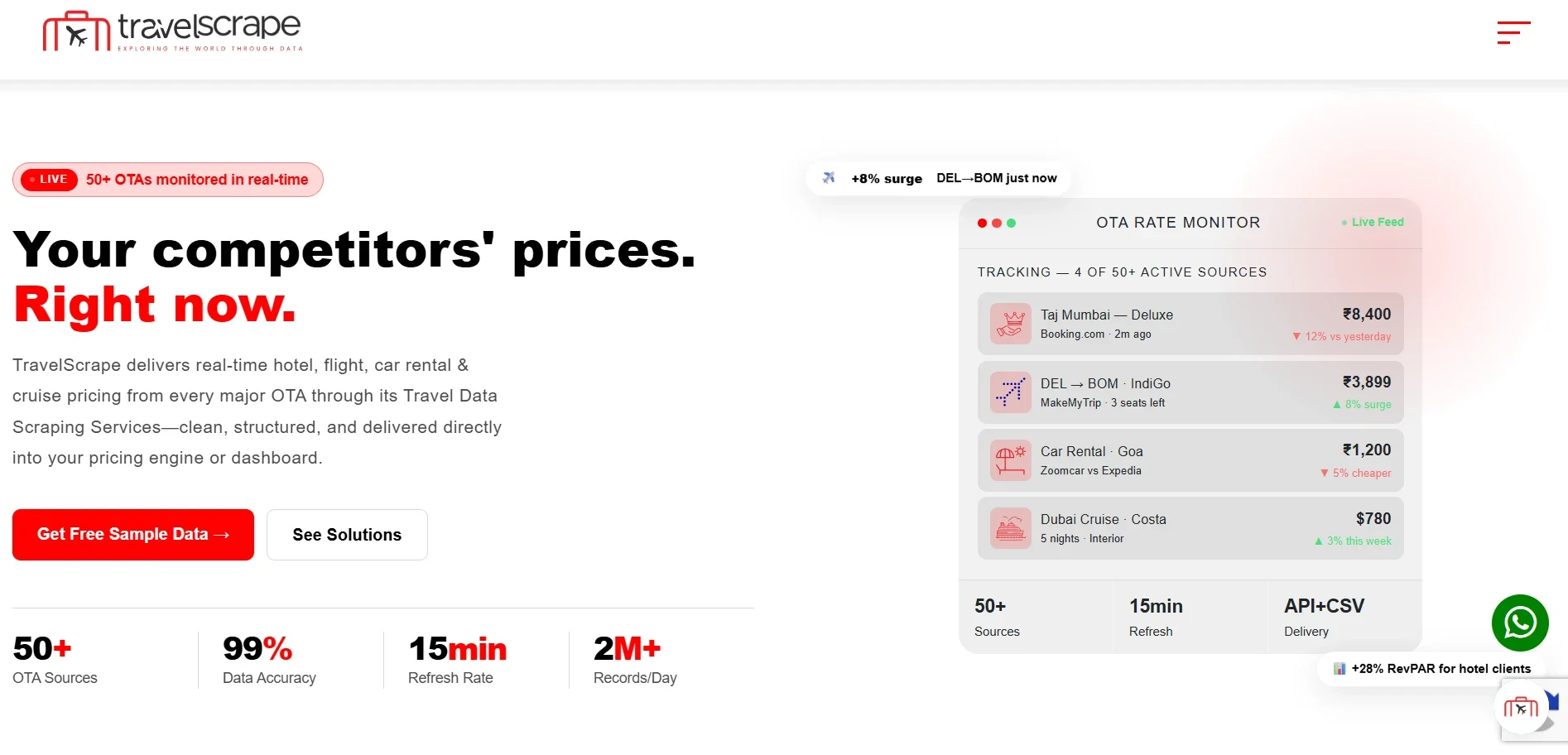
Travel Scrape is a scraping agency built specifically around the travel vertical rather than treating it as one industry among many. Its three core offerings are a fully managed scraping solution, live scraping access to more than 50 travel platforms, and curated datasets for market trend analysis.
The platform claims more than 100,000 data points scraped daily across over 100 data sources, with named coverage extending to global names like Airbnb, Booking.com, Expedia, Google Hotels, and regional platforms like MakeMyTrip and IRCTC. A 99% uptime guarantee is stated for its scaling infrastructure, similar to the reliability bar that serious mobile proxy networks need to clear for large-scale automated collection.
Market coverage: Hotels, flights, car rentals, cruises, and vacation rentals, with pricing, availability, dynamic rates, and booking trend data.
Compliance: Not publicly disclosed; available on request.
Pricing: Demo and consultation available; pricing requires a direct sales contact.
Best suited for: Businesses with vertical-specific travel data needs that fall outside the standard hotel-and-flight mold, like cruise or regional OTA data.
7. Scrappey
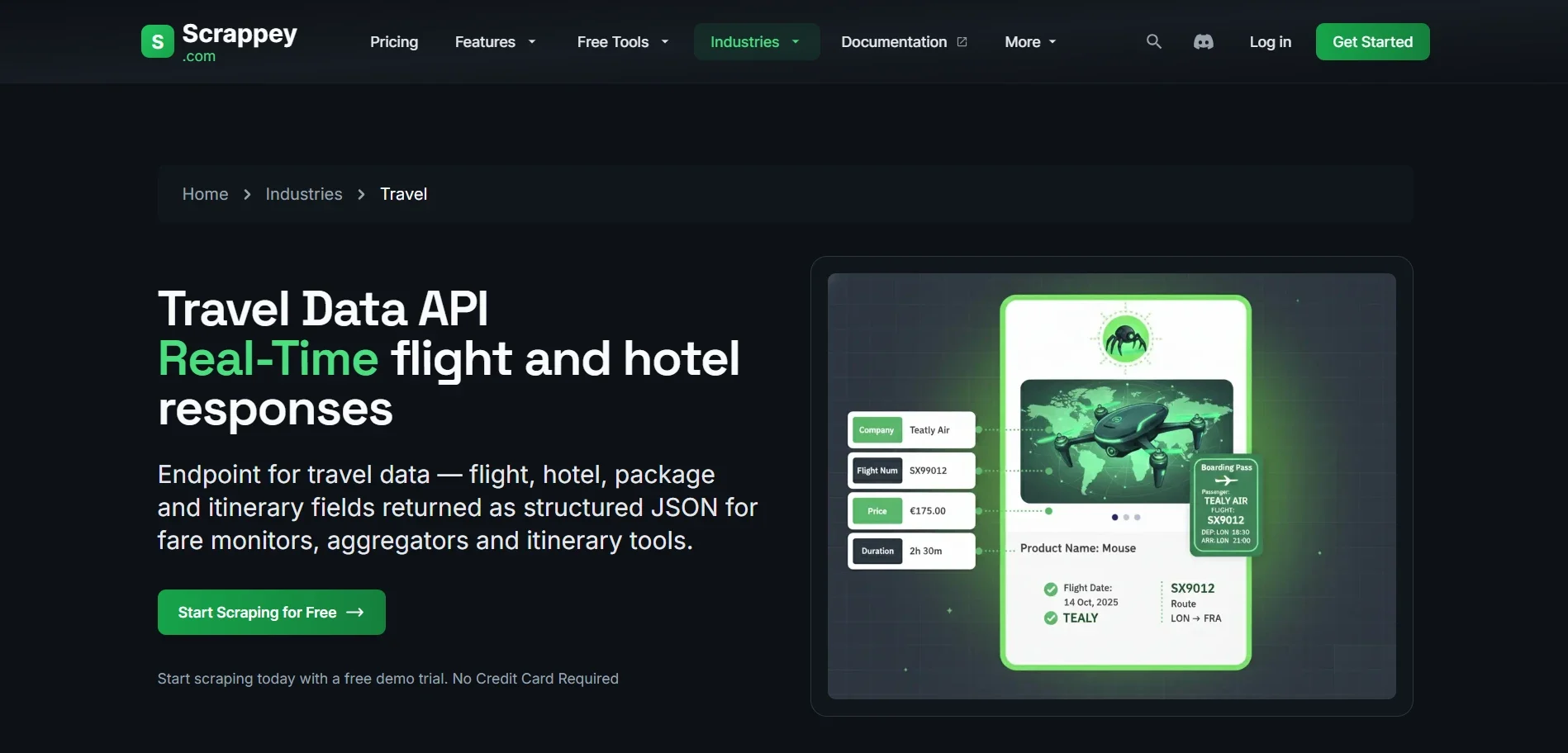
Scrappey approaches travel data from the developer-API side rather than packaging finished datasets. It is a general-purpose web scraping API with a dedicated travel use case covering flight pricing, hotel rates, and review extraction, built to handle the dynamic content and region-locking that travel sites are notorious for.
What sets Scrappey apart in pricing is its pay-per-success model: failed requests are never billed, and residential proxies are bundled into every tier rather than charged separately. The company reports access to more than 100 million residential, mobile, and datacenter IPs across over 150 countries, with a stated 95%+ success rate on travel-site requests, a similar bar to what dedicated social media data collection tools need to maintain against aggressive anti-bot systems.
Market coverage: Real-time flight pricing, route combinations, seat classes, and baggage policies, plus hotel rates, availability, cancellation policies, and guest reviews.
Compliance: Operates on a responsible-use model, requiring users to comply with each target site’s terms, robots.txt rules, and applicable privacy law.
Pricing: €0.20 per 1,000 direct HTTP requests and €1.00 per 1,000 full-browser requests, with a free trial requiring no credit card.
Best suited for: Developers who want direct API control over travel scraping without committing to a long-term dataset contract.
8. WebData Crawler
WebData Crawler offers both ready-made travel datasets and scraping APIs aimed at travel market analysis, with source coverage spanning Agoda, Trivago, Skyscanner, Booking.com, and Airbnb, among others. Its datasets focus heavily on the analytical side of travel: pricing trends, destination popularity, traveler type, and trip duration, rather than just raw listing data.
Delivery is flexible by design. Datasets are exported in CSV, JSON, or XLSX, and can be piped directly into cloud storage, including AWS S3, Google Cloud Storage, Azure, or Oracle Cloud, which removes a common integration headache for teams already standardized on a specific cloud stack.
Market coverage: Pricing, availability, customer preferences, accommodations, transportation, facilities, trip duration, and traveler type and ratings.
Compliance: States it respects legal regulations and each target site’s stated policies.
Pricing: Sample dataset provided during evaluation; full pricing available on request.
Best suited for: Travel market researchers who need destination-level trend data rather than just transactional listings.
9. Real Data API
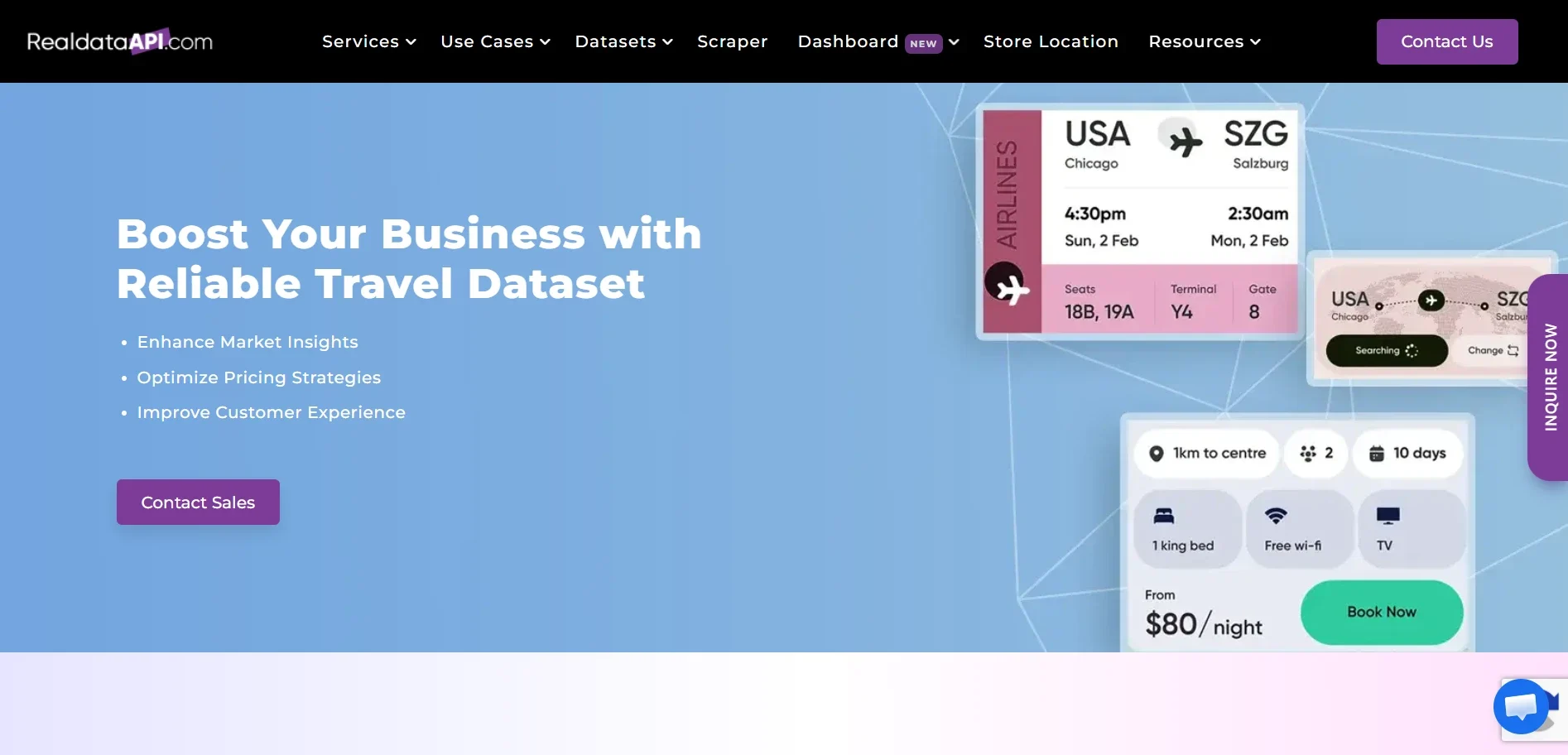
Real Data API positions itself around removing the burden of building and maintaining scrapers in-house, offering both ready-to-use travel datasets and live scraping APIs. Its travel coverage spans destinations, hotels, flights, car rentals, and tours, with named source support for Airbnb, Booking.com, Expedia, TripAdvisor, Skyscanner, Agoda, Google Flights, and Hotels.com.
The company markets itself heavily around competitor benchmarking use cases, with data normalization built into its pipeline so that pricing, reviews, and availability figures arrive in a consistent structure regardless of which source site they came from originally. This matters more than it sounds: anyone who has tried to reconcile review-star formats or price-currency fields across five different OTAs knows how much manual cleanup that alone can save.
Market coverage: Destinations, hotels, flights, car rentals, tours, reviews, availability, and booking URLs.
Compliance: Not publicly disclosed.
Pricing: Sample dataset available for quality evaluation; pricing requires a sales quote.
Best suited for: Teams running ongoing competitor price-tracking programs that need normalized data across multiple OTA sources.
10. Open Travel Data (OPTD)
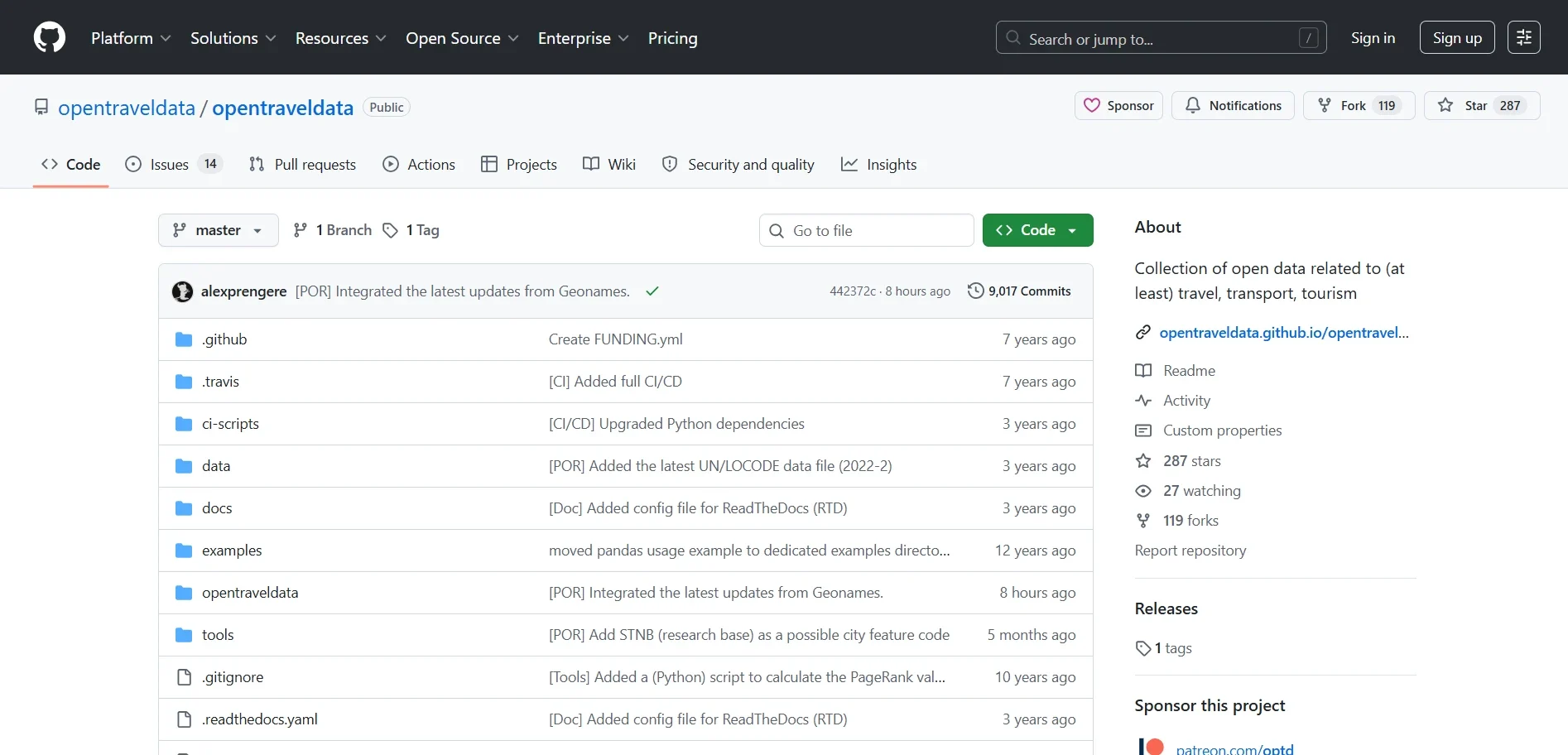
Open Travel Data is the clear outlier on this list, and intentionally so. It is a free, open-source, community-maintained project hosted as a public repository rather than a commercial company. OPTD aggregates travel reference data from sources like Geonames, Wikipedia, and UN/LOCODE, covering airports, airlines, locations, and geographic identifiers in flat-file format.
Because it is licensed under CC-BY 4.0, the data can be used commercially as long as attribution is provided, which makes it a genuinely useful supplementary source for filling in airport codes, location hierarchies, or airline reference tables, rather than a primary source for pricing or availability data, which it does not collect at all.
Market coverage: Airport, airline, location, and geographic reference data curated from open community sources.
Compliance: Licensed under CC-BY 4.0, permitting commercial use with attribution.
Pricing: Completely free.
Best suited for: Academic researchers, AI/ML projects, and developers who need reliable airport and location reference data without paying for a commercial dataset.
Travel Datasets vs. Travel Scraping APIs: Which Do You Actually Need?
This question comes up constantly, and the honest answer is that most serious travel data programs eventually need both.
Pre-built travel datasets make sense when you are doing historical analysis, building a forecasting model, or benchmarking seasonal patterns. You are not paying for freshness; you are paying for someone else to have already done the collection, cleaning, and structuring work. This is the better starting point if your team lacks scraping infrastructure entirely.
Live scraping APIs make sense the moment your use case depends on what is happening right now. Dynamic pricing, availability checks, and real-time competitor monitoring all lose value if the data is even a few hours stale. The tradeoff is that you take on more responsibility for handling anti-bot defenses, rate limits, and data cleaning yourself, unless the provider runs a fully managed service.
A simple way to decide: if your question starts with “what happened” or “what’s the trend,” reach for a dataset. If it starts with “what is the price right now,” you need a scraper.
Frequently Asked Questions
Where does travel data actually come from?
Most travel data is sourced from publicly accessible pages on airline websites, hotel booking platforms, metasearch engines, and review sites. Common source platforms referenced across the providers above include Booking.com, Expedia, Airbnb, Skyscanner, Agoda, Tripadvisor, and Google Flights or Google Hotels.
Is it legal to collect travel data through scraping?
Scraping publicly available web pages is generally permitted, but every provider on this list states that compliance with the target site’s terms of service, robots.txt rules, and applicable privacy law, like GDPR, remains the user’s responsibility. None of the providers covered here claims to bypass logins, paywalls, or access controls.
What is a Traveler Trip Dataset?
A traveler trip dataset typically captures structured information about individual or aggregated trips: travel dates, departure and return points, booking source, passenger count, trip duration, and total cost. These datasets are commonly used to study booking behavior, segment travelers by trip type, and personalize travel marketing.
How fresh does travel data need to be for pricing decisions?
For dynamic pricing or rate parity monitoring, data older than a few hours can already be stale, which is why most providers offering pricing intelligence default to live scraping rather than static datasets. For trend analysis or demand forecasting, monthly or quarterly dataset refreshes are usually sufficient.
Can travel datasets be used to train AI models?
Yes. Several providers above, including Bright Data and Open Travel Data, explicitly position parts of their catalog for AI and machine learning use cases, since structured travel data is well-suited to training demand-forecasting models, recommendation engines, and travel-focused AI agents.
Choosing the Right Travel Data Partner
There is no single best travel data provider for every situation, and any list that claims otherwise is oversimplifying. The right choice depends entirely on what you are trying to build.
If your team needs a combined booking engine and data layer rather than a standalone scraper, Travelopro covers that ground. If you want priced, browsable datasets without a sales call, Actowiz Solutions makes that easy, and if you would rather hand the entire scraping project to a managed team, X-Byte fits that bill. For enterprise-scale infrastructure that handles both live scraping and historical datasets under one roof, Bright Data and Oxylabs cover the most ground. If your team wants direct API control with transparent, pay-per-success pricing, Scrappey is worth a look. And if your need is simply reliable airport and location reference data without spending a dollar, Open Travel Data remains hard to beat.
Whichever direction you go, the same advice applies regardless of provider: request a sample before committing to a contract, confirm exactly which source platforms are covered, and check how the schema maps to the fields your analysis actually depends on. A travel dataset that looks comprehensive in a sales deck can still be missing the one field your pricing model needs, the same diligence worth applying when comparing US-based proxy providers for any region-specific scraping project.
For those exploring data beyond travel, our guides on the Best Dataset Websites, Best LinkedIn Dataset, Best Amazon Dataset Providers, and Best Social Media Datasets cover similar ground across other high-demand verticals.
