
I run a content-focused website built around long-form articles, reviews, and evergreen informational content. Like many publishers in this space, I’ve relied heavily on display and video ads for monetization over the past few years. Once traditional display CPMs began to flatten, video ads felt like the obvious next step. Everywhere you look, video monetization is hyped as the solution: higher CPMs, premium demand, better revenue per user.
The reality, at least in my experience, has been far messier.
Yes, video ads can generate strong numbers on paper. But actually turning those headline CPMs into stable, predictable earnings without hurting user experience or search performance is harder than most ad network landing pages admit. I’ve tested multiple video ad networks over time, sometimes sticking with them for months, sometimes pulling the plug early when things went sideways.
This post isn’t about hype or promises. It’s about what I observed hands-on after running PubFuture on a real content site and comparing that experience with patterns I’ve seen across many typical video ad networks. I’m not claiming it’s perfect or that it will work the same way for everyone. But there are a few things PubFuture gets right that, frankly, many networks still get wrong.
Common Challenges With Video Ad Networks
Before getting into PubFuture specifically, it’s worth laying out the problems that kept repeating themselves for me across different video ad setups.
Impressive CPMs that don’t translate into earnings
Dashboards love showing $20, $30, even $40+ video CPMs. But once you factor in fill rate, auction loss, demand throttling, and various deductions, the actual revenue often looks far less exciting. I’ve had months where CPMs went up while total revenue stayed flat or even dropped.
Inconsistent fill rates and revenue volatility
One of the biggest frustrations has been unpredictability. A strong month followed by a sudden 30–40% drop, with no clear explanation. Seasonality explains some of it, but not all of it. Planning content investment or cash flow becomes difficult when revenue swings wildly without warning.
Aggressive ad behavior that hurts UX
Auto-play videos with sound, surprise pop-ups, redirects on mobile, or video units that hijack scrolling; these things absolutely show up in engagement metrics. I’ve seen bounce rates spike and session duration drop after enabling certain video formats, even when revenue looked good in the short term.
Lack of transparency when performance changes
When revenue drops, the explanations are often vague: “market conditions,” “demand shifts,” or “temporary adjustments.” That may be true, but without concrete insight into what’s changing, it’s hard to make informed decisions.
Slow or unhelpful support
Support experiences vary, but too often I’ve run into generic replies, long response times, or advice that feels copied from a playbook rather than tailored to my site.
These issues don’t make video ads unusable, but they do make them stressful to rely on over the long term.
My Experience Using PubFuture

Revenue Stability Favored Over Flashy CPMs
One of the first things that stood out to me about PubFuture was that the CPMs didn’t appear particularly impressive at first glance. They were fair, and at times even on the lower side, compared to other platforms I’d used. However, the real value became clear over time.
Rather than pushing for the highest CPM numbers, PubFuture focused on maximizing actual revenue per session. Once the initial ramp-up phase passed, my daily earnings became noticeably more stable. In my experience, revenue evened out after roughly 2–3 weeks and no longer fluctuated dramatically day to day. That level of consistency made things much easier, both mentally and operationally.
Prebid-Based Video Setup With Multiple Demand Sources
A common weakness with many video networks is reliance on a limited set of buyers. PubFuture’s Prebid-based setup pulls in multiple demand sources, reducing dependence on any single partner.
I didn’t see an overnight jump in revenue. Instead, earnings improved gradually as additional demand partners were approved and activated. That slow, incremental improvement felt healthier than the “big spike, big drop” pattern I’d seen before.
A Defined Learning and Approval Phase
One thing I appreciated was the absence of an illusion of instant results. PubFuture was upfront about the learning and approval phase. It took several days and, in some cases, a couple of weeks for everything to fully settle.
Because expectations were clear, I didn’t constantly change placements or second-guess the setup. Performance climbed step by step, which made it easier to trust the process rather than panic after a slow first week.
Faster Approval With Existing GAM or AdSense History
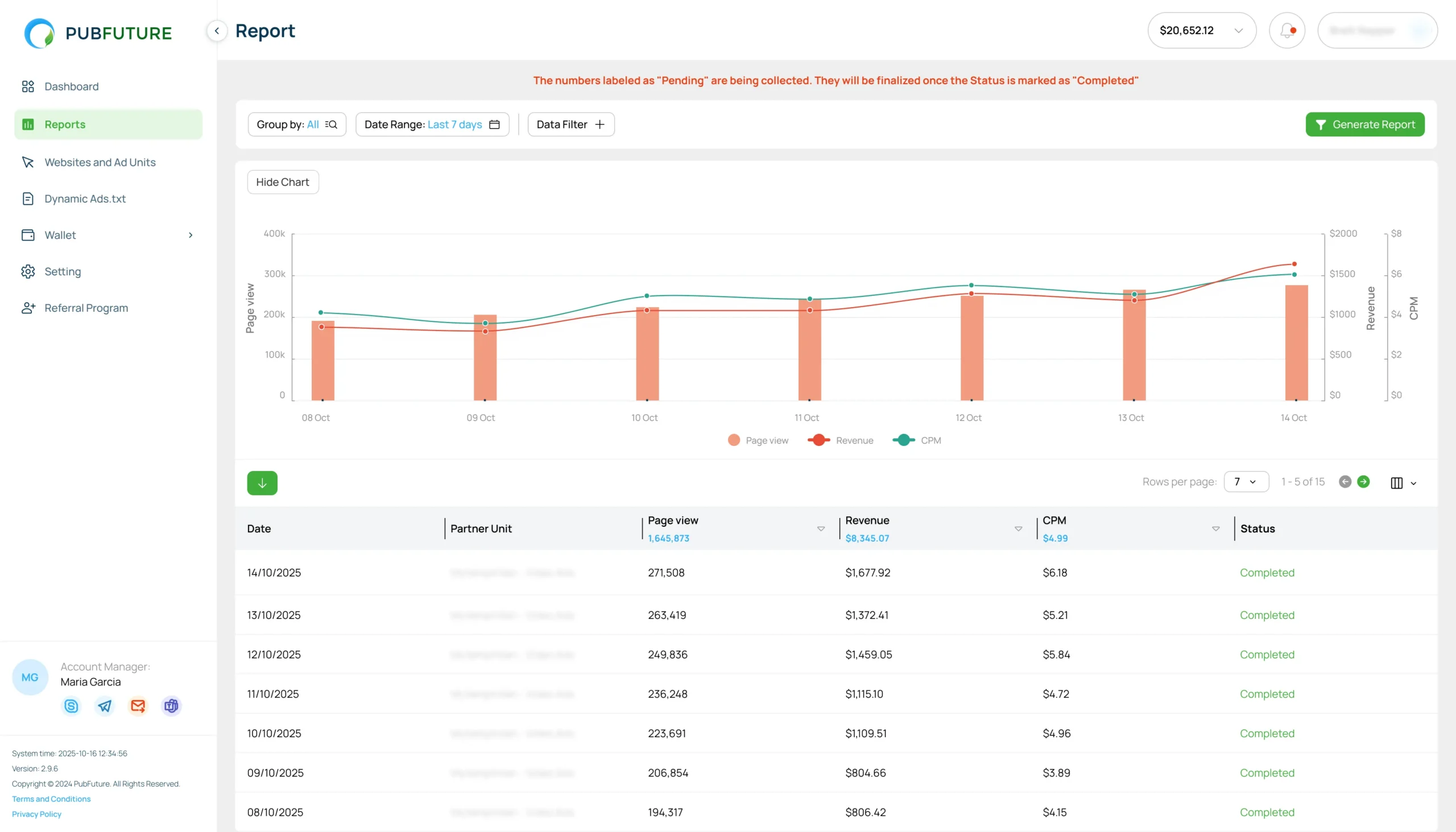
Because my site already had a history with Google Ad Manager and AdSense, the approval process moved faster and felt more straightforward. That existing track record helped establish trust early, reduced friction, and avoided the kind of unexplained deductions I’ve faced with other networks. Once live, reporting, and payouts stayed aligned, with clear, predictable Net-30 payment terms.
Attention to Ad Quality and User Experience
This was one of the most important factors for me. PubFuture’s video ads were noticeably less intrusive. No forced pop-ups, no random redirects, and no auto-play sound surprises.
I closely monitored bounce rate, pages per session, and time on site during the rollout. Those metrics stayed mostly flat, indicating the ads weren’t actively harming user behavior. The video units felt integrated into the content rather than fighting it.
Flexible Approach to Video Formats
Instead of enforcing a rigid setup, PubFuture allowed a flexible, page-level approach to video monetization. Different formats outstream, sticky, and in-content video were tested based on each page’s layout, content depth, and user behavior, rather than applying blanket defaults.
This flexibility made the implementation feel tailored to the site rather than forced.
Frequency optimization was approached gradually to balance user experience and revenue. Instead of launching with high ad load, we began conservatively at one video per 30 minutes, progressively tested two per 30 minutes and one per 5 minutes, and ultimately lifted frequency caps on select placements where engagement remained stable. This ensured monetization scaled without disrupting session quality.
The default video player was customizable at the publisher’s request, allowing styling and features to align with the site design. This contextual player configuration helped video ads feel more native and user-friendly within content.
Initial video CPMs typically started around $2.5–$3.5 in the early days after setup. As optimisation progressed, with demand onboarding, placement refinement, and frequency tuning, CPMs rose to approximately $4.5–$6.0 for Tier-1 traffic. Certain sticky, in-content placements occasionally peaked at higher levels depending on geo and engagement.
Importantly, reported revenue matched paid revenue throughout the test, with no unexpected deductions or discrepancies.
Gradual Optimisation and Scaling
Rather than launching multiple aggressive placements at once, we started conservatively. Only after performance stabilized did we experiment with scaling.
That approach helped prevent sudden user fatigue or revenue shocks. Scaling felt deliberate, not rushed, and the site never felt overloaded with ads.
Communication and Support Experience
Support was direct and reasonably responsive. What stood out was the tone; it wasn’t salesy. When something changed, I usually got a clear explanation and a practical suggestion, not a vague reassurance.
I didn’t feel pressured to add more placements just to chase higher numbers, which I appreciated.
Payment Transparency and Reliability
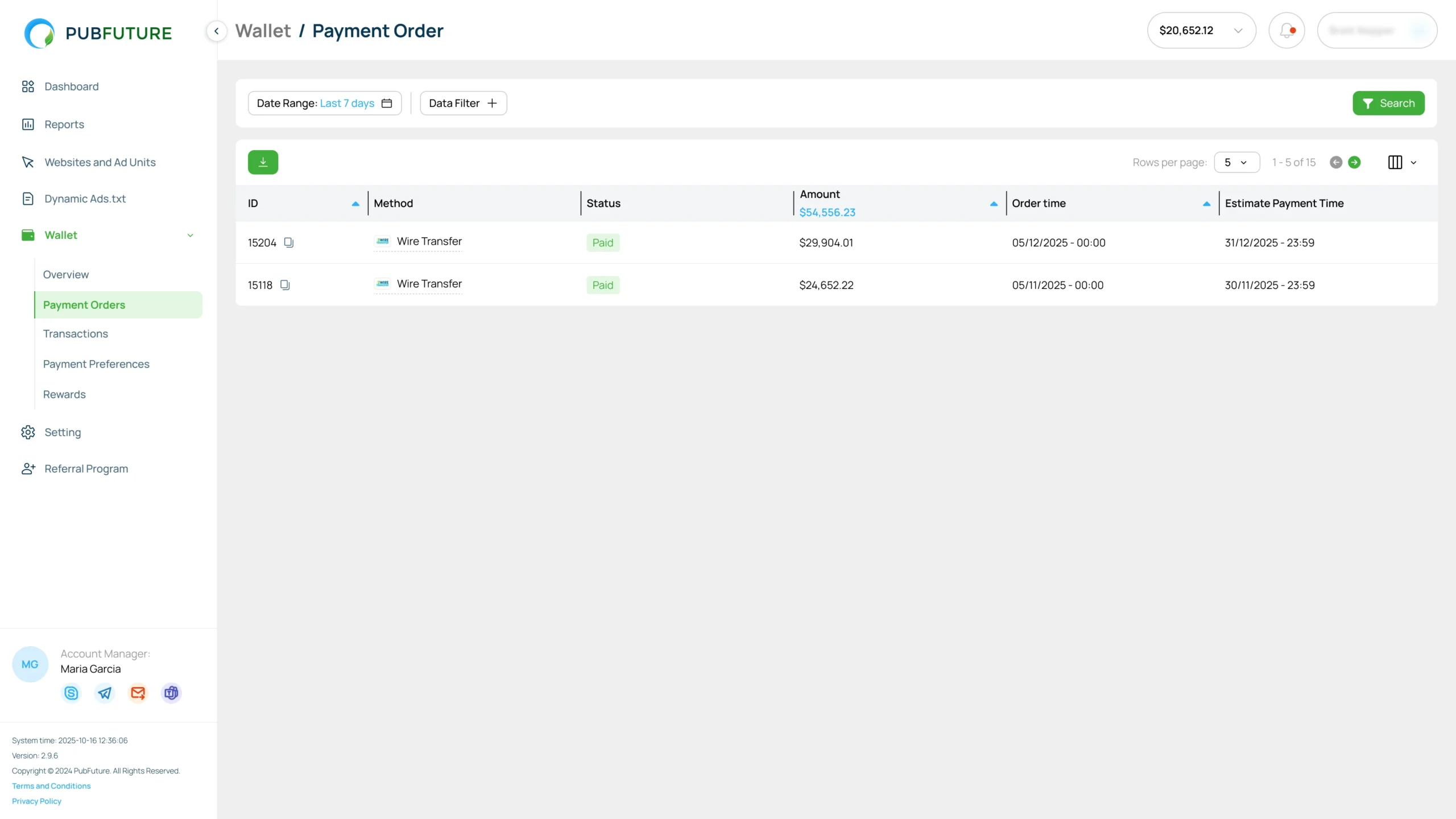
Reporting was straightforward and easy to understand. Payments arrived consistently on Net 30 terms, making cash flow planning much easier.
After dealing with delayed or unclear payouts elsewhere, having predictable payment timing was a relief.
Conclusion
After working with multiple video ad networks over the years, what stood out to me about PubFuture wasn’t explosive growth or flashy CPMs. It was the focus on stability, transparency, user experience, and realistic scaling.
It’s not perfect. The initial setup requires patience, and performance still depends heavily on traffic quality and geography. But compared to the usual volatility and opacity in video monetization, PubFuture felt refreshingly grounded.
If you’re running a content-driven site and struggling to make video ads work without compromising UX or sanity, it may be worth testing PubFuture carefully, and with your own benchmarks in mind. As always, do your due diligence. But based on my experience, it’s one of the more balanced approaches to video monetization I’ve seen so far.
