
The global residential proxy market is expected to grow steadily over the coming years, driven by the rising demand for real-time data across industries. Businesses use this data to train custom language models, monitor pricing trends, carry out market research, verify ads, track search engine results, and access content limited by location.
Residential proxies have become an important part of modern web scraping because they resemble real user traffic. While many websites can easily detect data center proxies, residential proxies are much harder to identify. Even on highly protected platforms like major e-commerce sites and search engines, they continue to deliver reliable performance and strong success rates. Despite this, understanding different proxy types can still feel confusing, which is why residential proxies often receive more attention in discussions about privacy and data collection.
These proxies usually cost more because their IP addresses come from real households and legitimate internet service providers rather than from cloud servers. This leads many people to question their purpose, legality, and overall value.
This article explains residential proxies clearly and simply, without going too deep into technical details. If you have come across terms like rotating IPs, shared proxies, or dedicated residential addresses and felt unsure, this guide will help clarify them.
What are Residential Proxies?
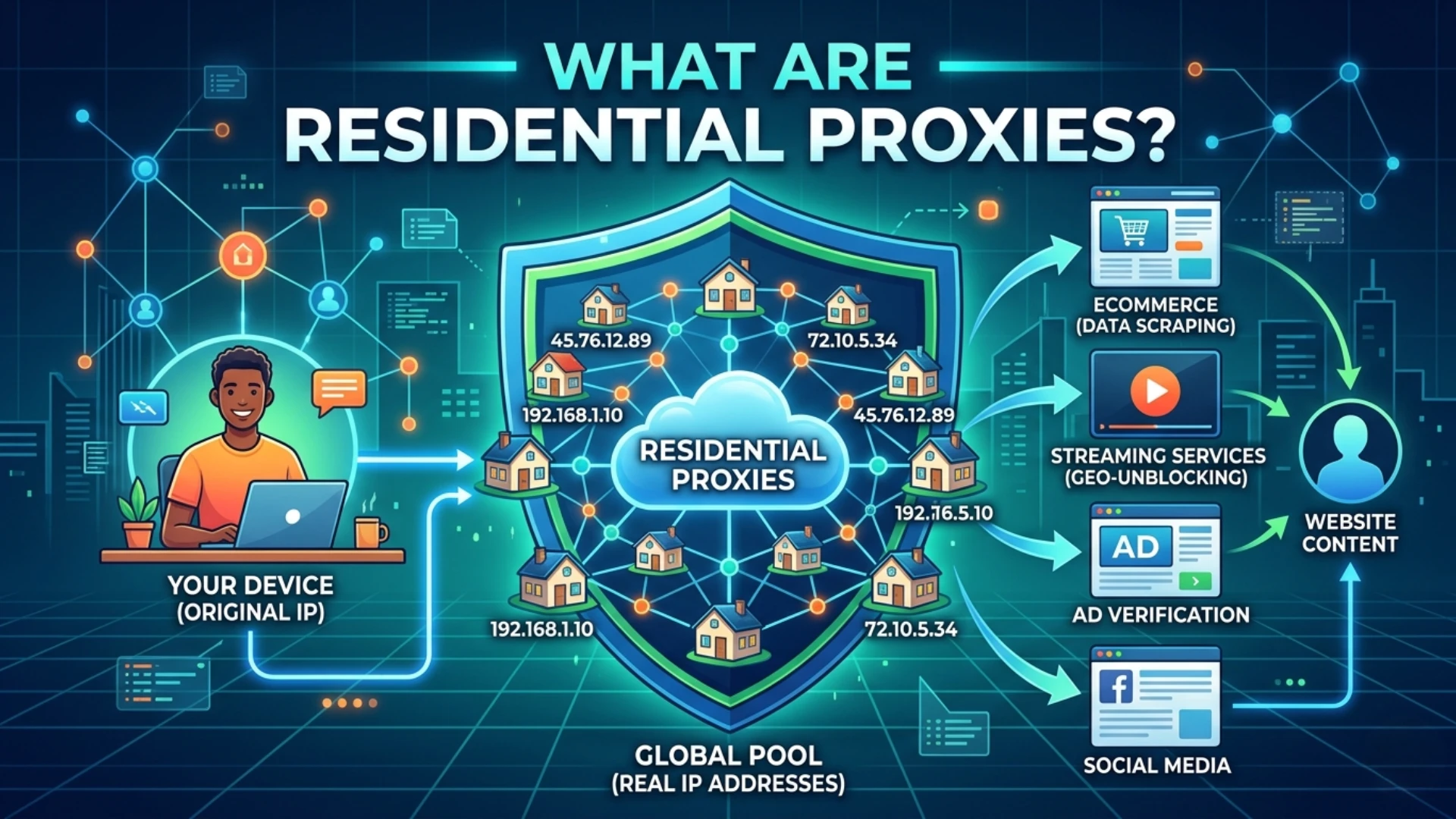
A residential proxy is essentially a middleman between the user and the internet, but instead of using server-based IPs, it routes requests through real household IP addresses assigned by internet service providers. This makes the connection appear as if it is coming from an actual person browsing from a home network rather than from a bot or automated system. Because of this, websites treat traffic as genuine user activity rather than flagging it as suspicious or artificial.
When a request is sent through a residential proxy, the target website sees only the residential IP address, not the original user behind it. This adds a layer of anonymity and helps users operate without revealing their true identity or location. It also reduces the chances of being blocked, rate-limited, or served misleading data, which is common when using data center proxies.
These proxies are widely used to maintain online privacy, as they help mask users’ identities and browsing behavior. At the same time, they play a key role in collecting publicly available data from websites that often restrict or block automated access. Many platforms have robust detection systems that can easily identify and block data center IPs, but residential proxies are much harder to detect because they blend into normal user traffic.
As a result, residential proxies are commonly used in tasks such as web scraping, price monitoring, market research, ad verification, and accessing location-specific content. Their ability to mimic real users while maintaining stable access makes them a reliable choice for individuals and businesses that depend on accurate and uninterrupted data collection.
How a residential proxy works
A residential proxy works as a protective layer between you and the website you want to access. Instead of your device connecting directly to the site, your request is first routed through the residential proxy. The proxy then forwards your request to the target website, receives the response on your behalf, and sends it back to you. Throughout this entire process, your original IP address stays hidden, helping protect your identity and location.
Because residential proxies rely on IP addresses assigned to real households by legitimate internet service providers, websites interpret the traffic as normal user behavior. This greatly reduces the chances of being blocked, flagged, or interrupted, even on platforms with strict security measures.
Here is a simple breakdown of how the process works:
- The user sends a request to access a website
- The residential proxy intercepts the request and forwards it to the target site
- The website processes the request and returns the data to the proxy
- The proxy delivers the response back to the user
This entire flow happens in seconds, making the experience smooth while adding a strong layer of privacy. It also enables users to browse more freely, access region-specific content without restrictions, and perform tasks like data collection with a much lower risk of IP bans or detection.
What is a residential IP?
Residential IPs belong to real devices, such as mobile phones, computers, and tablets, that connect to everyday home or mobile internet networks. They are registered to physical locations and assigned by legitimate service providers, making them appear as genuine user connections rather than artificial traffic. Because of this, a website can determine the internet provider and the approximate region of the user connected to that IP address, helping it assess whether the request looks natural.
This level of authenticity is why residential proxies have a high success rate when working with sensitive or protected websites. Since the traffic closely matches normal browsing behavior, it is less likely to be flagged, restricted, or blocked by advanced security systems. This allows users to interact with websites more smoothly, maintain consistent access, and gather reliable data without frequent interruptions or detection issues.
Different Types of Residential Proxies
Even though residential proxies are already one specific category, the market offers multiple variations that cater to different needs, use cases, and levels of control depending on how you plan to use them.
Shared residential proxies
These are used by multiple people simultaneously and are usually the most affordable option. Even while being shared, they can be surprisingly fast thanks to their robust network architecture and distributed traffic handling. However, they may not offer the highest level of privacy and may face more frequent blocks or slowdowns because multiple users share the same pool of IP addresses.
Mobile residential proxies
These use IP addresses coming from mobile devices on cellular networks. They are known for exceptional speed and reliability and are suited for tasks that require strong anonymity and dynamic IP behavior. Their cost is higher, and they sometimes get blocked on websites because they are widely used for automation, testing, and high-frequency request activities across different regions.
Rotating residential proxies
These proxies automatically change IPs at intervals, either with every request or after a set time period, depending on configuration. The constant rotation makes it nearly impossible for websites to track scraping patterns or identify repeated behavior. They provide excellent security and reliability and are considered elite for heavy-scale tasks such as large-scale data extraction, monitoring, and automation workflows.
Static residential proxies
These give a user the same residential IP address for a longer session while maintaining the authenticity of a real household IP address. They are perfect for platforms where repeatedly logging in from different IPs might raise suspicion or trigger security checks. Sticky residential proxies take this further by keeping the IP address stable for a fixed period while still allowing session control and maintaining consistent browsing behavior.
What are Dedicated Residential Proxies?
Dedicated residential proxies provide a single user with private residential IP addresses that are not shared with anyone else. This means all bandwidth, session control, and usage are fully reserved, giving the user full control over how the proxy is used. Because there is no shared access, the risk of IP bans caused by other users’ activities is significantly reduced, making them far more reliable for sensitive operations.
That exclusivity is why they are preferred for maximum speed, privacy, and stability. Since the IP is not being reused across multiple users, performance remains consistent, and connections are less likely to slow down or become unstable. This makes them ideal for tasks that require uninterrupted sessions, such as account management, login-based activities, and long browsing sessions without triggering security alerts.
They can be costly and may require a slightly more advanced setup than shared options, especially when managing multiple dedicated IPs or integrating them into automation workflows. However, the added cost often reflects the higher level of control, security, and dependability they offer.
In demanding environments, such as high-level scraping, competitive data monitoring, or when other proxy types fail due to detection or blocking, dedicated residential proxies often perform successfully. Their ability to maintain a consistent identity while still appearing as genuine residential traffic makes them a powerful choice for users who need accuracy, stability, and long-term reliability.
Residential Proxies and Datacenter Proxies Compared
Residential proxies and datacenter proxies are often compared because both are used to mask a user’s IP address and enable anonymous browsing or data collection. However, they differ significantly in how they operate and how websites perceive them. Datacenter proxies originate from cloud servers and virtual environments, not from real-world households. While they can efficiently handle large volumes of requests, their traffic patterns often appear artificial to advanced detection systems.
Residential proxies, on the other hand, use IP addresses assigned to real homes by legitimate internet service providers. This makes them blend in with normal user activity, allowing them to bypass strict anti-bot mechanisms more effectively. They are especially useful for accessing websites that closely monitor traffic behavior, making them ideal for tasks such as market research, price tracking, and large-scale data collection from protected platforms.
Datacenter proxies are generally more affordable and widely available, making them a good starting point for basic tasks. When sourced from reliable providers, they can still perform well for less restrictive websites. However, as projects grow more complex and target platforms implement stronger defenses, businesses often transition to residential proxies to improve success rates, stability, and the risk of detection or blocking.
What are Residential Proxies used for
Residential proxies support a wide range of business intelligence and operational tasks by enabling safe, uninterrupted access to public websites while maintaining a natural browsing footprint.
Price monitoring for competitive e-commerce data and market insights
Businesses use residential proxies to track competitor pricing across multiple regions without getting blocked or shown misleading data. This helps them adjust pricing strategies in real time, identify trends, and stay competitive in fast-moving markets.
Ad verification to ensure ads appear in the right location, format, and audience
Companies rely on residential proxies to confirm that their ads display correctly across geographies and devices. This helps detect ad fraud, incorrect placements, or unauthorized modifications that could impact campaign performance.
Review monitoring to identify customer feedback from different regions
Residential proxies enable businesses to collect reviews from multiple locations, ensuring they receive accurate, localized feedback. This helps in understanding customer sentiment, identifying recurring issues, and improving products or services based on real user opinions.
Anti-phishing analysis to scan harmful lookalike sites with strong anonymity
Security teams use residential proxies to investigate suspicious or malicious websites safely without exposing their identities. This helps detect phishing attempts, protect brand reputation, and prevent users from falling victim to fraudulent platforms.
Real-time product tracking for maintaining inventory awareness and competitive intelligence
Companies track product availability, stock levels, and listing changes across multiple platforms. Residential proxies help gather this data continuously without interruptions, enabling better supply chain decisions and faster responses to market shifts.
MAP rule monitoring to detect minimum advertised price violations across platforms
Brands use residential proxies to monitor whether sellers are complying with pricing agreements. This ensures consistency across marketplaces and helps identify violations that could harm brand value or disrupt pricing strategies.
These tasks involve browsing online platforms in a way that appears completely normal to website security systems, and residential proxies make that possible by ensuring a smooth, reliable, and undetectable experience.
Why Choosing an Ethical Proxy Provider Matters
Residential proxy services should always be powered by ethically sourced IP addresses to ensure both legal compliance and user trust. This means proxy networks must collect IPs only with clear, informed consent from participants, rather than using hidden or questionable methods. Ethical providers typically explain how their network works, what data is shared, and how users can opt in or out at any time. This level of transparency helps create a more sustainable ecosystem where both businesses and individuals benefit.
Frequently asked questions
Are residential proxies legal?
Yes, residential proxies are legal when sourced with clear user consent and used for legitimate purposes, such as collecting publicly available data, conducting research, verifying ads, or performing online security and fraud-prevention tasks. Their legality depends on ethical sourcing practices and responsible, compliant usage.
Why are residential proxies expensive?
Residential proxies are more expensive because their IP addresses come from real households, making them harder to source, verify, and maintain compared to server-based alternatives. This added authenticity allows them to closely mimic real user behavior, significantly improving success rates, reducing the risk of detection, and minimizing blocks during data collection or browsing.
Can residential proxies get blocked?
They can still be blocked if used carelessly or at very high request volumes, but the risk is much lower than with datacenter proxies. Because they use real household IPs, their traffic closely resembles natural browsing behavior, allowing them to blend in with genuine users and avoid triggering strict anti-bot systems.
Do residential proxies guarantee privacy?
Residential proxies hide your real IP address and location by routing your traffic through genuine household networks, which adds a strong layer of privacy and anonymity. This makes it harder for websites or third parties to trace your original identity or track your activity. As long as you choose a trustworthy and transparent provider, you can expect secure, stable, and private connections suitable for both personal browsing and professional use.
Can residential proxies be used for streaming or gaming?
Yes, residential proxies can help access region-restricted content by routing your connection through IP addresses located in different countries or cities. This allows users to view content that may otherwise be unavailable in their region. They also improve privacy in gaming or streaming by masking your real IP address, reducing the risk of tracking or targeted restrictions.
However, performance can vary depending on the provider, network quality, and the distance between the proxy location and the target server. Factors such as speed, latency, and connection stability are important, so choosing a reliable provider is essential for a smooth experience.
Also, Read –
Final Word
Residential proxies may not be the cheapest option, but their performance speaks for itself. They offer unmatched anonymity, access to global content, and extremely high success rates with difficult websites. From web scraping to business intelligence tasks, they combine privacy and power into a single seamless tool.
If you want a proxy that mimics genuine human browsing behavior and avoids unnecessary blocks, residential proxies are always the safest option for consistent results. Their smart design makes them a reliable companion for both small projects and global-scale data operations.
Beyond the performance benefits, residential proxies represent a maturing approach to internet privacy that responsibly balances transparency, consent, and technology. As the industry evolves, ethical sourcing and reliable infrastructure will set apart providers worth trusting.
