
The internet has become the largest source of publicly available information in the world. Businesses, researchers, marketers, and analysts rely heavily on web data to understand trends, monitor competitors, analyze customer behavior, and support strategic decisions. However, most of the data available online is presented in formats designed for human viewing rather than machine processing.
Webpages are typically built using HTML, JavaScript, and other technologies that structure content visually but not necessarily in a way that is easy to analyze programmatically. Important information such as product prices, reviews, company details, or research data may be embedded within complex page layouts that include navigation menus, advertisements, and scripts.
To make this information useful for analysis, it must be transformed into clean and structured datasets. Structured data allows organizations to store information in databases, perform queries, run analytics, and build automated workflows.
Modern web scraping technologies have made this transformation significantly easier. Advanced parsers, artificial intelligence, and automated data aggregation pipelines enable businesses to efficiently extract large volumes of structured information. These technologies help convert messy webpage content into organized formats such as JSON, XML, or tabular datasets that can be analyzed and reused.
In this guide, we will explore how to extract clean, structured data from websites using advanced parsing techniques and AI-powered scraping tools. We will also discuss common challenges in data extraction, structured output formats, aggregation methods, and best practices for maintaining reliable data pipelines.
Understanding Structured Data in Web Extraction
Structured data refers to information that follows a predefined format and can be easily processed by software systems. Unlike unstructured data, such as text paragraphs or raw HTML content, structured data is organized into fields that represent specific attributes.
For example, a product page on an ecommerce website may display several important pieces of information, including the product name, price, rating, availability, brand, and description. While this information appears clearly to users in a browser, it is embedded within HTML elements that must be interpreted programmatically.
If this information is extracted and converted into a structured format, it may look like the following dataset
- Product Name
- Brand
- Price
- Currency
- Rating
- Number of Reviews
- Availability
- Product URL
Once the data is structured, it can be stored in databases, visualized in dashboards, or used in machine learning models.
Structured data plays a crucial role in many business operations. Market research companies collect structured datasets to monitor industry trends. Ecommerce platforms analyze structured product data to track competitor pricing. Digital marketing teams rely on structured datasets to perform SEO analysis and keyword research.
Without structured data, analyzing web information at scale would be extremely difficult. This is why effective data extraction methods are essential for organizations that depend on web-based insights.
Challenges in Extracting Clean Data from Websites
Extracting clean and structured data from websites is not always straightforward. While the concept of web scraping is simple, real-world websites often present several technical challenges that must be addressed.
One major challenge is dynamic website content. Many modern websites load information using JavaScript after the page has already been rendered. Content may appear only after user actions such as scrolling or clicking. Traditional scrapers that rely on static HTML may fail to capture these dynamically generated elements.
Another difficulty involves inconsistent page structures. Even within the same website, different pages may contain slight variations in layout. Some product pages may display additional attributes such as discounts or promotional tags, while others may omit certain fields. These inconsistencies can disrupt simple scraping scripts.
Websites also implement anti-scraping measures to prevent automated data collection. Rate limiting, IP blocking, and CAPTCHA challenges are commonly used to detect and restrict bot traffic. Scrapers must handle these restrictions carefully while maintaining stable extraction pipelines.
Noise within webpages also complicates data extraction. Pages often contain large amounts of irrelevant content such as advertisements, tracking scripts, sidebars, and navigation menus. Identifying the specific elements that contain valuable data requires intelligent parsing techniques.
Because of these challenges, advanced tools and AI-based systems are increasingly used to improve the accuracy and reliability of web data extraction.
Traditional Parsing Methods
Traditional web scraping relies on rule-based parsing methods that analyze a webpage’s structure and extract specific elements using predefined instructions.
Two of the most widely used techniques are XPath and CSS selectors.
XPath allows scrapers to navigate the hierarchical structure of HTML documents and locate elements based on their position in the document tree. For example, a scraper can identify the exact path to a product price element within the page structure.
CSS selectors provide another way to locate elements based on their attributes, such as class names or identifiers. This method is often simpler and widely supported by many scraping libraries and automation frameworks.
Rule-based parsing works well when website structures remain stable. Once the correct selectors are identified, scrapers can consistently extract information from similar pages.
However, these methods have limitations. If a website updates its layout or changes the location of certain elements, existing selectors may no longer work. Maintaining large scraping systems based solely on fixed selectors can become time-consuming as websites evolve.
This limitation has encouraged the development of more adaptive extraction techniques powered by artificial intelligence.
AI Parsers and Intelligent Data Extraction
Artificial intelligence has significantly improved the way data can be extracted from complex web environments. Instead of relying entirely on rigid selectors, AI parsers analyze webpage content and identify patterns that represent meaningful information.
AI-powered systems can understand the relationships between elements on a page. For example, they can recognize that a number appearing near a product title and currency symbol likely represents a price. They can also identify review sections, ratings, author names, and publication dates within articles.
Natural language processing techniques enable AI parsers to interpret text and automatically detect relevant entities. This means the system can extract structured information from pages even when the exact HTML structure varies.
AI-based extraction systems also learn from multiple examples. By analyzing a collection of similar pages, they can identify common patterns and apply them to new pages that follow slightly different layouts.
These capabilities make AI parsers more resilient than traditional rule-based scrapers. They require less manual maintenance and can adapt more easily when websites update their designs.
As AI models continue to improve, they are becoming a central component of modern web data extraction systems.
Advanced Data Parsing Techniques
Several advanced techniques are commonly used to improve the accuracy and reliability of structured data extraction.
Schema-based extraction is one of the most effective methods. In this approach, a predefined schema specifies the fields to extract from each webpage. The parser then maps webpage content into these fields.
For example, a product scraping schema might include
- Product name
- Brand
- Price
- Rating
- Availability
- Product URL
- Product category
Defining the schema in advance ensures that extracted data remains consistent across thousands of pages.
Adaptive parsing is another useful technique. Instead of relying solely on fixed selectors, adaptive parsers analyze surrounding elements and contextual clues to locate relevant information. This allows them to handle small layout changes without breaking.
Pagination handling is also important for large datasets. Many websites organize information across multiple pages of results. Advanced scraping systems automatically follow pagination links and continue extracting data until all pages have been processed.
These techniques help ensure that structured datasets remain accurate and complete even when dealing with complex websites.
Converting Extracted Data into Structured Formats
After extracting data from webpages, the next step is converting it into standardized formats that can be stored and analyzed easily.
JSON is one of the most commonly used formats in modern data pipelines. It represents information as key-value pairs and integrates easily with web applications, APIs, and databases.
XML is another widely used format, particularly in enterprise systems. It provides a hierarchical structure that supports complex datasets and schema validation.
CSV files are often used for tabular datasets because they are simple and compatible with spreadsheet software and analytics tools.
Structured text formats, such as Markdown-style data structures, may also be used for lightweight processing or documentation.
Choosing the appropriate format depends on how the data will be used. Analytics systems, reporting dashboards, and machine learning pipelines often require different data structures.
Advanced Data Aggregation Techniques
Collecting structured data from a single website can provide useful insights, but the true value of web data often emerges when information from multiple sources is combined.
Data aggregation involves merging datasets from different websites into a unified structure. This process allows analysts to compare information across platforms and generate deeper insights.
One important step in aggregation is deduplication. When collecting data from multiple pages or categories, duplicate entries may appear. Removing duplicates ensures that datasets remain accurate.
Normalization is also essential. Different websites may present information in slightly different formats. For example, prices may appear in different currencies or measurement units. Standardizing these values allows meaningful comparisons.
Data enrichment can further enhance datasets by adding additional attributes such as geographic location, timestamps, or product categories.
Aggregated datasets are commonly used in applications such as price-monitoring tools, market-intelligence platforms, and search-engine research systems.
AI-Powered Scraping Infrastructure
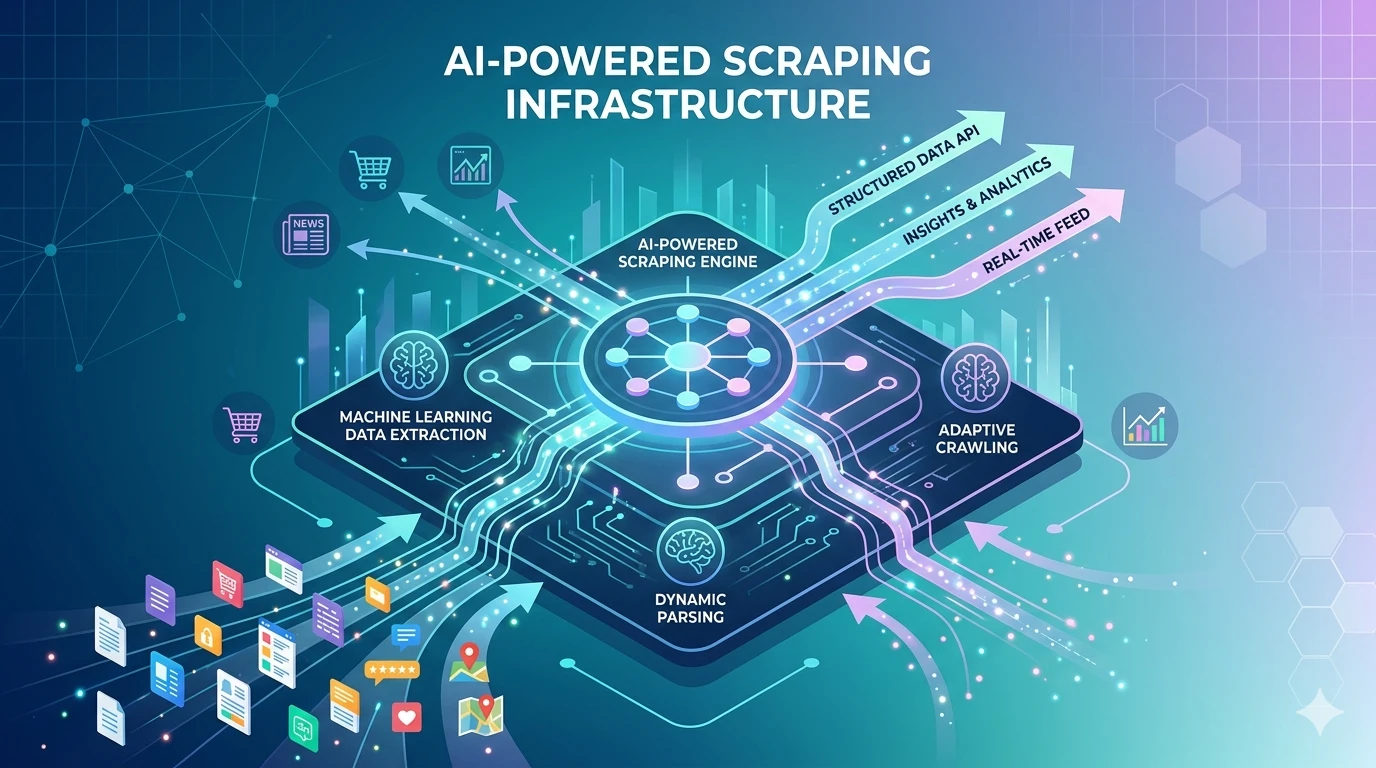
Modern data extraction workflows often rely on integrated scraping platforms that combine multiple technologies into a single system. These platforms typically include automated crawlers, proxy networks, and AI-powered parsing engines.
Automated crawlers discover and navigate webpages while identifying links and data sources. Proxy infrastructure ensures that requests are distributed across multiple IP addresses to maintain stable access to websites.
AI-based parsing engines analyze webpage content and automatically convert relevant information into structured outputs.
Some modern scraping platforms also integrate AI-driven scraping technology designed to simplify complex data extraction tasks. Solutions such as Decodo provide infrastructure that combines automation, proxy networks, and intelligent data parsing to support scalable web data collection.
By integrating these technologies into a unified workflow, organizations can gather large volumes of structured datasets without constantly maintaining custom scraping scripts.
Real World Applications of Structured Web Data
Structured web data powers many real-world applications across different industries.
Ecommerce companies use structured datasets to monitor competitor pricing and adjust their own pricing strategies. This allows them to remain competitive in rapidly changing markets.
Marketing teams analyze structured data from search engines and social platforms to identify trending topics and improve content strategies.
Financial analysts collect structured data from news sources, economic websites, and company reports to track market movements and evaluate investment opportunities.
Research institutions also rely on structured datasets for academic studies and large-scale data analysis.
In each of these scenarios, the ability to extract clean and organized data from the web enables organizations to transform raw information into actionable insights.
Best Practices for Extracting Clean Structured Data
Building reliable data extraction pipelines requires careful planning and adherence to best practices.
The first step is defining a clear extraction schema. Knowing exactly which fields are required ensures consistent data collection across all sources.
Automated validation systems should be used to detect missing fields or formatting errors. This helps maintain high data quality.
Monitoring extraction pipelines is also important. Website changes may occasionally disrupt scraping processes, so alerts should detect unusual drops in data collection.
Data cleaning pipelines should normalize values such as dates, prices, and categories to ensure consistent formatting.
Using scalable infrastructure and intelligent parsing tools can also improve long-term stability.
Ethical and Responsible Data Extraction
Responsible data extraction practices are essential for maintaining ethical standards and avoiding unnecessary disruptions.
Organizations should respect the website’s terms of service and consider robots’ guidelines where applicable. Scraping systems should avoid sending excessive requests that could overload servers.
Data collection should focus on publicly available information rather than restricted or private content.
Maintaining responsible scraping practices helps ensure sustainable data collection and reduces potential conflicts with website operators.
Conclusion
The ability to extract clean and structured data from the web has become increasingly valuable in the modern digital economy. Businesses, researchers, and analysts rely on web-based datasets to gain insights that support strategic decisions.
While traditional scraping methods can extract information from simple webpages, modern websites require more advanced techniques. AI-powered parsers, schema-based extraction, and automated aggregation pipelines have enabled the transformation of complex web content into reliable, structured datasets.
When combined with scalable scraping infrastructure and responsible data collection practices, these technologies enable organizations to efficiently gather large volumes of information.
As artificial intelligence continues to evolve, the process of extracting structured data will become even more automated and accurate. Organizations that adopt modern data extraction techniques will be better positioned to unlock valuable insights hidden across the vast landscape of online information.
