

A proxy comparison can look surprisingly simple until you start putting actual requirements beside the provider names. Bright Data and Oxylabs both offer residential, datacenter, and ISP proxies. Both have scraping APIs, unblocking products, datasets, and newer tools aimed at AI developers. Both also apply compliance checks to certain products. A basic feature list can make them look almost interchangeable.
The differences become much more obvious once the traffic starts moving. Pricing models affect the final bill. The same proxy type can behave differently against a particular target. Mobile performance can tell a different story from residential performance, and an API priced per result cannot be compared directly with an unblocking service charged by bandwidth. That is why this Bright Data vs Oxylabs and alike comparison looks beyond the usual pool-size claims and compares pricing, performance, scraping tools, AI products, targeting, compliance, and several alternatives. The pricing and pool figures used here reflect provider information available in September 2026, while performance figures are identified by their source rather than presented as universal results.
The basic idea behind a proxy is straightforward. A proxy server sits between your scraper and a website, sending requests through another IP address. That becomes useful when a site limits automated requests or treats repeated traffic from one address as suspicious. Imperva’s Bad Bot Report found that automated traffic accounted for 51% of all internet traffic in 2024, meaning websites have plenty of reason to invest in bot detection. IP reputation is only part of the equation. Fingerprinting, rate limits, CAPTCHAs, and request patterns can all affect whether a scraping request succeeds.
Bright Data vs Oxylabs at a Glance
The table below gives you a quick comparison before getting into the details. Unless stated otherwise, these figures come from the providers’ own published information.
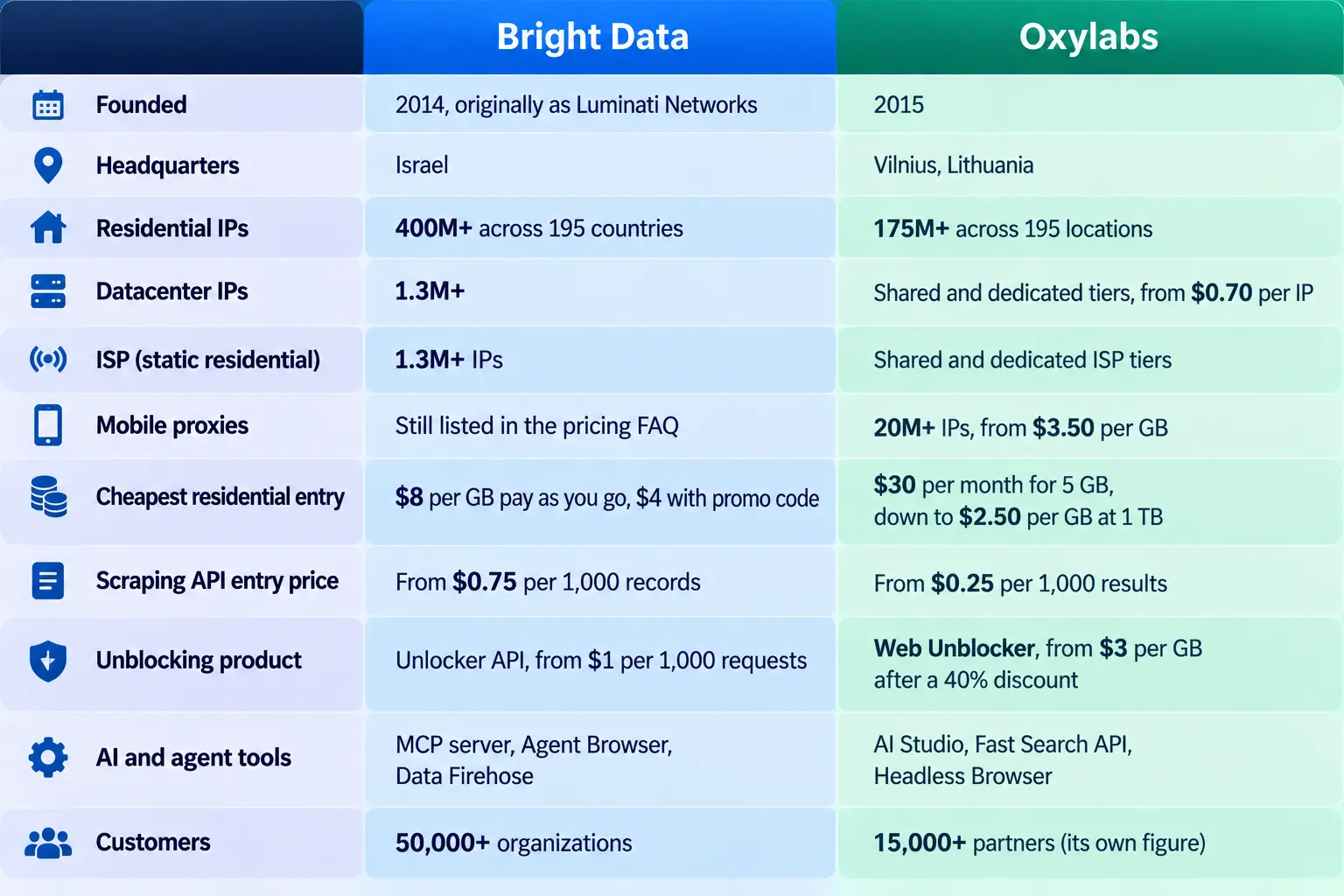
At a high level, Bright Data offers a broader product catalog and a strong focus on managed web data and AI-agent tooling. Oxylabs has a more focused range, with competitive pricing on several scraping products and a notable mobile proxy offering. Those differences only become useful when matched to a real workload. A team collecting product listings every hour may care more about API billing and e-commerce coverage, while a project maintaining long-lived sessions on mobile-heavy targets may weigh mobile proxy performance much more.
Where Each Company Comes From
Bright Data
Bright Data began in 2014 as Luminati Networks, with Ofer Vilenski and Derry Shribman among its co-founders. The company adopted the Bright Data name in 2018 and is headquartered in Israel. It says more than 50,000 organizations use its services, ranging from Fortune 500 companies and research institutions to smaller teams. The company also lists offices in the United States. Its own materials describe Bright Data as a leading web data infrastructure provider, although that description is company positioning rather than an independent industry ranking.
Bright Data has been involved in residential proxies for years, and its product range has expanded well beyond the proxy gateway itself. Its current catalog includes scraping APIs, datasets, browser products, data feeds, and managed collection services. AI has become another major area of development since 2025, with products intended to give AI systems access to live web content. That wider ecosystem is important when comparing Bright Data with Oxylabs because the decision is no longer simply about whose proxy pool is larger.
Oxylabs
Oxylabs was founded in 2015 in Vilnius, Lithuania, and grew out of the Tesonet accelerator. The company says its platform is trusted by more than 15,000 partners, including dozens of Fortune Global 500 companies. In 2026, Oxylabs announced its first outside investment at a valuation of $3.6 billion. Its reputation has largely been built around large-scale proxy infrastructure, web scraping, and enterprise customers, although its current product lineup now includes AI-focused tools and browser automation as well.
That history helps explain some of the differences between Oxylabs and Bright Data. Oxylabs has kept a strong emphasis on proxy infrastructure and managed enterprise relationships, while Bright Data has expanded more aggressively into data acquisition, datasets, and related web intelligence products.
How We Compared Them
This comparison draws from three sources of information. The first is current pricing and product information published by Bright Data and Oxylabs and reviewed in September 2026. The second is an independent proxy benchmark updated on September 16, 2026. The third consists of claims published by the providers themselves. Vendor claims are identified as such rather than being treated as independently verified measurements.
There are a couple of limitations worth keeping in mind. The organization behind the independent benchmark says that both Bright Data and Oxylabs subscribe to its testing services, and the benchmark page includes affiliate links. Older reviews are still useful for understanding how the services developed, but a comparison published in 2023 should not be used as the authority for a 2026 price. We also did not run our own load tests for this article. A five-day trial against your actual targets will tell you more about practical performance than any generalized benchmark.
Oxylabs vs Bright Data Product Lineup: What Each Platform Sells
Both platforms started with proxy networks and have since added products that sit higher in the web data stack. The overlap is extensive, but the emphasis is different enough to matter when choosing a platform.
Bright Data’s catalog
Bright Data divides its main products into web access APIs, data feeds, data and insights, and proxy infrastructure. That gives customers access to:
- Residential, ISP, and datacenter proxies as the network layer
- Unlocker API, SERP API, and Browser API for difficult websites
- Scraper APIs covering 800+ websites, plus Scraper Studio for custom collection
- Datasets from 900+ domains and Data Firehose for real-time HTML delivery
- Retail Intelligence and Managed Data Acquisition for organizations that prefer a managed approach
AI products sit alongside these services. The result is a platform that can cover several stages of a data project, from obtaining an IP address to collecting structured records and delivering ongoing data feeds. A development team may never need all of those services, but having them under the same provider can simplify procurement and integration.
Oxylabs’ catalog
Oxylabs groups its products around proxies, advanced proxy solutions, scraping tools, and datasets. Its range includes:
- Residential, datacenter, ISP, dedicated ISP, and mobile proxies
- Web Unblocker for websites that are difficult to access directly
- Web Scraper API with E-Commerce, SERP, and Real Estate variants
- Headless Browser for automation and AI agents
- Datasets, AI Studio, and the newer Fast Search API
Oxylabs also provides some free developer-oriented tools, including a Chrome proxy extension and an Android proxy manager that can work with proxies from other providers. Those tools are not likely to determine an enterprise purchase by themselves, but they are useful during testing and configuration.
The two catalogs overlap heavily. Bright Data currently goes further into managed data services and real-time data delivery, whereas Oxylabs keeps the core offering relatively focused around proxy infrastructure, scraping, browser automation, and datasets. For a team that wants a single vendor to cover a large portion of its web data operation, that difference can be significant.
IP Pool Size and Geographic Coverage
Proxy companies like to lead with IP pool numbers because they are easy to understand. They are also easy to misuse. A pool containing hundreds of millions of addresses sounds impressive, but the number that matters to a scraper is the number of usable addresses available for the country, city, carrier, or ASN it actually needs.
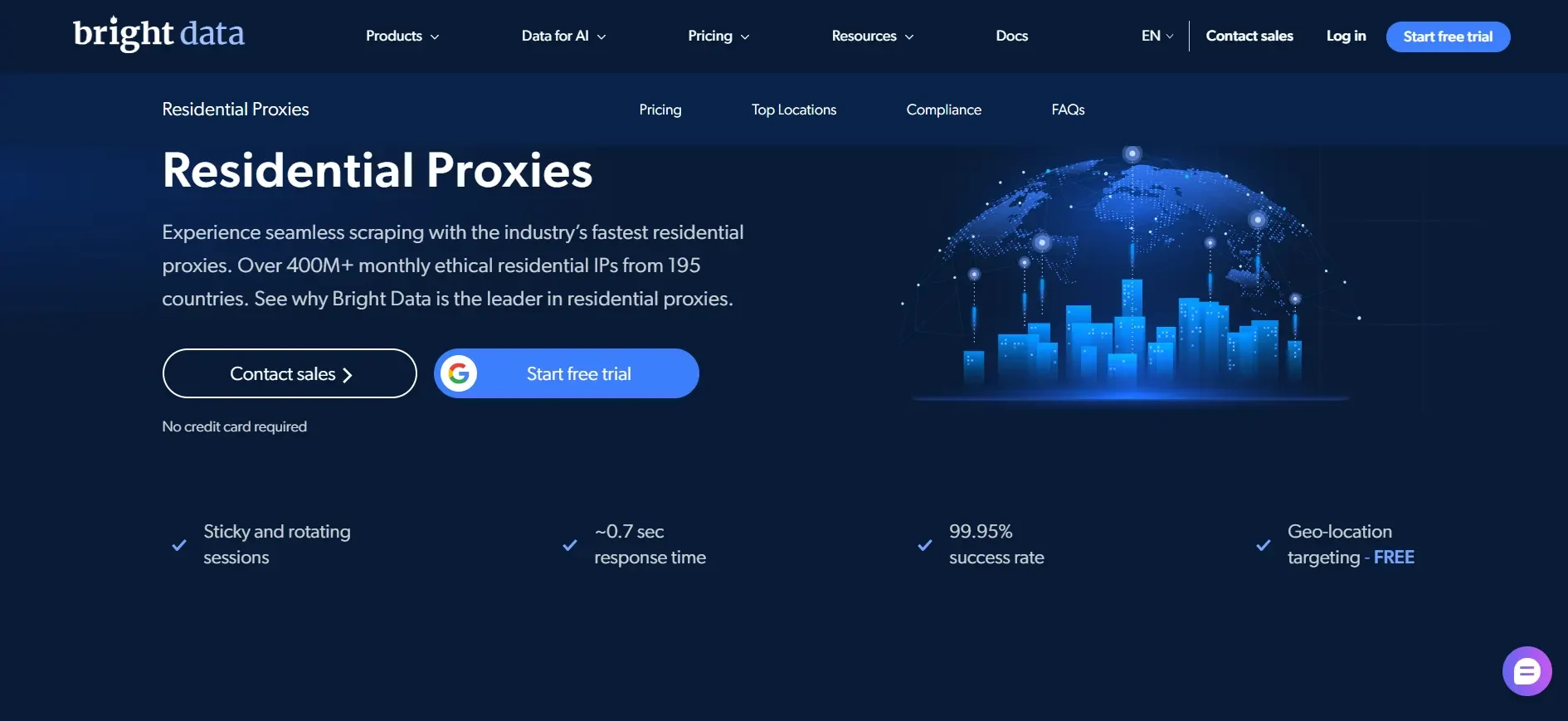
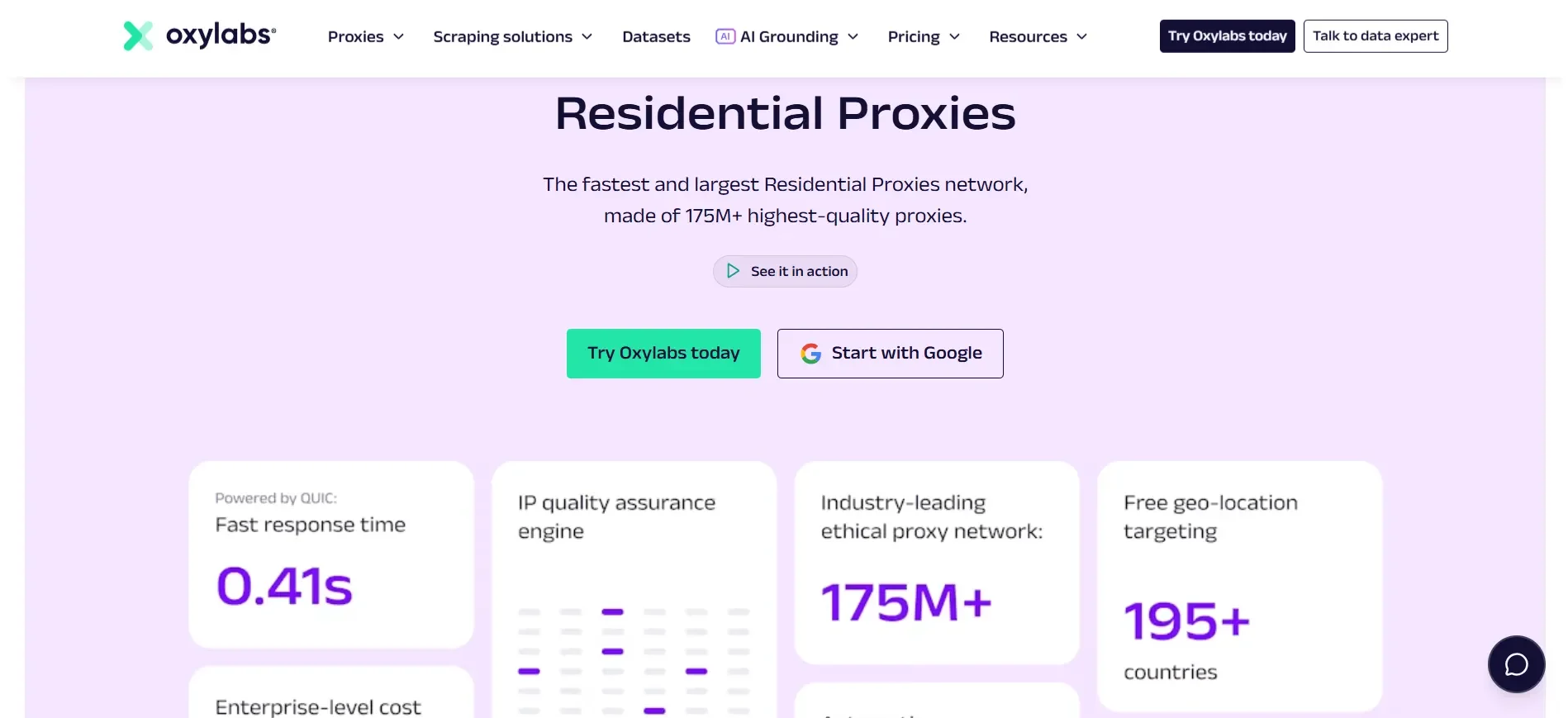
Bright Data advertises more than 400 million residential IPs across 195 countries. Its residential service provides targeting by country, state, city, ZIP code, and ASN. Oxylabs advertises more than 175 million residential IPs across 195 locations and provides targeting by continent, country, city, state and ZIP code. It also offers filters for IP version and platform, with some advanced filters potentially requiring a KYC check.
Datacenter and ISP figures require a little more caution. Bright Data lists more than 1.3 million datacenter IPs and more than 1.3 million ISP IPs. Oxylabs does not show a single headline datacenter number on its main pricing page. Bright Data’s comparison materials credit Oxylabs with more than two million dedicated datacenter IPs and coverage in 188 countries, but that is a competitor’s statement rather than a current inventory figure published by Oxylabs. Anyone buying specifically for a country or city should ask for current availability rather than relying on a global pool number.
Mobile proxies are an area where Oxylabs publishes a particularly clear figure. Its mobile network is advertised at more than 20 million IPs from real devices, with prices beginning at $3.50 per GB. Bright Data’s pricing FAQ still mentions mobile as one of its network types, although its main product navigation now emphasizes residential, ISP, and datacenter services. A mobile-heavy project should confirm current Bright Data availability and pricing before treating the two offerings as directly comparable.
Looking beyond the two largest names gives some perspective. Decodo advertises more than 125 million IPs across 195+ locations, while SOAX advertises more than 155 million residential IPs across 195+ locations. Neither matches Bright Data’s published residential pool figure, but raw size is only part of the buying decision.
What Has Changed Since Older Comparisons
Older Bright Data vs Oxylabs comparisons can be useful, but only if you treat them as historical references. A well-known comparison updated in November 2023, for example, listed Bright Data at roughly 72 million monthly residential IPs and Oxylabs at more than 100 million. The figures currently advertised by the providers are much larger, with Bright Data reporting 400M+ residential IPs and Oxylabs 175M+. That is a substantial change in only a few years.
Product names have moved too. Bright Data now presents Web Unlocker as Unlocker API and its Scraping Browser as Browser API. Scraper Studio has joined its web scraping products, and the company has built a large collection of ready-made Scraper APIs. Oxylabs has added Headless Browser, AI Studio, and Fast Search API and has expanded its SERP targets to include ChatGPT and Gemini. Decodo has also replaced the Smartproxy name, so an older article mentioning Smartproxy may actually be referring to the same company you find today under the Decodo brand.
That makes publication dates especially important when researching proxy providers. A price from an old review can be wrong. A pool size can be outdated. A product that was once missing may now be standard. Before making a purchase based on a comparison, check when the figures were collected and compare them against the provider’s current pricing and product pages.
Bright Data versus Oxylabs Performance: What Independent Tests Show
Performance claims are tricky because there is no single number that captures proxy quality. Oxylabs reports an average response time of 0.6 seconds and a 99.95% success rate on its residential product page. Bright Data reports 99.99% network uptime on its pricing page and has cited a 98.44% success rate from a benchmark covering 11 scraping providers. Those figures come from specific testing environments and should not be treated as guaranteed results against every website.
A recent independent benchmark provides another view. It tested residential proxies, mobile proxies, and unblockers and compared success rates and response times.
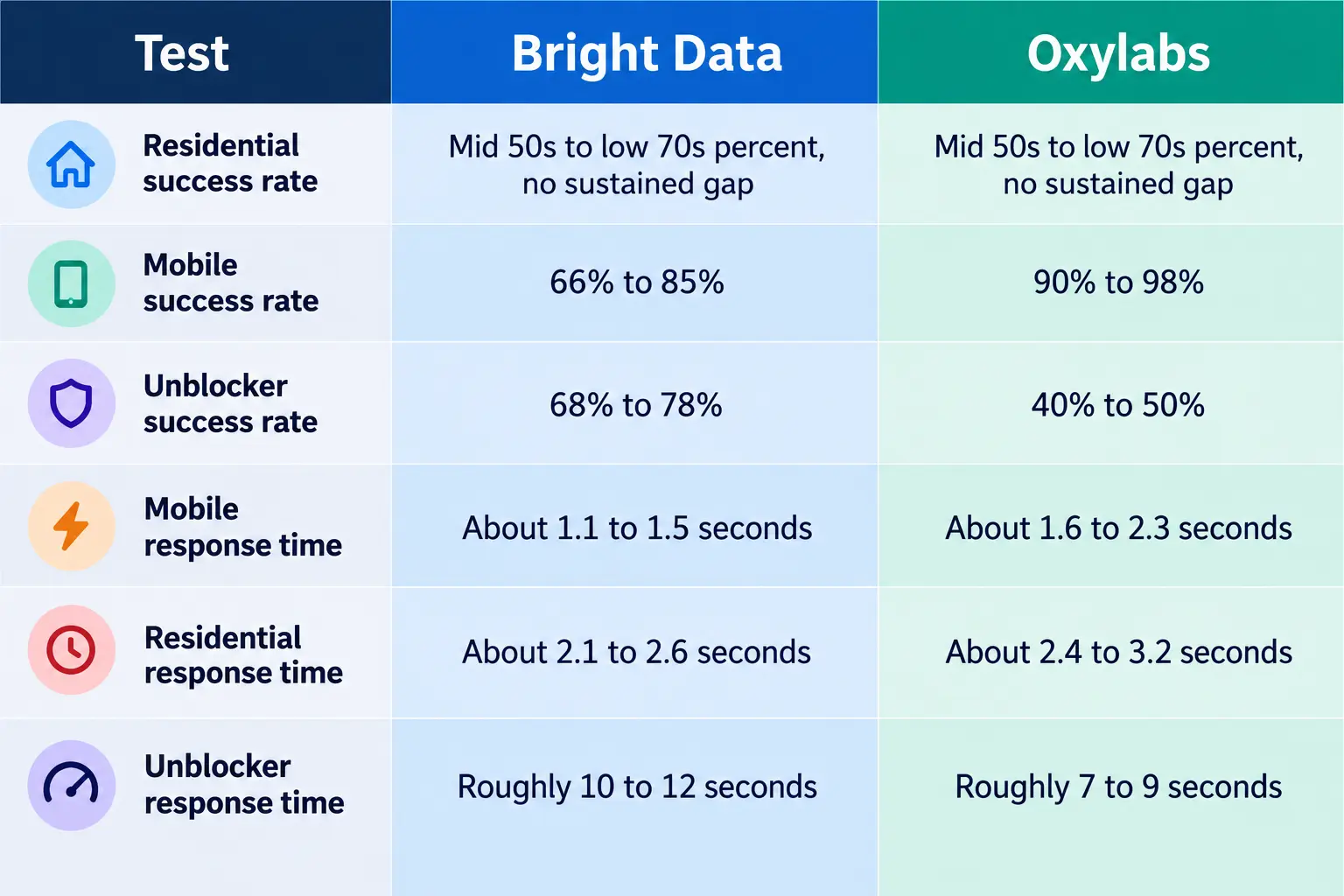
The numbers point to a fairly interesting split. Residential results were broadly similar, with no sustained difference between the two. Mobile performance favored Oxylabs by a wide margin in the test, while Bright Data had the stronger unblocker success rate. Oxylabs’ successful unblocker requests came back faster.
The benchmark’s success rates are also much lower than the headline percentages published by the providers. That does not automatically mean either company is exaggerating. A difficult-target test can produce very different results from a controlled vendor benchmark. Website choice, request volume, browser fingerprints, headers, and session handling all influence the outcome. A team mainly interested in response time can also consult our list of the fastest proxy providers for additional context.
The practical lesson is to test the exact websites you care about. A provider that performs well against one retailer, search engine, or social platform may behave differently against another.
Scraping APIs, Unblockers and Browsers
Raw proxies are not always the most efficient way to collect data. Once a project starts dealing with rendering, retries, CAPTCHAs, and browser fingerprints, the engineering effort required to manage the proxy layer can become substantial. Scraping APIs and browser products move some of that complexity into the provider’s infrastructure.
Bright Data
Bright Data’s Unlocker API handles CAPTCHAs, retries, and rendering through a single endpoint. It starts at $1 per 1,000 requests and has a free tier. The SERP API also starts at $1 per 1,000 requests and supports Google, Bing, DuckDuckGo, and Yandex. Scraper APIs for specific websites and categories, including LinkedIn, e-commerce, and social platforms, are listed from $0.75 per 1,000 records, discounted from $1 at the time of writing. Browser API, its remote browser product with stealth capabilities, starts at $5 per GB.
There is another small but practical distinction in the onboarding process. Bright Data’s pricing FAQ says its Unlocker does not require the same KYC process used for residential and mobile proxies. For a developer who needs to test an unblocking workflow quickly, that can make the initial setup simpler.
Oxylabs
Oxylabs Web Scraper API starts at $0.25 per 1,000 results and includes a free trial. Web Unblocker is priced by bandwidth and is listed at $3 per GB after a 40% discount from the $5 list price at the time of writing. Headless Browser starts at $4.7 per GB and targets browser-based automation. Fast Search API adds another option for applications that need quick search results, particularly AI-oriented workflows.
The lower entry price of Web Scraper API stands out, but the numbers should not be compared without looking at the billing model. A service charging per result behaves differently from one charging per gigabyte.
The billing difference matters more than the price
Bright Data generally charges several API products by request or record. That makes the unit economics easier to understand when your output is a fixed number of records. Oxylabs’ Web Unblocker uses bandwidth billing, which can work well when page sizes are consistent but becomes harder to predict when target pages vary.
Imagine a scraper that requests a product page containing only lightweight HTML in one case and a heavily rendered page with substantial resources in another. The two requests can consume very different amounts of bandwidth even though both represent a single page. Under a per-result model, that difference may have less direct impact on the API charge. Under a per-GB model, it matters immediately.
Before comparing the lowest prices in a Bright Data vs Oxylabs table, calculate average page weight, retry rates, and the number of successful records produced. Cost per successful record is much more useful than cost per unit in isolation.
AI and Agent Tooling
The rise of AI agents has changed what proxy companies sell. Developers increasingly need systems that can retrieve information from live websites, interact with pages, and feed structured data into AI applications. Bright Data and Oxylabs have both responded, although their product approaches are not identical.
Bright Data offers an MCP server that it lists as free, Agent Browser for AI agents that need to interact with live websites, and Data Firehose for real-time HTML delivery. It also has a startup program for AI companies. According to Bright Data’s own comparison material, the MCP server works with tools and clients such as Claude, Cursor, Windsurf, n8n, and LangChain. For a development team already working inside those ecosystems, that can reduce integration work.
Oxylabs has AI Studio, Fast Search API, and Headless Browser. Its Web Scraper API also covers ChatGPT and Gemini as SERP targets according to its product menu. Bright Data’s comparison article says Oxylabs does not have a public MCP server, although that claim could not be independently confirmed through Oxylabs’ own pages. Anyone treating MCP as a requirement should verify the current situation directly with the provider.
For an AI agent that needs to browse, click, and interact with live websites, Bright Data currently presents the more extensive set of agent-specific products. A system focused on retrieving search results quickly may care less about the difference. Decodo and other providers have also entered the MCP market, so the category is changing quickly.
Oxylabs vs Bright Data Pricing: What You Will Pay
Proxy pricing changes often enough that every figure should be treated as a snapshot. The prices below reflect the September 2026 information used for this comparison.
Residential proxies
Oxylabs lists four monthly residential plans:
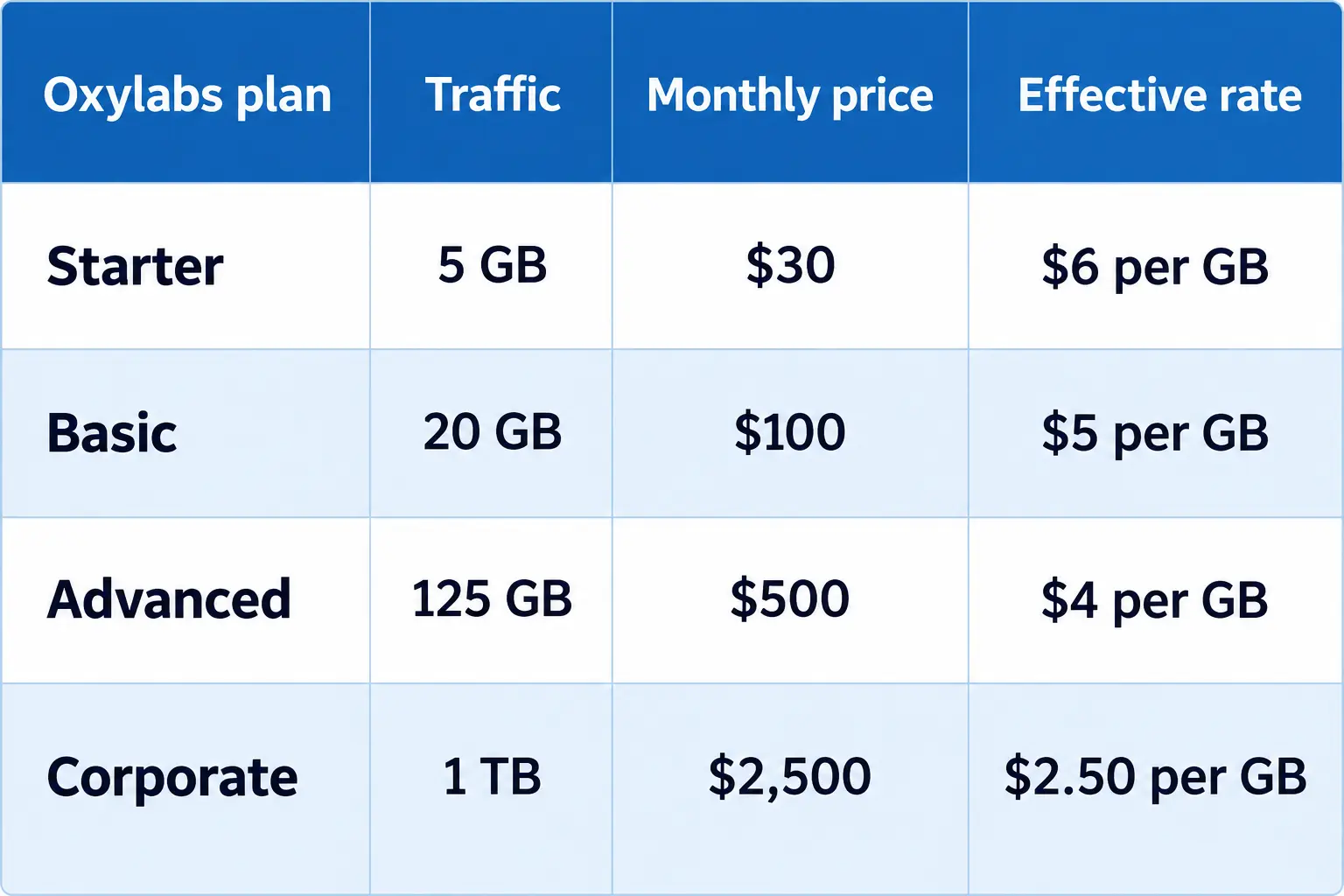
The plans include 24/7 support and a dedicated account manager. Oxylabs states that its refund policy applies only to self-service products and only within three days of the first payment, with usage below 20% of purchased traffic on regular plans. Anyone making a larger initial purchase should read those conditions before committing.
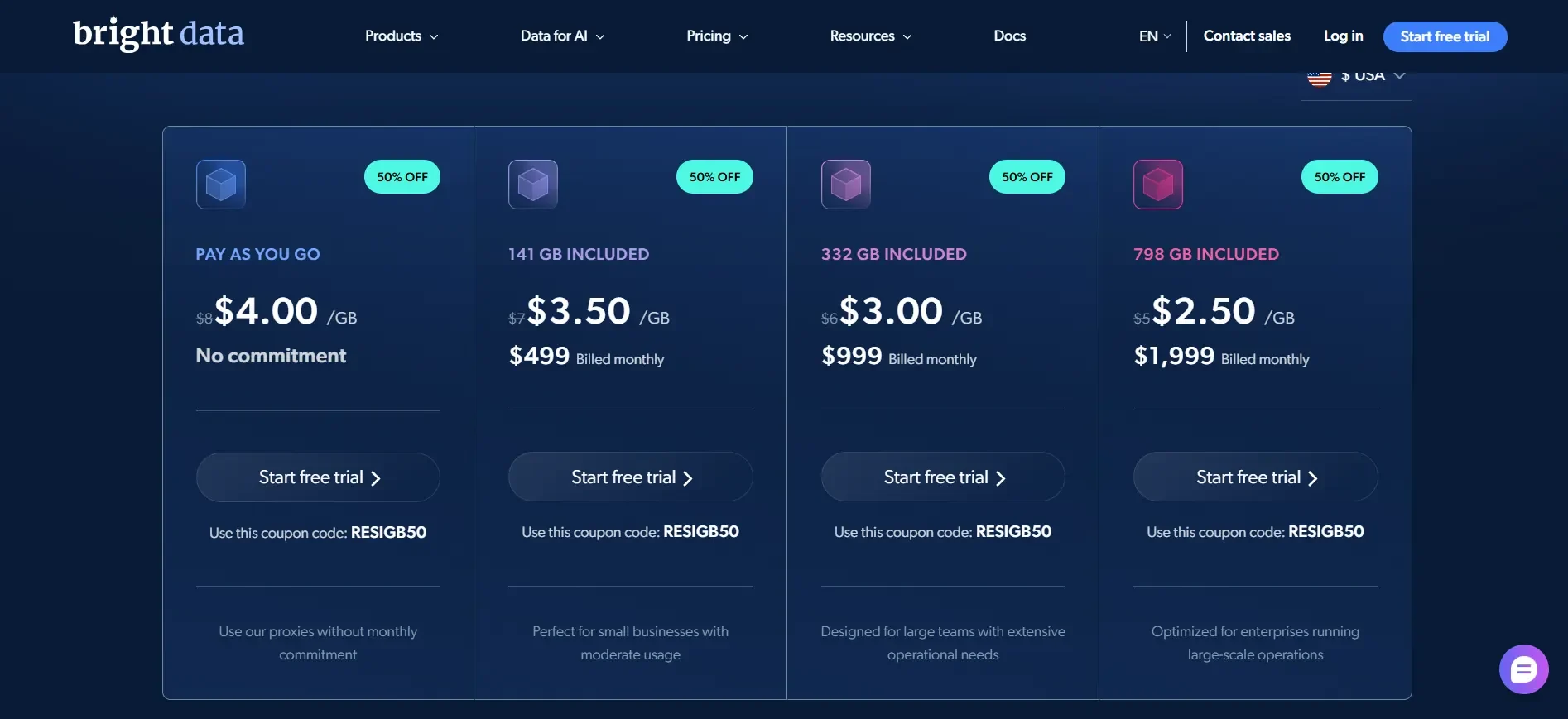
Bright Data offers residential proxies on a pay-as-you-go basis at $8 per GB without a commitment. Its listed monthly plans include $499 for 141 GB, $999 for 332 GB, and $1,999 for 798 GB. At the time of writing, the pricing page advertises RESIGB50 for 50% off residential proxies for three months, bringing pay-as-you-go pricing to $4 per GB during the promotion. Bright Data’s comparison article says the code covers six months, so the checkout terms should be treated as the final word. Bright Data also promotes a first-deposit offer matching deposits up to $500.
Other proxy types and products
| Product | Bright Data | Oxylabs |
|---|---|---|
| Datacenter proxies | From $0.90 per IP | From $0.70 per IP |
| ISP proxies | From $1.30 per IP | From $1.20 per IP, dedicated from $2.50 per IP |
| Mobile proxies | Ask sales | From $3.50 per GB |
| Unblocking | Unlocker API from $1 per 1,000 requests | Web Unblocker from $3 per GB (40% off) |
| Scraper API | From $0.75 per 1,000 records | From $0.25 per 1,000 results |
| Browser | Browser API from $5 per GB | Headless Browser from $4.7 per GB |
| Datasets | From $250 per 100,000 records | See Oxylabs datasets page |
The units in this table are deliberately different because the providers bill their products differently. A price per 1,000 records cannot be placed on the same scale as a price per gigabyte or a price per IP. Retries, failed requests, and page weight can change the final cost substantially.
Bright Data’s pricing FAQ says bandwidth includes request headers, request data, response headers, and response data. Trial traffic does not count toward the bill. Its ability to cap daily spending by bandwidth or dollars for a zone is another practical feature for teams worried about an unexpectedly large scraper bill.
Ethical Sourcing, KYC and Compliance
Residential proxies raise questions that do not apply in quite the same way to datacenter IPs. The addresses belong to real consumer connections, so the way those addresses enter a proxy network matters.
Bright Data says its residential IPs come through opt-in bandwidth-sharing programs that include EarnApp, Bright VPN, and an SDK that developers can embed in applications with user consent. Residential and mobile access requires KYC, which can include a short video call and verification of company or personal information. Its trust materials list ISO 27001 certification and GDPR readiness.
Oxylabs says its residential network consists of consenting and informed users who are fairly compensated. The company publishes a Residential Proxy Acquisition Handbook describing its sourcing practices and supplier requirements. It also maintains ISO/IEC 27001:2022 certification, a Trust Center, and a KYC policy. Oxylabs restricts certain target categories on its residential network, including banking and financial institutions, government websites, streaming, ticketing, and all Apple domains.
Neither provider should be treated as an unrestricted access service. A project involving regulated industries, financial websites, or government targets should be checked with the provider before procurement. For larger organizations, sourcing documentation and compliance paperwork can matter just as much as network performance because those documents often need to pass an internal vendor review.
Dashboard, Documentation and Support
The dashboard is easy to overlook during procurement. It should not be. A scraper team that spends hours trying to understand zones, authentication, or rotation settings can lose more money in development time than it saves through a slightly lower proxy rate.
A 2023 comparison described Oxylabs as organizing services into separate dashboard tabs, while Bright Data used a unified zone-based system combining plans and sub-users. Bright Data’s model can take some time to learn, particularly for new users, but the centralized structure becomes useful once several proxy configurations are running. Interfaces change, so a current trial is more useful than relying on a screenshot from an older review.
Oxylabs lists 24/7 live chat and dedicated account managers on its plans. Bright Data also provides dedicated account management. An older 2023 comparison reported that Bright Data relied on ticket support rather than live chat at the time. That information is no longer current enough to treat as definitive, so response speed should be tested during the evaluation process. Send both providers the same technical question and see not only how quickly they respond, but whether the response actually solves the problem.
Documentation is strong on both platforms. Oxylabs offers a Developers Hub with Python and Go SDKs, a Web Scraper API Playground, and a Discord community. Bright Data provides documentation at docs.brightdata.com, a free Proxy Manager, integrations with common scraping and AI tools, and a Web Data Masterclass. Developers who prefer self-service support should spend some time in both documentation libraries before selecting a provider.
Sessions, Protocols and Control Features
Proxy performance is only half the experience. The way sessions and rotations behave can have a major effect on whether a scraper stays logged in, gets blocked, or produces inconsistent results.
Oxylabs’ residential product lists unlimited concurrent sessions, sticky sessions, flexible rotation, and support for HTTP(S), HTTP/3, and SOCKS5. Plans include three proxy users and ten whitelisted IPs, with authentication available through credentials or IP whitelisting. ISP products have additional limits. Oxylabs specifies, for example, different concurrent-session limits per ISP proxy depending on the monthly traffic used on that IP. A high-volume parallel scraper should account for those rules before purchase.
Bright Data provides extended session control, shared and dedicated IP options, a network status page, and Proxy Manager. Its pricing FAQ says SOCKS5 is available through Proxy Manager. The manager also gives developers control over rotation rules. That can be useful for workflows where a scraper needs to retain the same address through several requests before rotating.
There is no universal winner here. A straightforward proxy gateway can be preferable when developers do not want to spend time configuring individual rotation behaviors. More granular controls become valuable for login flows, account-based scraping, and workloads where IP persistence matters. The session model should be tested with the same application that will eventually run in production.
Datasets: When Buying Data Beats Scraping It
Sometimes the most effective proxy strategy is to avoid scraping altogether. If a provider already sells the information you need in a structured form, buying the dataset can remove the need to maintain proxies, parsers, browser sessions, and retry systems.
Bright Data’s dataset catalog covers more than 900 domains, with pricing starting at $250 per 100,000 records. It also offers custom dataset requests and delivery to cloud storage. Oxylabs sells datasets and provides custom collection services as well, although Bright Data’s comparison material describes its ready-made catalog as larger.
Professional-network data illustrates the point. A team looking for company or job records at scale can compare LinkedIn dataset providers before building a custom scraper. A heavily protected site can require ongoing proxy rotation, browser automation, and parser maintenance. The dataset may have a higher upfront price but still cost less when engineering time and maintenance are included.
Beyond Oxylabs vs Bright Data: Other Providers Worth Testing
Bright Data and Oxylabs are not the only serious choices. The two companies attract attention because of their scale, but mid-market providers can be perfectly adequate for projects that do not need enterprise-level infrastructure.
Decodo (formerly Smartproxy)
Decodo advertises more than 125 million IPs in 195+ locations. Residential proxies start at $2 per GB, mobile proxies at $2.25 per GB, datacenter proxies at $0.02 per IP, and static residential proxies at $0.27 per IP. Its Site Unblocker starts at $0.95 per 1,000 requests, and the Web Scraping API at $0.09 per 1,000 requests. Decodo lists more than 135,000 clients, a free MCP server, a 14-day money-back option, and free trials. The company emphasizes ease of setup, making it an obvious provider to test when Bright Data or Oxylabs pricing feels excessive for a smaller workload. Our Decodod review covers the service under its former brand name.
SOAX
SOAX advertises more than 155 million residential IPs across 195+ locations, with targeting down to the city level. It lists a $1.99 trial. Independent reviews have highlighted its city and ASN targeting and 24/7 chat support while also pointing out fewer proxy management tools and monthly per-GB billing as limitations. SOAX is particularly relevant when geographic precision matters and traffic volumes are predictable enough to justify a monthly plan.
IPRoyal
IPRoyal’s residential pricing starts at $7 per GB and can fall to $1.75 per GB at higher volumes. Purchased traffic does not expire, which can be useful for projects that run periodically instead of consuming the same amount every month. The company advertises more than 32 million IPs in 195+ countries. Its pool is smaller than the networks offered by Bright Data and Oxylabs, but a smaller pool can be entirely sufficient for a modest scraper.
How the alternatives differ from the big two
The lower price is the obvious reason to investigate these providers. The more important question is what you give up in exchange. Smaller pools, fewer managed products, and less extensive enterprise documentation may not matter to a developer scraping a few thousand product pages each week. They become more significant when the scraper handles heavily protected websites, large traffic volumes, or business-critical data.
A project collecting moderately protected public data may discover that a mid-market service performs just as well as a premium provider. There is little reason to pay for infrastructure you will not use. A high-volume operation facing sophisticated anti-bot systems has a different calculation because downtime and engineering overhead can quickly outweigh the difference in proxy pricing.
Best Fit by Use Case
The same proxy provider can look excellent for one workload and unnecessary for another. Looking at the actual task makes the comparison much easier.
Price monitoring and e-commerce data. Retail websites frequently use anti-bot systems and often serve different content according to geography. City and ZIP targeting can therefore matter as much as the size of the residential pool. Bright Data’s e-commerce Scraper APIs and Unlocker API are relevant for protected retail pages. In contrast, Oxylabs’ E-Commerce scraping tools and lower starting price per 1,000 results can be attractive for recurring catalog collection.
Search engine results tracking. A dedicated SERP API usually removes much of the complexity involved in managing raw proxies for search results. Bright Data supports several search engines through its SERP API. Oxylabs and Decodo also have fast search products aimed at newer AI workflows. Check the search engine, country, and result format you need before comparing rates.
Social media and multi-account work. Static ISP addresses can help workflows where keeping a consistent IP through a longer session is important. Both providers offer ISP proxies. Bright Data lists more than 1.3 million ISP IPs, while Oxylabs offers shared and dedicated ISP tiers. Mobile addresses may also be relevant, and the independent benchmark used here gave Oxylabs a clear advantage in mobile success rates.
Ad verification and localized content checks. Location accuracy is central to this type of work. Bright Data offers country, state, city, ZIP, and ASN targeting, while Oxylabs provides country, city, state, and ZIP options. For a campaign checking content in a handful of smaller cities, do not assume global coverage guarantees sufficient local inventory. Run the actual locations through a test.
AI training and agent workflows. Bright Data has MCP, Agent Browser, and data products aimed directly at AI applications. Oxylabs has AI Studio, Headless Browser, and Fast Search API. The choice depends heavily on whether your system needs interactive browsing, search results, or large volumes of structured web data.
Lead generation and company data. A dataset can be more practical than maintaining a scraper. When the required company or professional information already exists in a maintained dataset, compare the data purchase against the engineering cost of collecting it yourself. Bright Data and Oxylabs both operate dataset businesses, so proxy pool size is not necessarily the deciding factor here.
Oxylabs vs Bright Data: Which Provider Fits Which Project
There is no need to force a universal winner. The more useful question is which platform gives your particular workflow fewer problems.
Consider Bright Data if:
- You are developing AI agents and want MCP, Agent Browser, and web data products under one provider
- Unblocker success is particularly important, and the cited benchmark is relevant to your target sites
- You want pay-as-you-go access before committing to a larger monthly package
- Residential targeting down to ZIP code and ASN is useful to your workflow
- You want the option of managed data acquisition or ready-made datasets alongside proxy infrastructure
Consider Oxylabs if:
- Mobile proxy performance is important, and the benchmark’s results resemble your workload
- Your traffic is predictable enough to justify a monthly plan
- A dedicated account manager is useful to your development or procurement team
- Lower starting prices for Web Scraper API, datacenter, and ISP products are attractive
- Published sourcing documentation and ISO/IEC 27001:2022 certification matter during vendor review
Consider Decodo, SOAX, or IPRoyal if:
- You want to keep initial proxy spending low
- Your targets have moderate anti-bot protection
- You would rather start with a smaller test and increase volume after seeing actual results
- Your team can handle retries, browser automation, and other scraper logic without extensive managed assistance
A five-day test is usually enough to expose major differences. Use the same targets, request volume, and scraper configuration for each provider. Record successful requests, response times, IP-related blocks, total traffic, and actual cost. Ask the same support questions. By the end of the test, you will have a much more useful comparison than a generic claim about which company has the “best” proxies.
For more detailed reviews, see our Bright Data review and Oxylabs review. Those articles examine the individual platforms and pricing structures in more detail.
Mistakes to Avoid When Comparing Proxy Providers
Proxy comparisons often go wrong because the easiest numbers are given too much importance. IP pool size is the obvious example. A 400-million-IP network is not automatically more useful than a 175-million-IP network. If your scraper needs 20,000 clean residential addresses in one specific market, the relevant question is how many suitable addresses are actually available there.
Billing is another common trap. Per-GB, per-request, per-record, and per-IP prices measure different things. Put them into a common calculation using your own traffic. A provider charging $0.25 per 1,000 results can be more expensive than a provider charging $1 if its success rate is much lower or its retries consume substantially more traffic.
A single benchmark should not decide the purchase either. The test cited in this article showed a substantial mobile advantage for Oxylabs and stronger unblocker success for Bright Data, but another set of targets can produce different results. Treat benchmarks as a way to narrow the shortlist, then run your own test.
Compliance should be checked early. Residential and mobile access can require identity verification or use-case approval, and restricted targets can prevent a technically sound project from launching. Starting the compliance process only after the development team has completed its integration is an avoidable delay.
Restricted target categories also deserve attention. Oxylabs publishes blocked categories for its residential network, and Bright Data evaluates use cases as part of its access process. Banking, government, streaming, and similar targets should be discussed with the provider before a purchase is made.
Finally, avoid buying the biggest package simply because it has the lowest effective unit price. A discounted 1 TB plan is not a bargain if the provider fails your target sites. Start small, measure actual results, and increase the volume once the numbers justify it.
Frequently Asked Questions
Is Bright Data better than Oxylabs, or Oxylabs better than Bright Data?
The answer changes according to the workload. The independent benchmark used here found broadly similar residential performance, significantly stronger mobile success rates for Oxylabs, and higher unblocker success for Bright Data. Oxylabs’ successful unblocker requests were also faster in that test. Those differences are useful clues, but the decisive test remains your own target websites.
Which is cheaper, Oxylabs or Bright Data?
There is no single answer because the providers use different billing models and offer different products. Oxylabs lists lower starting prices for datacenter proxies, ISP proxies, and Web Scraper API, and its residential plans reach $2.50 per GB at 1 TB. Bright Data offers residential pay-as-you-go pricing at $8 per GB, with the stated promotion reducing that to $4 per GB during the promotion period. The right comparison is cost per successful result after retries rather than the lowest advertised rate.
Do Bright Data and Oxylabs require verification?
Certain products do. Bright Data requires KYC before residential or mobile proxy access, while its pricing FAQ says Unlocker does not require the same process. Oxylabs also operates a KYC policy, and some advanced residential filtering options can require verification. Projects with a fixed launch date should complete this part of the process early.
Does Oxylabs offer a free trial?
Oxylabs lists free trials for Web Scraper API and Web Unblocker. ISP proxy trials can be requested through support. Residential proxy trial availability can vary, so prospective customers should contact the provider rather than assuming every product has the same trial terms.
What is the difference between residential, datacenter and ISP proxies?
Residential proxies use addresses associated with household internet connections. Datacenter proxies come from server infrastructure and are generally cheaper and faster, although they can be easier for sophisticated websites to identify. ISP proxies are hosted in data centers but registered under internet service providers, giving them a combination of datacenter infrastructure and ISP-associated addressing.
Are there good alternatives to Bright Data and Oxylabs?
Decodo, SOAX, and IPRoyal are worth testing, especially when the budget does not justify a premium provider. Their pools are smaller, but a smaller network can still handle a moderate scraping project. Decodo emphasizes straightforward access and low entry pricing; SOAX is notable for geographic targeting, and IPRoyal offers non-expiring purchased traffic.
Can I use these providers for AI training data?
Both companies market products for AI-related data collection. Bright Data offers MCP, Agent Browser, and data products, while Oxylabs provides AI Studio, Headless Browser, and Fast Search API. Technical access does not remove the need to consider the source site’s terms, applicable law, and your organization’s data policies. Those checks should happen before collecting data at scale.
Final Verdict
Bright Data and Oxylabs are close competitors, but they are not interchangeable products with different logos. Bright Data has built a particularly broad ecosystem around proxies, scraping APIs, datasets, managed data services, and AI-agent tooling. Its large published residential pool and targeting options add to that appeal. Oxylabs brings strong proxy infrastructure, competitive scraping API pricing, enterprise support, and a mobile network that performed notably well in the independent benchmark used for this comparison.
The alternatives deserve a place in the evaluation too. Decodo can lower the cost of getting started, SOAX is worth examining when geographic targeting is central to the project, and IPRoyal offers an unusual non-expiring traffic model. For a modest scraper, those differences can matter more than having access to the industry’s largest possible IP pool.
The most reliable way to settle a Bright Data vs Oxylabs and alike decision is to test the providers against the work you actually need to do. Run identical targets, record successful results rather than raw requests, calculate the real cost after retries, and measure support response time. That turns the comparison from a list of impressive specifications into a purchasing decision based on evidence.
