
Disclosure: Some links in this article are affiliate or sponsored links. If you buy through them, we may earn a commission at no extra cost to you. Our opinions are our own.
Oxylabs has built its reputation on a large residential proxy network, a broad product range, and enterprise-focused support. Those strengths come at a price. If you scrape a few hundred thousand pages a month, run projects with uneven traffic, or want to test a service without speaking to sales, a smaller or more specialised tool may be a better Oxylabs alternative than another enterprise platform.
This article compares seven alternatives to Oxylabs for web scraping: Bright Data, Decodo, Zyte, ScraperAPI, Scrapingdog, Crawlbase, and Proxyrack. The comparison uses the vendor pricing and product information provided and checked in 2026. Promotional rates and “from” prices can change, so verify the provider’s current pricing before budgeting. For background on the original service, our Oxylabs review explains its product range and practical use cases.
Top Alternatives to Oxylabs at a Glance
| Provider | Starting Price | Best For |
|---|---|---|
| Bright Data | $8/GB listed price; $4/GB promotional rate | Enterprise scraping and large proxy networks |
| Decodo | $3.75/GB on the 3 GB starter plan | Affordable residential proxies |
| Zyte | From $0.06 per 1,000 successful responses | Scraping sites with different levels of protection |
| ScraperAPI | $49/month for 100,000 credits | Managed scraping API |
| Scrapingdog | $40/month for 200,000 credits | Structured data from popular websites |
| Crawlbase | From $3 per 1,000 standard requests | Variable workloads and successful-request billing |
| Proxyrack | Plan-dependent | Bandwidth-heavy scraping jobs |
Prices are snapshots from the supplied source material and may change. Promotional and volume-based rates have conditions; confirm the provider’s current terms before budgeting.
These prices are not directly interchangeable. Proxy services may bill by gigabyte, IP, or concurrent thread, while scraping APIs may charge per request or credit. The useful comparison is the cost of a page that returns the data you actually need.
Why Teams Look for an Oxylabs Alternative
Oxylabs is a serious provider. Its residential network spans 195 countries, and its catalogue includes scraping APIs, Web Unblocker, and mobile, ISP, and datacenter proxies. Teams generally look elsewhere not because the service lacks capability, but because the billing model or product scope no longer matches their workload.
Bandwidth costs and minimum commitments
The official Oxylabs pricing page describes a unified subscription with access to its products. Residential traffic is still billed per gigabyte, with the supplied pricing snapshot showing $6/GB on the 5 GB Starter plan and $2.50/GB on the 1 TB Corporate plan, listed at $2,500 per month. The lowest per-GB rate requires a substantial commitment. Our Oxylabs pricing guide compares the tiers against real usage; smaller or irregular workloads can end up paying the highest rate per gigabyte.
How failed requests are counted
The Web Scraper API’s billing rules are another factor. Entry plans start from $0.50 per 1,000 results. Oxylabs says provider-side 5xx and 6xx failures are not billed, while 2xx and 4xx responses count as successful. A page blocked with a 403 response can therefore use quota. That rule may be acceptable for some projects, but it affects costs when target sites frequently reject requests.
The product may be more than you need
Solo developers, agencies, and mid-sized data teams often want a low entry price, a self-serve trial, and a billing unit that matches the job. One team may need only proxy IPs; another may want parsed Google results or a managed API that handles rendering and retries. Paying for features you do not use rarely helps the budget.
What to Check Before You Switch
Before moving a scraper, compare providers on billing, target coverage, trial size, targeting, and failure handling. Convert the quote into a cost per successful page rather than comparing price labels alone. Check whether you need country, city, or ASN targeting, and confirm how the provider treats blocked, empty, or challenged responses. A small trial may not be enough to test a difficult target; look for enough requests to repeat the pages that usually fail.
So, let’s get started with the list of best alternatives to Oxyalbs.
Best Oxylabs Alternatives
1. Bright Data
Bright Data is the closest like-for-like rival to Oxylabs for enterprise work. It offers residential, datacenter, ISP, and mobile proxies, as well as Web Unlocker, a SERP API, and scraper IDEs. The company advertises more than 400 million monthly residential IPs. Pay-as-you-go access is available across several proxy types and products, giving teams a way to test without a monthly commitment.
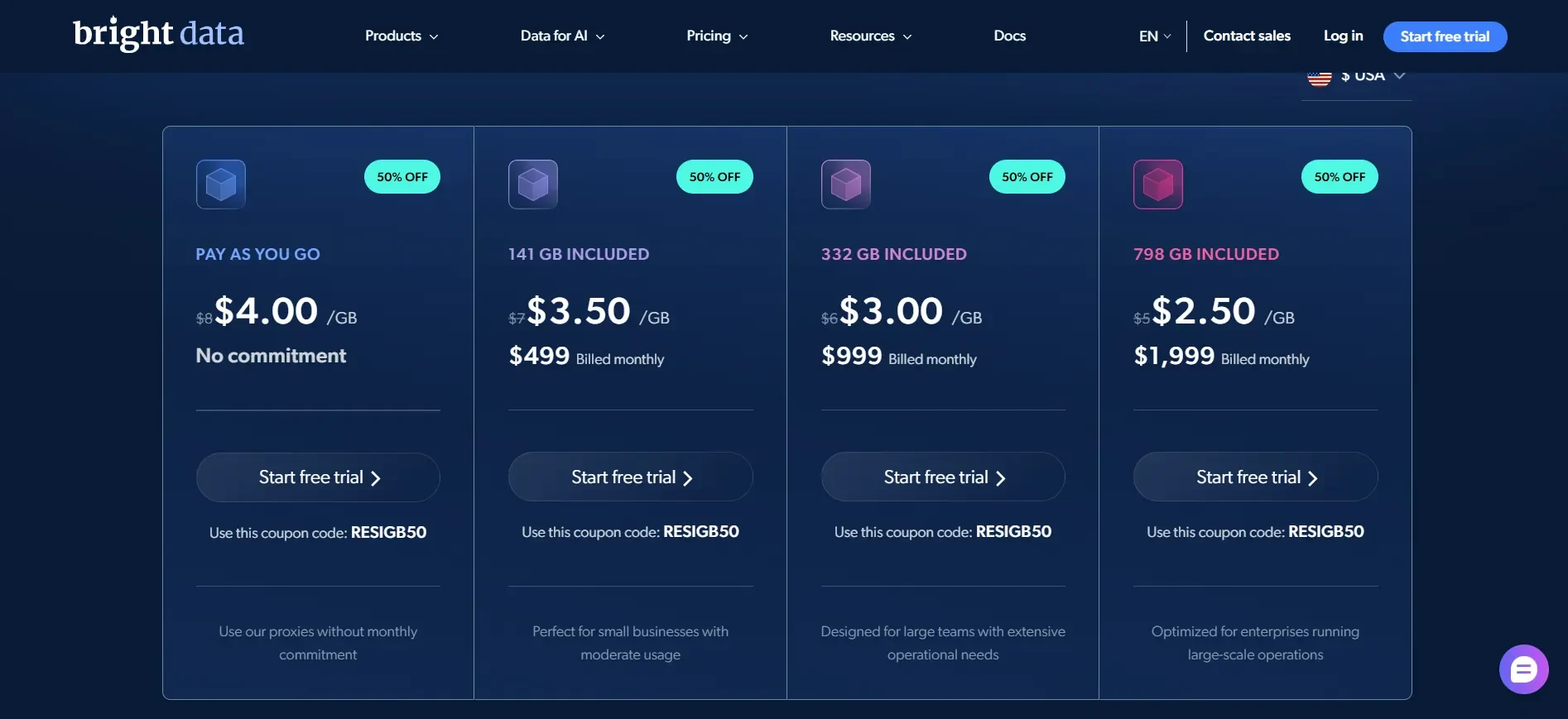
The supplied residential pricing snapshot lists $8/GB as the standard pay-as-you-go price and $4/GB as a promotional rate. Subscription examples include 141 GB at $3.50/GB, 332 GB at $3/GB, and 798 GB at $2.50/GB. These are discounted figures, so check the price that applies after a promotion ends. Access to residential and mobile networks also involves a compliance review.
The trade-off is complexity. Products use different billing units, and promotional pricing can make future costs harder to forecast. Our Bright Data comparison breaks down network size, features, and costs side by side. Best for: large teams that need a broad toolset and can manage a multi-product bill.
2. Decodo
Decodo, formerly Smartproxy, sells residential, mobile, ISP, and datacenter proxies alongside a scraping API. It advertises more than 125 million IPs across over 195 locations and a 99.99% uptime figure. That pool is smaller than the largest enterprise networks, but may be sufficient for many mid-sized projects.
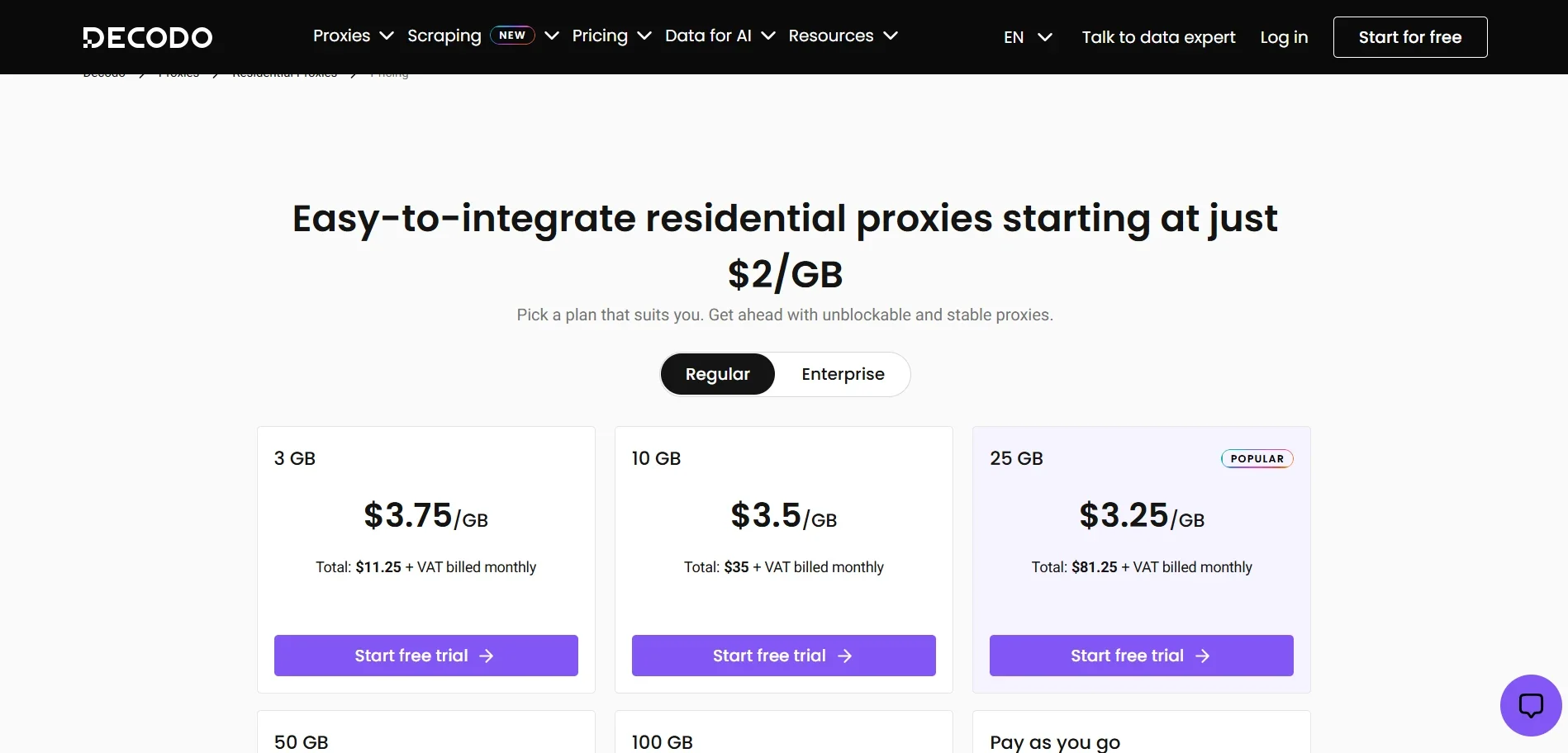
Residential traffic starts at $3.75/GB on the 3 GB plan, billed at $11.25 per month. The headline $2/GB rate applies at the largest volume tier. Mobile proxies start from $2.25/GB, ISP proxies from $0.27 per IP, and datacenter proxies from $0.02 per IP. Site Unblocker, which handles CAPTCHA challenges and rendering, starts from $0.95 per 1,000 requests. Decodo offers a three-day free trial on proxy types. See our Decodo pricing breakdown for the tier-by-tier details.
Tougher sites protected by systems such as Cloudflare may require Site Unblocker rather than standard residential IPs, increasing the effective cost. Best for: developers and small teams that want residential proxy access at a lower entry price.
3. Zyte
Zyte, the company behind the open-source Scrapy framework, offers an API that manages proxy rotation, bans, and browser rendering through one endpoint. Its pricing depends on the technology needed to access a particular site. Straightforward pages cost less than heavily defended ones, and the described model charges only for successful requests.
Prices start at $0.06 per 1,000 successful responses. New accounts receive $5 in credit to use within 30 days, with no subscription required. This can work well when a project mixes easy and difficult websites, because simpler targets can remain inexpensive. The drawback is that costs vary by the difficulty tier assigned to each domain. Run a pilot against your own target list before estimating the monthly bill. Best for: Python and Scrapy teams that want managed anti-bot handling without leaving their existing ecosystem.
4. ScraperAPI
ScraperAPI combines proxy rotation, JavaScript rendering, and CAPTCHA handling in one API call. The supplied plans list Hobby at $49 per month for 100,000 API credits, Startup at $149 for 1,000,000, and Business at $299 for 3,000,000, with custom plans above those tiers. New users can try the service for seven days with 5,000 credits and no card, and a free plan provides 1,000 credits each month for light testing.
Credits do not always equal requests. Rendering or premium IPs can consume more than one credit, so a 100,000-credit plan may return fewer than 100,000 finished pages. ScraperAPI does not bill by bandwidth, which can help when responses contain large amounts of HTML. Use the trial on real targets and measure credit use per successful page. Best for: developers who have their own parsing code and want a predictable proxy and rendering layer.
5. Scrapingdog
Scrapingdog provides dedicated scraping APIs for Google Search, Google Maps, Amazon, Walmart, LinkedIn, YouTube, and other popular websites. These endpoints return structured JSON rather than raw HTML, which can reduce the amount of parsing work needed downstream.
The free plan includes 100 credits without a payment card. Paid plans start at $40 per month for 200,000 credits, followed by $90 for 1,000,000 credits and $200 for 3,000,000. All plans include access to the APIs, with differences in credits, concurrency, and support. Failed requests are not charged, according to the supplied product details.
Credit use depends on the request: a standard rotating-proxy request uses one credit, JavaScript rendering uses five, and premium proxies use ten. Google and many social endpoints use between five and ten credits per request. The limitation is that Scrapingdog returns data rather than general-purpose IP access. If your software needs a proxy gateway for arbitrary sites, consider a proxy provider instead. Best for: SEO teams, price monitoring, and developers who need structured data at a low monthly cost.
6. Crawlbase
Crawlbase keeps the request process simple: send a URL with a token and receive HTML or JSON. When a page needs a browser, use a JavaScript token. Proxy rotation, CAPTCHA handling, and retries happen on the service side. The supplied details list up to 5,000 free requests without a card and billing only for successful requests.
For larger jobs, its asynchronous Crawler can send results to a webhook or cloud storage. It also offers Smart AI Proxy for teams that prefer proxy-style access. Published pricing starts at $3 per 1,000 standard requests for the first thousand and falls as volume grows; JavaScript requests cost more credits than standard ones.
Crawlbase has a lighter console than Oxylabs, with fewer built-in scheduling and parsing tools. That can suit developers who want a straightforward endpoint, but may frustrate teams looking for a single dashboard to manage a broader scraping operation. Best for: developers with variable workloads who want to pay only for successful requests.
7. Proxyrack
Proxyrack sells residential, datacenter, and mobile proxies. Its unmetered residential access is limited by concurrent threads rather than bandwidth, so downloading a large page can cost the same as downloading a small one, subject to the plan’s concurrency limits. For media-heavy or high-volume scraping, that can be useful compared with per-gigabyte billing.
Geographic targeting needs care. Proxyway’s independent testing reported that requests on Proxyrack’s unmetered residential pool exited through New Jersey, even when connections started in Europe, Singapore, or Brazil. Projects that rely on precise location targeting should test this first and consider the metered Premium pool or another provider. Proxyrack is a proxy supplier rather than a scraping API, so your team must build and maintain its own scraper. Best for: bandwidth-heavy work where predictable monthly cost matters more than fine-grained geo control.
Proxies or a Scraping API: Which Route Fits?
A proxy provider supplies IP addresses; your code retrieves pages, handles retries, and parses the output. A scraping API takes on more of that retrieval work and may manage rotation, rendering, and blocks before returning page content or JSON. Decodo and Proxyrack lean toward proxy access; Scrapingdog, ScraperAPI, Zyte, and Crawlbase focus on APIs. Bright Data and Oxylabs offer both.
If you choose proxies, the IP type affects price and success rate. Our guide to residential proxies explains how they differ from datacenter proxies before you commit to a per-gigabyte plan.
Which Oxylabs Alternative Fits Your Situation?
Bright Data is worth testing when you need the largest advertised pool and a broad set of products. Decodo suits teams seeking self-serve residential bandwidth. Zyte is relevant for a mix of easy and difficult targets, especially in Python workflows. ScraperAPI suits developers who want a credit-based API and already have a parser. Scrapingdog is a practical candidate for parsed Google, Amazon, or LinkedIn data. Crawlbase fits variable monthly demand, while Proxyrack deserves consideration when large pages make bandwidth bills expensive.
Whichever provider you shortlist, test it against your hardest target. Send the same 500 to 1,000 requests through two services, count the responses that contain usable data, and divide the cost by that number. The provider with the lower cost per successful page may be a better choice than the one with the most attractive headline rate.
When Oxylabs Is Still the Right Call
An alternative should solve a real problem. Oxylabs may remain the right choice if you run high, steady volume, rely on its residential footprint and targeting options, need its managed platform and account support, or already have contracts and integrations built around its dashboard. Switching also takes engineering time: request handling, retries, and monitoring may need to be adjusted and tested. If the current service meets your requirements at a defensible cost, staying put can be the sensible decision.
Frequently Asked Questions
What is the best Oxylabs alternative for web scraping?
There is no single winner. Bright Data is a close match for enterprise needs, Decodo is worth evaluating for lower-cost proxy access, and Scrapingdog, ScraperAPI, Zyte, and Crawlbase suit teams that prefer an API over direct proxy management. The right Oxylabs alternative depends on your targets, monthly volume, and how much scraping code you want to maintain.
What is the cheapest Oxylabs alternative?
Zyte starts at $0.06 per 1,000 successful responses for eligible requests. Scrapingdog starts at $40 per month, and ScraperAPI at $49 per month. For residential proxies, Decodo’s smallest listed plan is $3.75/GB, with lower rates at higher volumes. Compare the cost per usable result rather than relying on starting prices.
Is there a free Oxylabs alternative?
Several providers offer a free starting point. Scrapingdog provides 100 credits, ScraperAPI offers a seven-day trial with 5,000 credits and a monthly free allowance, Crawlbase offers up to 5,000 free requests, and Zyte provides $5 in credit for 30 days. Decodo offers a three-day proxy trial. These allowances help test target compatibility, but may not cover production workloads.
How does Bright Data compare with Oxylabs?
Both providers offer large residential networks, several proxy types, and scraping products. Bright Data advertises a larger pool and pay-as-you-go options across more products. Oxylabs offers a unified subscription and an established enterprise support model. Compare current pricing for the specific product and workload you plan to use.
Should I use proxies or a scraping API instead of Oxylabs?
Choose proxies when you already have a scraper and need IP addresses. Choose a scraping API when you want the provider to handle more of the retrieval process, including rendering, retries, or CAPTCHA challenges. An API can cost more per request but may save development and maintenance time.
Final Verdict
The best Oxylabs alternative is the provider that returns the data you need at a cost you can forecast. Bright Data is a natural candidate for enterprise teams that need a broad product range; Decodo is worth testing for lower-entry residential proxy access; and Zyte, ScraperAPI, Scrapingdog, and Crawlbase suit different API-based workflows. Proxyrack may work well for bandwidth-heavy jobs, provided its geographic limitations fit your project.
Run a controlled test before switching. Compare usable results, total bandwidth or credit consumption, and the engineering effort needed to maintain the integration. That will tell you more about the right provider than a headline rate alone.
